



























When Yoko comes home to find her daughter lying face down on the floor, the child’s behavior presents another demand upon an already occupied woman’s attention. Kozue offers little explanation for herself. Her mother has work, a household, and Kozue’s ill grandmother to attend to; understanding this child requires time that those responsibilities have already claimed. The encounter contains a difficulty that Shuntaro Uchida’s Incinerator approaches with considerable tenderness: affection can exist within a family whose members lack the means to understand one another.
The distribution of those means deserves closer attention than the film consistently gives it. Yoko works long hours in a bookstore-related workplace and cares for Kozue’s hospitalized grandmother. Kenji, Kozue’s unreliable musician father, drinks and drifts through his responsibilities, retaining the appeal of a man with a guitar and some warmth to spare. His personality is available for appreciation; hers must be extracted from the performance of necessary tasks. Akiko Kikuchi gives Yoko a composed humanity that resists reducing her to a schedule of obligations. Yet the familiar arrangement persists: the mother’s dependability supplies the conditions under which the father can remain agreeably irresponsible.
Kozue’s solitude develops inside this household, though it cannot be explained entirely through her parents. Approaching her tenth birthday, she spends long stretches in the school infirmary and walks alone while other children hurry past. Karin plays her with an attentive stillness, allowing the close-ups to register the activity of watching without translating every look into an identifiable feeling. When Kenji teases Kozue for failing to understand an explanation he has repeated, the scene exposes the limits of familiarity. Knowing a child’s habits can become an excuse to stop listening to her. Uchida’s adaptation of Kaori Ekuni’s short story is strongest when it allows that failure of understanding to remain uncomfortable.
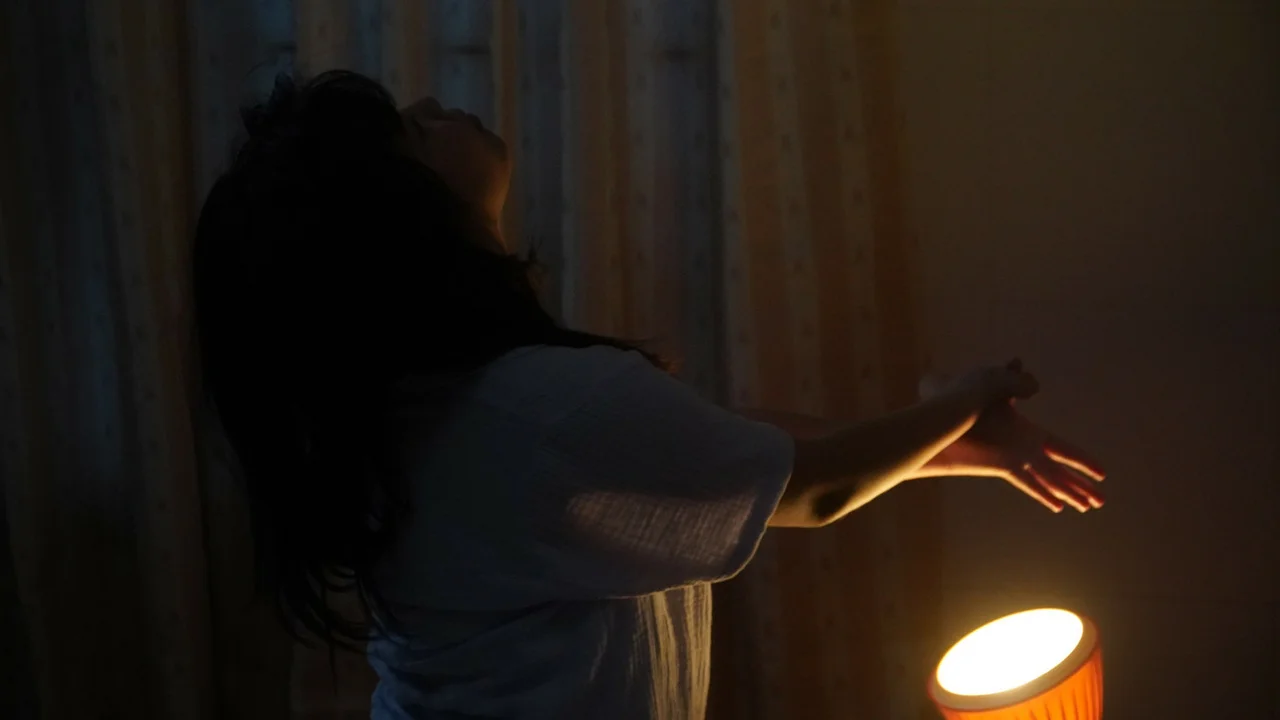
The school incinerator gives Kozue a form of control unavailable in conversation. She throws into it objects associated with unpleasant memories, choosing what will cease to occupy physical space. Calling this a symptom would close down the behavior too quickly.
Within a life largely spent observing, burning is something she can accomplish. It also gives her feelings a material consequence without requiring her to make a persuasive account of them to an adult. The ritual has an unsettling independence that the film’s softer passages sometimes lack. Kozue can act upon her surroundings, and her action need not be charming.
Jinta’s shadow puppetry offers a different relationship between an object and a feeling. A university student visiting the school, he creates silhouettes against colored backgrounds; the image of a baby particularly absorbs Kozue. The attraction begins through attention to something he makes.
Taiki Shinozuka’s reserved presence gives their connection a welcome lack of insistence, and their shared interest in burning objects allows an affinity that precedes any conventional explanation of it. Here is someone whose behavior can sit beside hers without immediately correcting it. The relationship becomes valuable through that companionship, even before the film gives it the recognizable shape of a childhood crush.
That shape brings its own restrictions. Kozue’s attraction belongs to her, while Jinta treats her as a younger, sisterlike companion. The distinction matters, and the film supplies no grounds for turning him into a calculating threat. Still, placing her growing emotional openness alongside an attachment to an older male figure makes a familiar cultural story readily available: the unusual girl becomes easier to understand once she desires someone. Her destructive ritual requires interpretation; her crush supplies its own accepted vocabulary. The relationship permits expression while making Kozue’s difference less difficult for the narrative to accommodate.
Shin Yonekura’s warm light and soft summer colors encourage a sympathetic reception of that development. The shadow performance has genuine sensory appeal, with its dark figures and luminous backgrounds offering a visible reason for Kozue’s absorption.
Across the surrounding summer scenes, however, the reassuring photography gives solitude and companionship a similar gentleness. Little in this visual atmosphere presses against the unequal ages and emotional expectations within the relationship. The concern is the limited room left for awkwardness: Kozue’s feelings can be innocent and still carry demands that Jinta cannot meet.
Uchida’s leisurely pacing produces a related uncertainty. The lingering outdoor passages and persistent insect sounds make the summer feel expansive, full of hours that have no obvious destination. This is a persuasive scale for childhood, when an afternoon can contain an entire emotional weather system invisible to everyone else. Yet the repeated stretches of looking and waiting do not always deepen that experience.
Karin’s restraint initially invites close attention; repetition increasingly asks her face to sustain meanings that the surrounding scenes have barely developed. Refusing a dramatic breakthrough is a legitimate choice. The film still needs distinctions between the things Kozue experiences, and its enveloping calm sometimes smooths them away.
Her excursion with Jinta provides a sharper test. Kozue asks him to take her to a village she remembers, making a specific request and setting events in motion. Any account of her as wholly passive fails here. The trip also gives Jinta’s attention a practical value: he helps her pursue something that matters to her, without needing to share its significance. When they arrive and walk through the countryside, the place fails to correspond to her memory. The disappointment belongs to an attempt she has chosen to make. It gives her uncertainty a shape that the extended passages of idle observation often withhold.
Their understated goodbye leaves the outing suspended between an act of kindness and an unsuccessful search. Jinta has answered Kozue’s request, but accompanying her cannot restore the remembered village. That limit gives the relationship a useful difficulty. His availability has encouraged her to express a wish, and expressing it has exposed her to a disappointment that silent wishing could postpone. The remembered place remains beyond the reach of their afternoon together, leaving Kozue with an experience she must absorb after the helpful adult has gone.
Incinerator premiered at the Karlovy Vary International Film Festival on July 7, 2026, winning the Proxima Special Jury Prize before its theatrical release in Japan on August 7, 2026. Directed and written by Shuntarō Uchida and adapted from a short story by Kaori Ekuni, the coming-of-age Japanese drama centers on an isolated ten-year-old girl named Kozue, whose emotionally distant routine shifts after an older boy visits her classroom to perform traditional kamishibai paper card storytelling.
Full Credits
Title: Incinerator (Japanese: Shokyakuro / 焼却炉)
Distributor: Nakachika Pictures, Low Light Films
Release date: July 7, 2026 (Karlovy Vary International Film Festival), August 7, 2026 (Japan)
Rating: PG-12
Running time: 1 hour 37 minutes (97 minutes)
Director: Shuntarō Uchida
Writers: Shuntarō Uchida, Kaori Ekuni
Producers and Executive Producers: Satoshi Takata, Takuma Nagao
Cast: Karin, Taiki Shinozuka, Akiko Kikuchi, Takuma Nagao
Director of Photography (Cinematographer): David Bauer
Editors: Shuntarō Uchida
The Review
Incinerator
Incinerator gives an unusual child room to remain difficult to understand, with Karin’s watchful performance supplying much of its emotional texture. Its tenderness becomes restrictive when familiar parental roles and a childhood crush make Kozue easier to explain. The village excursion finds a sharper balance, allowing her initiative to lead toward disappointment without demanding a breakthrough. Elsewhere, the soothing summer atmosphere leaves too many distinct feelings indistinct.
PROS
- Karin’s attentive, restrained performance
- Absorbing shadow-puppet imagery
- Village excursion gives Kozue meaningful initiative
CONS
- Familiar division of parental roles
- Childhood crush narrows Kozue’s unconventional characterization
- Repeated observational passages yield limited development