



























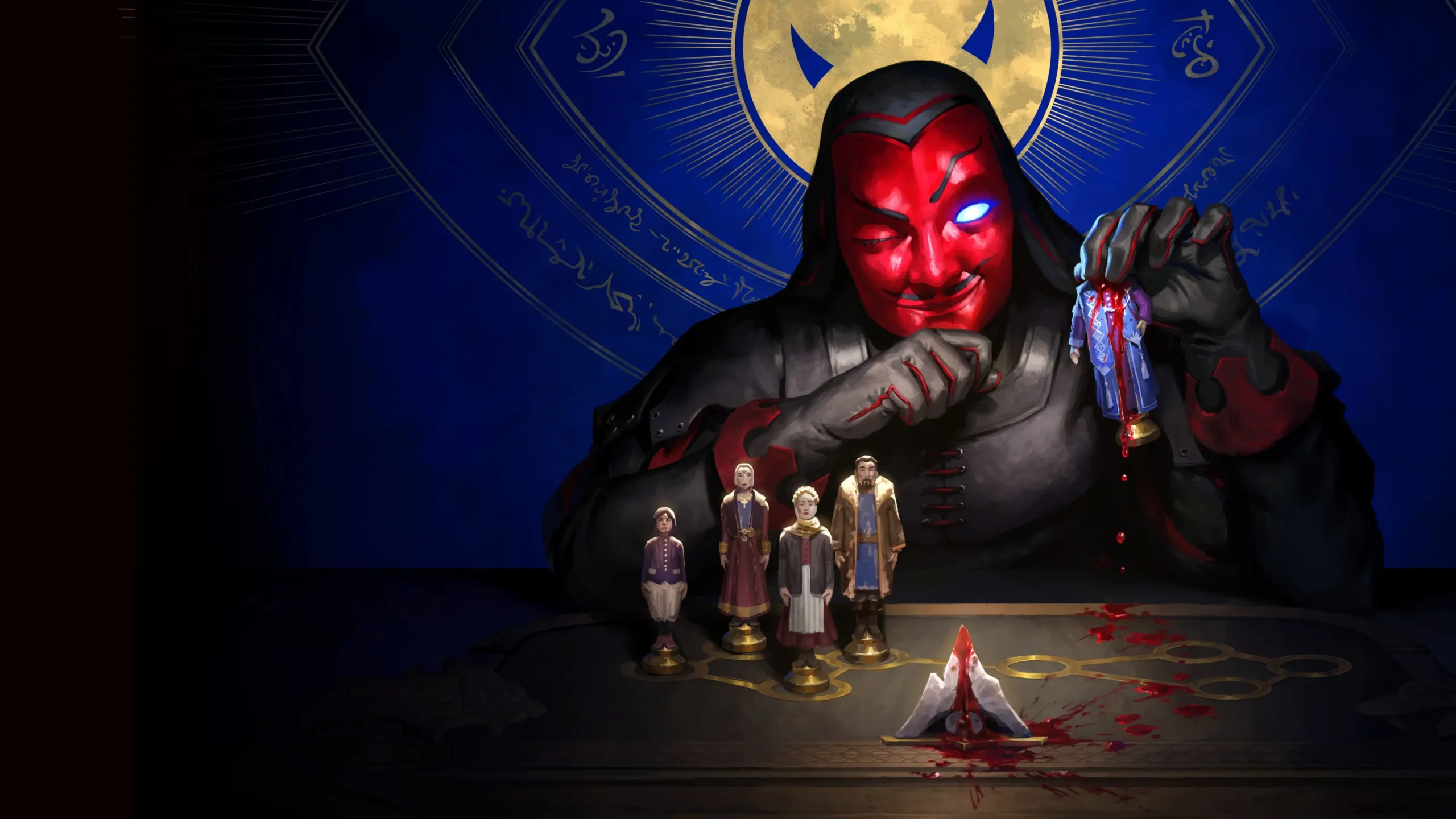

Mariken Svangård leaves her descendants a debt payable in souls. Her bargain with the red-masked One Eye survives her death, making the family answerable for an agreement they never negotiated. Arriving at their remote island manor as her former student, you possess the occult knowledge needed to challenge its terms. The Killing Stone places this dispute in the seventeenth-century Arctic, where mourning becomes entangled with contractual obligation. Visiting the dead woman’s household means discovering how much authority she still exercises over the living.
The family’s predicament takes a particularly effective form in their decks. Three relatives have their own story arcs and collections of cards, with curses to cleanse through ritual combat. Their inheritance occupies space in the player’s hand. This gives the game’s theatrical tragedy a practical point of resistance: an apparently settled fate can be contested through play. The familiar Faustian question of what someone will surrender for power shifts toward the people expected to pay afterward. Saving them requires working through the consequences of Mariken’s choices, card by card.
That northern setting speaks through an English theatrical register, and the game sensibly allows some distance between the language heard and the language read. Period dialogue and modern prose can be selected separately for voices and text.
Hearing the older register while reading clearer subtitles preserves its ceremonial sound without making every exchange an exercise in historical comprehension. The arrangement suits a work that places several cultural forms together: Scandinavian names, an Arctic household, the devil’s bargain, and speech associated with the English stage. Its atmosphere comes from their interaction. Selecting modern text leaves those relationships intact.
Liam O’Brien’s One Eye benefits especially from the theatrical approach. His welcoming manner gives the encounters a host’s apparent generosity, while his relish for the proceedings keeps the threat audible. Emma Gregory supplies Mariken with an abrasive authority that persists through flashbacks and communication after death.
The imbalance appears when these performances meet the unvoiced family members. An exchange involving One Eye can sound like half a conversation, with the player reading the human response between his spoken contributions. The relatives have their doubts and objections, yet the devil receives an immediate vocal presence that the people facing damnation cannot answer in kind.
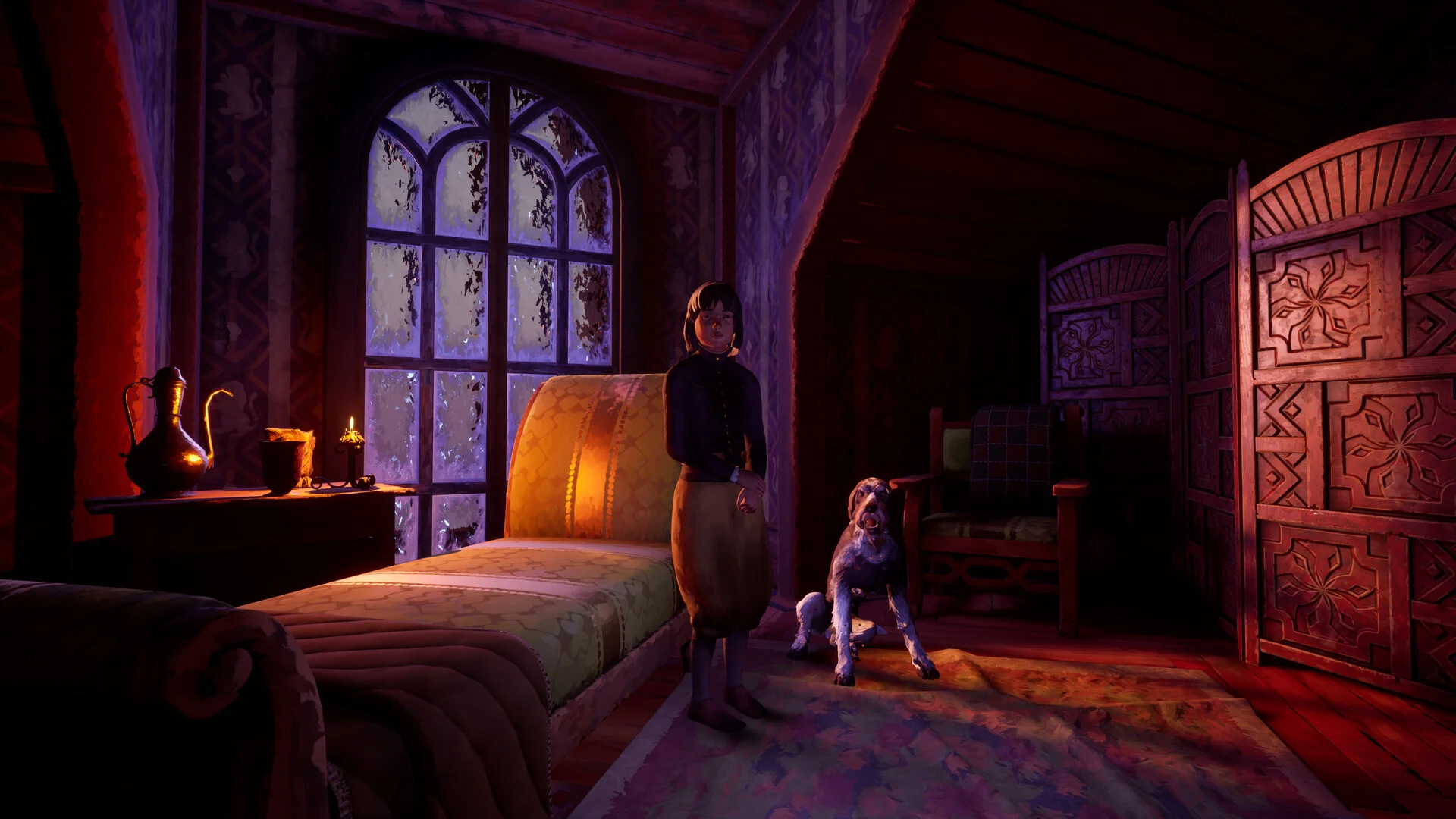
Moving through the manor between battles helps restore some attention to those people. First-person exploration gives their predicament a domestic location beyond the ceremonial board, while conversations gradually disclose their suspicions about your arrival and methods.
Mariken’s animal familiars connect that household to the work of disputing its contracts. Their searches uncover information and hidden clauses that feed into mechanical benefits. There is pleasing incongruity in animals assisting with infernal legal interpretation, but their usefulness also keeps the supernatural practices from becoming ornamental. Investigating the house changes what you can bring to the table.
Combat gives that interpretive work a physical arrangement. Creatures occupy an active line, with reserves placed above them to replace fallen units or supply supporting effects. The distinction makes placement a question of relationships rather than simply selecting the strongest available attacker. A creature held back can influence the battle before entering it. Damage previews allow adjustments before resolution, encouraging the player to inspect the likely consequences of an arrangement. The board becomes a place to test the meaning of an ability through its interaction with another.
The Dhampyr provides a particularly satisfying example. Its modest starting strength conceals an ability to gain maximum health whenever it attacks an enemy. Support from reserve can grant Counter, allowing retaliation after a hit, and Blast, extending that attack to a second enemy. Together, those effects allow an incoming blow to provoke two attacks and further health growth. The pleasure lies in seeing several ordinary provisions sustain an unexpectedly durable creature. Within the fiction of bargaining against demons, this feels appropriately resourceful: success comes from discovering what the terms allow and making the other side live with it.
Bargaining itself extends that logic beyond individual attacks through boons and banes that alter the conditions of play. The difficulty is absorbing these possibilities alongside upgrades, curses, resources, family history, and the language of the setting. Early conversations already ask the player to retain personal and supernatural obligations; the card game then introduces its own vocabulary. Clearer subtitles help with the prose, but they cannot explain how a reserve effect will interact with a developing deck. The game’s demands are cumulative, and the satisfaction of a combination such as the Dhampyr’s arrives after a considerable amount of interpretation.

Its visual presentation both assists and complicates that process. Animated figures and spell effects give the ritual contest a physical liveliness, making a resolved turn feel like an event on a table. Some creatures, however, are easier to identify in their card information than among the animated pieces. That matters in a system whose pleasures depend on recognizing relationships quickly enough to think beyond them. Pausing to distinguish a figure adds another small demand to a game already asking the player to move between narrative clues, contractual conditions, and tactical forecasts.
The developing decks offer a better measure of learning than the sheer quantity of rules. Later chapters and optional contracts provide opportunities that make an early collection look limited, and the option to revisit a family member’s arc allows that recognition to become practical. A deck once assembled around immediate survival can be rebuilt around interactions the player did not yet understand. Since those earlier decks are retained for the final confrontation, an initially successful rescue can leave you carrying a collection you would now assemble differently.
The Review
The Killing Stone
The Killing Stone makes its Faustian inheritance playable through cursed decks, demonic negotiations, and combinations that reward close interpretation. Its Arctic household and English theatrical register meet most successfully in dialogue settings that preserve atmosphere while easing comprehension. The learning burden, uneven voicing, and occasional visual ambiguity interrupt that achievement, but its strongest battles give the family’s struggle a satisfying tactical expression.
PROS
- Family obligations take concrete form in cursed decks.
- Reserve mechanics enable satisfying combinations.
- Flexible language settings preserve theatrical character.
- Strong performances from the two central voices.
CONS
- Narrative and mechanical vocabulary accumulate heavily.
- Selective voicing makes some conversations feel incomplete.
- Some animated figures are difficult to distinguish. 1.