
























The Hungarian evacuation team in Operation Kabul arrives during the August 2021 withdrawal with a list of roughly 200 people to collect and two days to get them out. Outside the airport, thousands are trying to escape. Director Zsombor Dyga gives the assignment an uncomfortable simplicity: the soldiers have names to check, transport to arrange, and orders defining whom they can help. The people pressing toward the gates have reasons those instructions cannot accommodate. Before the film sends anyone into a firefight, it makes carrying out an apparently straightforward task feel almost impossible.
I found these airport passages especially effective because their suspense depends on access. Getting close to safety and being allowed inside are separate problems. As the Hungarian soldiers search for their assigned evacuees, every refusal adds pressure to a crowd already frightened by the Taliban’s arrival. The staging gives the audience a clear relationship to the space: the soldiers occupy an entrance that means something different to everyone approaching it. Dyga can generate tension through a decision to admit or refuse someone, leaving gunfire as a threat hanging over an already volatile encounter.
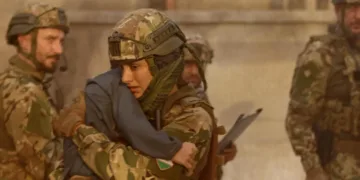
This limited assignment also gives the Hungarian perspective its dramatic value. These troops are one contingent within a multinational operation, responsible for a small part of an evacuation they cannot control. Officers try to preserve the mission’s scope while their subordinates push to help others. A soldier played by Nóra Trokán lifting a child out of tear gas gives that disagreement an immediate human form. Her subsequent distress registers the strain of an intervention that cannot fix the surrounding situation. The film is persuasive when it allows professional competence and emotional exposure to occupy the same scene.
The screenplay by Áron Horváth then narrows its attention further, introducing an earlier connection between Lieutenant Bálint Kerekes and Hungarian physician Eszter. Flashbacks return to Bálint’s previous deployment, two years before the evacuation, when he assisted her work.
A flashback earns its place when it changes how we understand a present decision; here, those earlier encounters explain why one name on the extraction list carries particular weight. When Bálint learns that Eszter has been captured in Kabul, rescuing her becomes both an operational problem and a personal obligation. His motivation is clear, while the responsibility of taking other soldiers into danger remains harder to settle.
Gábor Jászberényi plays Bálint with an appealing economy. His controlled bearing gives the officer credibility without requiring a succession of speeches about duty, and it helps contain a storyline that could easily become overheated. Blanka Mészáros gives Eszter a similarly restrained presence.
Their shared history has emotional weight without needing every part of it explained. Her medical work matters to the characterization, too: she has commitments that brought her to Afghanistan independently of Bálint. Captivity inevitably reduces what she can do within the rescue plot, but the earlier material gives us a person whose professional choices precede her function as someone awaiting recovery.
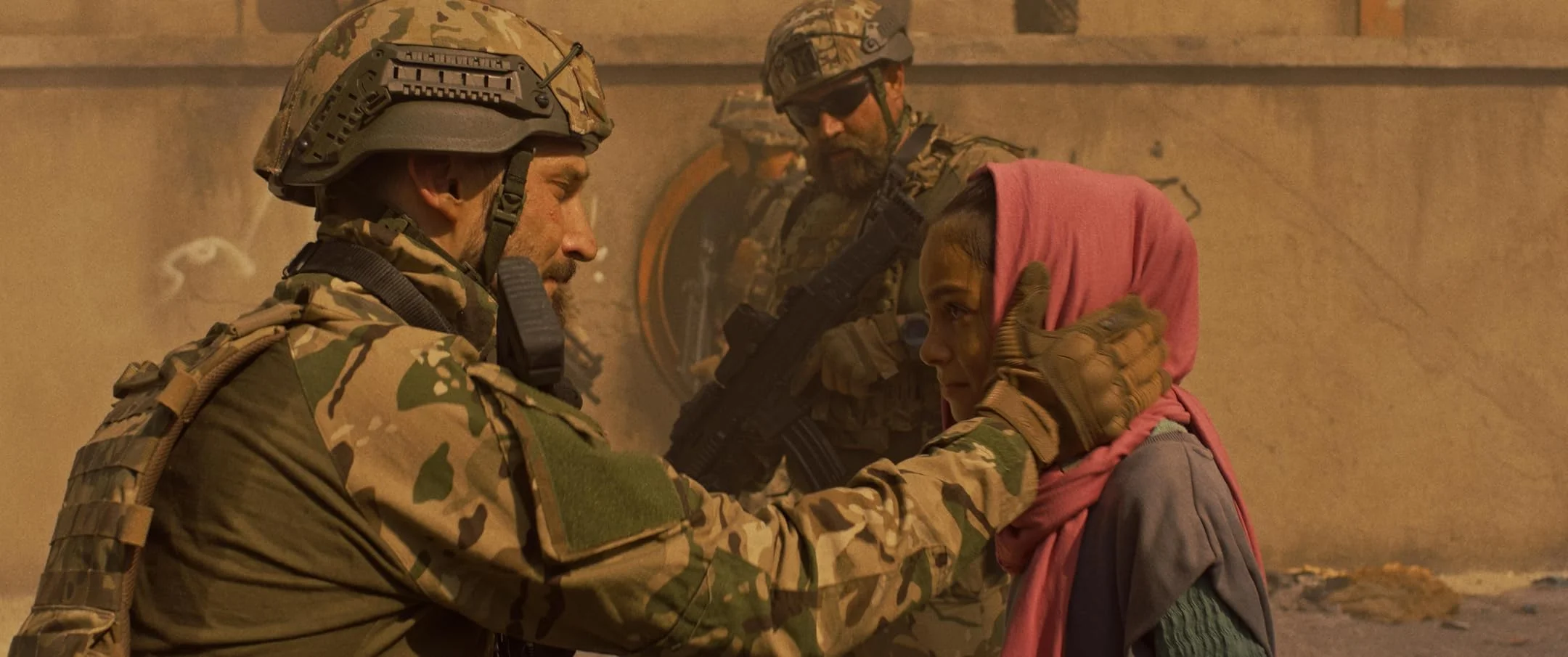
The allocation of that backstory creates a noticeable imbalance within the unit. We understand the experiences pulling Bálint toward Eszter, while the soldiers accompanying him are less individually developed. The child rescue briefly supplies the kind of specific behavior that makes a supporting figure memorable, connecting a soldier’s action to an emotional consequence.
Much of the team otherwise remains defined by the work it performs. That is sufficient to make their movements convincing, though the collective risk has less personal texture than the screenplay gives its lead. The film asks us to care about the group largely through our investment in its commander.
Once the small team leaves the airport, Dyga changes the source of suspense. Managing a crowded entrance gives way to moving through a city where the soldiers can be exposed and attacked. Cinematographer Tamás Dobos keeps the action close to them, restricting the viewer’s comfortable sense of an overview.
This is restricted perspective in practical form: we experience danger from the position of people who must move through it, rather than watching a battlefield laid out for inspection. The unit’s coordinated movement also gives the action a welcome sense of dependence. Bálint’s personal commitment may drive the rescue, but carrying it out requires other people’s skills and their willingness to share the risk.
The lighting helps make the transition legible. The airport’s harsh illumination offers a precarious sense of controlled space; the dark city exteriors make the nighttime mission feel exposed to what cannot be readily seen. Dyga and Dobos use that difference to support the action rather than interrupt it with decorative images.
These choices create persuasive physical circumstances for the thriller. The underlying rescue story is familiar, and its emotional machinery is easy to recognize. I was still drawn into the movement from the airport to the streets because the filmmaking makes each environment impose a different problem on the same small group.
The difficulty comes when the film tries to bring that experience to an emotionally satisfying close. Its late movement from mass violence toward reassurance is too abrupt, allowing little time for the surrounding catastrophe to register before the central mission supplies relief.
This is partly a question of editing: the space between two events affects how fully we absorb the first before responding to the next. Earlier, the airport scenes make every limit on assistance painful, and the child rescue briefly lets that pressure exceed the official assignment. Near the finish, the narrower rescue narrative takes precedence.
Operation Kabul was released on digital platforms on November 3, 2026. Directed by Zsombor Dyga, the action-history drama is inspired by true events during the chaotic 2021 military evacuation from Afghanistan, following soldiers executing a perilous rescue mission to secure hundreds of civilians.
Full Credits
Title: Operation Kabul
Distributor: Well Go USA / Capelight Pictures
Release date: November 3, 2026 (Digital)
Running time: 1 hour 45 minutes
Director: Zsombor Dyga
Writers: Áron Horváth
Producers and Executive Producers: Tamás Lajos
Cast: Gábor Jászberényi, Blanka Mészáros, Tamás Borovics, Dávid Hajmási, Gusztáv Dietz, Nóra Trokán, Marton Mathe, András Stohl
Director of Photography (Cinematographer): Tamás Dobos
The Review
Operation Kabul
Operation Kabul makes evacuation logistics gripping, using crowded gates, restricted viewpoints, and a dangerous nighttime rescue to turn limited options into sustained suspense. Jászberényi’s restrained performance anchors the personal story, while the flashbacks explain what pulls Bálint beyond his assignment. The supporting soldiers receive less individual attention, and the finish moves too quickly from catastrophe toward relief. Dyga’s precise staging remains the strongest reason to watch.
PROS
- Tense, clearly staged airport sequences.
- Restrained lead performances.
- Flashbacks give Bálint’s decisions emotional weight.
- Close camerawork strengthens the nighttime action.
CONS
- Supporting soldiers lack individual development.
- Abrupt transition from catastrophe to reassurance.