



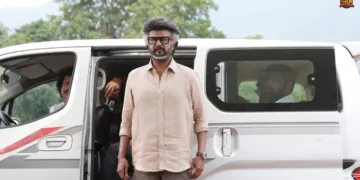

























The grazing ground initially appears to offer an elderly shepherd and his sheep considerable freedom. Greenery fills the view; the animals have space to move. Then the geography becomes clearer. This is a surviving patch behind concrete buildings on the outskirts of Amman, reached along a dusty track.
What looked expansive is hemmed in. Asmahan Bkerat establishes the vulnerability of the Najar family through this correction in our understanding of their surroundings. Her wide compositions allow us to register the distance around them while gradually questioning how much of it they can continue to occupy.
The soundtrack makes that uncertainty harder to escape. Wind and animal sounds meet the mechanical insistence of diggers, while music from a distant festival carries into the family’s surroundings. Rana Eid’s sound design gives these competing activities an acoustic hierarchy: the people living here cannot determine what they must hear. The festival is especially telling because its intrusion has no necessary connection to demolition. Other people’s recreation can occupy the family’s space without anyone entering their tent. Bkerat makes encroachment audible before every consequence has become visible.
Filmed over eight years, Concrete Land observes three generations of an Afro-Palestinian Bedouin family living beside their livestock as luxury development threatens their continued residence. Bkerat, a Palestinian-Jordanian filmmaker making her feature debut, works with a handheld camera and a small production presence. No narrator supplies introductions; no identifying captions sort the household for us.
Names and relationships emerge through conversation. This requires an initial adjustment, but it places our attention on the exchanges through which people know one another. Editor Ban Maraqa gives those exchanges time to establish habits, affections, and occasional friction before the relocation dispute takes fuller shape.
Hakima’s affectionate attention to Badrya, the family’s beloved sheep, makes the animals’ place within the household specific. Grooming and conversation have their own familiar rhythm. Nearby, a grandfather redirects children from art toward arithmetic, counting fingers with the confidence of someone who considers the curriculum settled. His educational reforms are swift.
The humor gives him a recognizable stubbornness, which matters as much as the tenderness elsewhere. Bkerat’s intimacy permits ordinary authority and irritation alongside affection. These people remain entitled to their idiosyncrasies; they need no exceptional goodness to make the threat against their home objectionable.
The danger in the film’s visual contrasts is that green space and concrete might acquire an excessively tidy moral division. Awad complicates it. He drives a cement truck for a living, earning money within the construction economy transforming the area around his family.
The contradiction is severe, yet calling it hypocrisy would grant him an implausible degree of economic freedom. His work makes dependence visible. The development that threatens the household also supplies employment, placing the wish to remain outside its reach under pressure from the need to support those living inside the tent.
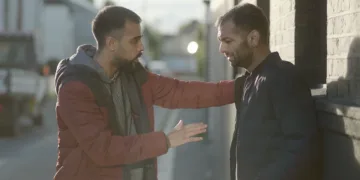
Awad’s restrained, tense conversation with a neighbor at a white villa brings that imbalance down to the scale of an encounter. The building gives residential permanence a conspicuous physical form beside the family’s precarious shelter. Yet a house cannot be treated simply as an instrument of dispossession.
Younger members of the household are receptive to housing, and the children imagine bedrooms of their own. Abu-Awad and Hakima’s attachment to tent life deserves attention alongside those wishes. The family’s disagreements prevent cultural continuity from becoming a demand that every generation desire identical living conditions.

Eman’s school life complicates the geography further. Her friendships and academic abilities give her attachments beyond the household, while bullying about Bedouin life and her father’s dark skin makes that wider belonging insecure. A move threatens connections she values; remaining does not protect her from prejudice.
Through Eman, the film gives displacement consequences that cannot be measured by comparing the tent with a prospective flat. School has its own relationships and exclusions. Her experience resists the reassuring suggestion that entry into urban institutions will automatically grant the acceptance withheld from her family elsewhere.
When an official notice requires the removal of animals, the earlier domestic attention acquires practical force. We have watched people tend, address, and make room for creatures now subject to administrative restriction. A regulation reaches into established relationships.
Bkerat has earned that recognition through time spent on activities that might initially seem incidental. The offer to rescue an old tree from nearby destruction works similarly: an older woman responds to machinery with a particular act of care, giving the upheaval a human scale without requiring an explanatory speech.
Time is also the film’s least resolved formal problem. Across roughly 100 minutes, domestic routines accumulate well before the stay-or-leave dilemma receives sustained development. Some repetition deepens familiarity; other passages maintain an emotional register we already understand.
The distinction matters. Eight years of access do not make every recurrence equally revealing, and the later family disagreements contain sharper changes in pressure than the extended preparation sometimes allows. Maraqa’s editing establishes a household we can recognize, but the movement from recognition toward contested decisions could be tighter without sacrificing the relationships that make those decisions painful.
There is a separate limitation in the treatment of power. The family’s exposure to removal becomes clear, while land ownership and the commercial or administrative processes behind it remain sketchier. The notice shows authority taking effect; it gives us less understanding of how that authority is organized or might be challenged.
This gap cannot be explained away as the inevitable price of observation. Conversations and encounters can carry procedural knowledge too. Bkerat’s camera stays close enough to register the personal consequences of decisions whose making remains at a greater distance, leaving the viewer’s emotional certainty ahead of their political understanding.
The later landscape views introduce another use for the film’s patient framing. Construction dust changes the visibility of ground that earlier appeared green and available. Holding our attention on the surroundings now lets us compare conditions across time, rather than waiting for another incident within the household. The wide view has become harder to read as spaciousness. Buildings, disturbed earth, and suspended dust occupy the area where the shepherd and his animals first appeared able to move freely.
Concrete Land premiered in competition at the BFI London Film Festival on October 8, 2026. Directed by Asmahan Bkerat, the intimate documentary portrait follows three generations of a Palestinian Bedouin family in Jordan as urban sprawl encroaches upon their traditional lifestyle, forcing them to navigate shifting familial dynamics, gentrification, and external hostility while striving to preserve their way of life.
Full Credits
Title: Concrete Land
Distributor: Odd Slice Films, Docwaves
Release date: October 8, 2026 (BFI London Film Festival)
Running time: 1 hour 41 minutes (101 minutes)
Director: Asmahan Bkerat
Writers: Ban Maraqa, Asmahan Bkerat
Producers and Executive Producers: Ban Maraqa, Asmahan Bkerat
Cast: Naji Al-Huwaitat, Um Naji Al-Huwaitat
Director of Photography (Cinematographer): Asmahan Bkerat
Editors: Ban Maraqa
The Review
Concrete Land
Bkerat makes displacement a matter of composition and sound: open land narrows, machinery intrudes, and familiar routines become vulnerable to regulation. The Najar family’s humor and conflicting wishes give that formal argument human complexity. Repetitive passages slow its development, while the processes behind eviction remain insufficiently explained. Yet the film’s attention to sheep, school friendships, and imagined bedrooms makes the threatened home specific without treating its occupants as relics.
PROS
- Wide compositions expose the family’s shrinking living space.
- Intrusive sound makes encroachment physically perceptible.
- Domestic humor preserves individual personalities.
- Generational disagreements complicate the meaning of home.
CONS
- Extended domestic routines delay the relocation dilemma’s development.
- Ownership and eviction procedures remain underexplained.