





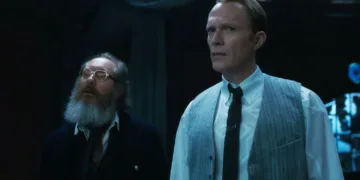



















Before Cui Xun can use a bite mark to identify a killer, he has to establish how such a comparison might work. The 1970s child-murder investigation in Chen Sicheng’s Traces of Justice gives him potatoes, dental impressions and a great deal of testing. When the potatoes run out, colleagues begin biting one another’s cheeks. Their marked faces register the practical absurdity of developing a procedure without the necessary resources. Chen lets the experiment occupy screen time, allowing an investigative possibility to become something the audience can follow through its awkward stages.
Later cases change the material and the scale. Fingernail samples require collection and repeated comparison; a bus bombing leaves investigators searching burnt wreckage for surviving traces, including fragments of identification. The early crime scenes, handled casually by gloveless officers, give way to a large, staffed investigative workspace. These changes give the separate stories a useful continuity. Each period inherits a capacity the previous one struggled to establish. The film can move from the 1970s through the following decades without having to pretend that all its crimes belong to one elaborate conspiracy.
Zhang Yi plays Cui, a fictional investigator inspired by forensic specialist Cui Daozhi, with a concentration that suits this design. In the examination scenes, his restrained performance makes prolonged attention credible. He seems equipped to remain with a fingernail problem after everyone else has lost patience.
That quality helps Chen turn research into suspense: we understand the obstacle, see the work it demands and want to know what the comparison will yield. The investigative passages have momentum because there is something specific left to establish. Their pleasures survive the considerable gaps in time between cases.
Those gaps place a different burden on Cui. His professional development links the investigations, while repeated images of his younger self searching for his missing mother in a sorghum field are meant to supply an emotional connection. The grief is understandable.
Its relationship to the adult man’s particular decisions receives less development. Returning to the same childhood wound reaffirms that it matters, yet gives us limited access to how he has lived with it across the intervening years. Zhang preserves a believable reserve, but the screenplay asks that reserve to cover large omissions in Cui’s private life.
The supporting characters make those omissions easier to identify. Ma Li’s Huang Rende drinks to manage her fear of blood, placing a bodily obstacle directly inside the work she has chosen. Her commitment has an immediate, uncomfortable price. Chen Minghao’s Wang Weiguo receives a sharper conflict when powerful figures attempt to secure a suspect’s release.
With military personnel intervening and police leadership prepared to accommodate them, Wang holds a gun to his own head rather than surrender the prisoner. His resistance carries a personal risk that a speech about duty could only describe. Later exposure to corruption complicates his relationship with that principle, giving his passage through the decades a less predictable shape than Cui’s.

This confrontation also gives the forensic material stakes beyond the satisfaction of solving a puzzle. Evidence becomes something that influence must overcome or suppress. The 1980s case connects privilege to the machinery of an investigation, making the question of who can be detained inseparable from whose family can intervene.
Chen Feiyu’s heightened interrogation performance concentrates the contradiction in a privileged young man who resents being defined by his father while benefiting from paternal power. His agitation has a specific dramatic use: the demand to be recognized independently collides with the protection on which he relies.
The bus-bombing perpetrators receive less productive exaggeration. Their emphatic villainy makes their moral character legible faster than their psychology develops. Forensic suspense can survive an obvious offender, but the film also wants to explain the people responsible, and here the theatrical presentation gets ahead of that work.
After insisting that investigators earn certainty through painstaking examination, the screenplay is surprisingly comfortable issuing psychological findings on sight. The objection concerns the shortcut inside the drama. The physical reconstruction of the bombing still offers absorbing work among the charred remains; its account of motive has less patience with what it cannot readily explain.
Chen’s account of official power is similarly pulled between what his cases dramatize and what his framing encourages us to celebrate. The older Cui’s medal, images of Tiananmen Square and a state emblem presented in bright sunlight place individual achievement within an assured national story.
A scene positioning victims and officers opposite one another in respectful acknowledgment makes that relationship explicit. Yet Wang’s confrontation has shown an investigator defending the integrity of a case against people exercising institutional authority. His later compromises keep that difficulty alive. The ceremonial images offer confidence that the dramatic encounters have made harder to grant without qualification.
The return to the 2016 sexual-assault and murder investigation has a clear purpose within this historical design. Earlier methods remain available alongside newer techniques, including DNA analysis. Fingerprint and fingernail trace work help connect modern practice to the labor already witnessed.
The framing case therefore earns its place as a demonstration of accumulated knowledge. Its weakness is the abbreviated investigation assigned to perform that task. Earlier episodes allow procedures to acquire meaning through collection, testing and setbacks. The modern return has less room for that process, making the final connection easier to understand than to experience as a sustained piece of detective storytelling.
This is where the distinction between covering decades and building a life becomes hardest to ignore. The modern case can draw on skills that the film has shown Cui developing, but the late return to his mother’s absence has fewer lived connections to draw upon.
The field imagery retains the sadness of a child searching for someone who should be there. Its emotional directness can move us, even as the adult years remain sparsely filled in. We have watched his working environment acquire people, equipment and shared knowledge; the private grief to which the film returns still belongs largely to the boy in the field.
Traces of Justice was released theatrically in China on October 1, 2026, followed by an international theatrical rollout through Trinity CineAsia beginning November 6, 2026. Directed and co-written by Chen Sicheng, the Chinese crime drama procedural follows a dedicated forensic evidence pioneer over half a century of casework, chronicling his groundbreaking methods for solving high-profile crimes while tracing the evolution of China’s modern criminal investigation system.
Where to Watch Traces of Justice (2026) Online
Full Credits
Title: Traces of Justice (Shentan Zhi Henji / 神探之痕迹)
Distributor: Trinity CineAsia, China Film Group Corporation
Release date: October 1, 2026 (China), November 6, 2026 (United Kingdom)
Rating: 15
Running time: 2 hours 20 minutes (140 minutes)
Director: Chen Sicheng
Writers: Chen Sicheng, Zhang Ji, Hui Zijie, Feng Rui
Producers and Executive Producers: Zhang Huixia, Chen Sicheng
Cast: Zhang Yi, Ma Li, Chen Minghao, Karry Wang, Fan Chengcheng, Chen Feiyu, Li Xuejian, Gao Ye
Director of Photography (Cinematographer): Cao Yu
Editors: Tang Hongjia
Composer: Fei Peng
The Review
Traces of Justice
Traces of Justice earns its suspense through the work of detection: collecting samples, testing comparisons and finding usable evidence in wreckage. Zhang Yi makes that patience credible, while the changing methods give the separate cases a coherent historical shape. Cui’s private life receives thinner treatment, and the compressed modern investigation sacrifices the procedural development that made the earlier cases absorbing. The film builds a convincing professional history around a man it never quite finishes writing.
PROS
- Concrete forensic problems generate sustained suspense.
- Zhang Yi gives Cui’s concentration credibility.
- Changing methods connect the decades effectively.
- Wang’s conflicts give professional duty a personal cost.
CONS
- Recurring childhood imagery leaves Cui’s adult inner life underdeveloped.
- Exaggerated villainy shortcuts the bus bombers’ psychology.
- The modern framing case receives abbreviated investigative development.