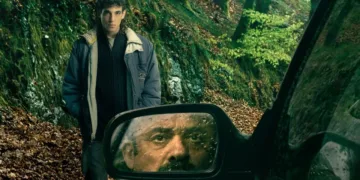























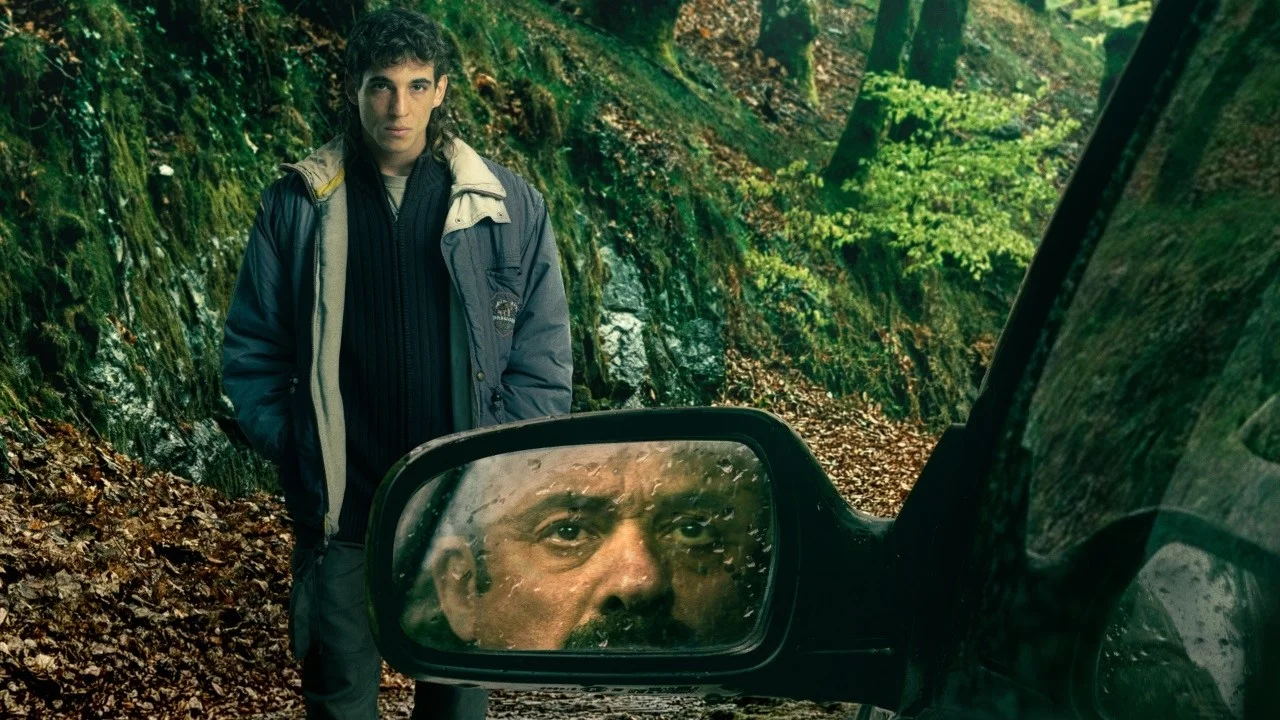

Daniel Calparsoro gives his two protagonists more room without releasing them. The prison and interrogation spaces of The Confidant eventually yield to meetings in larger settings, yet the wider compositions keep police officer Lleida and his informant Imanol visually hemmed in.
The change in shot scale offers little prospect of escape. What began as the physical confinement of a suspect becomes a condition shared by two men whose work steadily restricts what they can say, whom they can approach, and where they can safely belong.
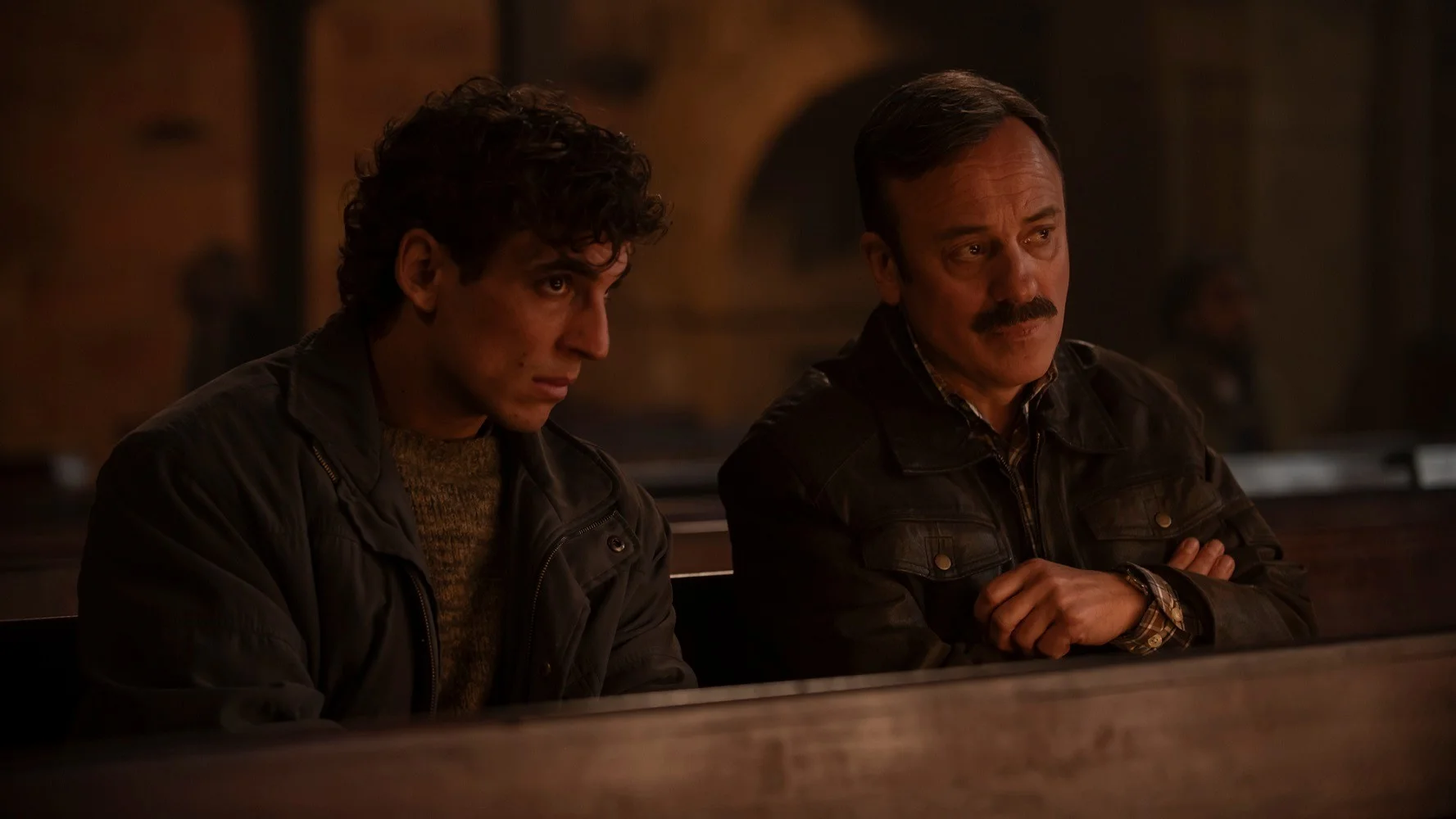
The close shots of Javier Gutiérrez and Miguel Herrán make that restriction personal. Gutiérrez brings a disciplined weariness to Lleida, a man accustomed to keeping distress operationally useful. Herrán gives Imanol a more agitated physical presence, with the strain of concealment pressing toward the surface.
Calparsoro lets us study both faces, but equal access does not confer equal authority. Lleida can examine Imanol for signs of unreliability while withholding his own intentions. Imanol must decide how much of himself to disclose to someone who has already learned to use disclosure as leverage.
Their arrangement takes shape in the early 2000s, after a collapsed ceasefire and renewed killings by ETA, the armed Basque separatist organisation. Following a raid, Lleida recognises Imanol’s disillusionment with the group’s violence and works on it until the younger man agrees to inform.
Fernando Navarro’s screenplay, drawing on journalist Pablo Muñoz’s research, makes this recruitment an uncomfortable foundation for the friendship that follows. Lleida’s understanding of Imanol is useful partly because it can be coercive. When Imanol returns to an active group in the French Basque Country, the officer’s apparent sympathy has acquired a dangerous practical consequence.
This gives the film a recognisably noir conception of intimacy: knowing another person can create an obligation and supply a means of control. The relationship develops because each man becomes someone to whom the other can admit what must remain hidden elsewhere.
Gutiérrez’s reserve helps keep Lleida’s affection from becoming an easy certificate of decency. Herrán’s eventual breakdown under the pressure of infiltration gives the arrangement a cost that professional reassurance cannot contain. His distress forces us to reconsider the earlier interrogations. The man who learned how to make him cooperate is now among the few people available to help him endure it.
Imanol’s family visit makes his isolation especially acute. They arrive at the rural hideout wearing black balaclavas, accepting the concealment required to see him while remaining ignorant of his cooperation with the police. The visible masks protect a meeting whose most dangerous secret belongs to the person they have come to visit.
Calparsoro finds suspense in the conditions of contact itself. Imanol can still occupy his place within the family, provided he suppresses the information that increasingly determines his life. The scene makes his dependence on Lleida credible without suggesting that the officer can replace everything the operation puts at risk.
Lleida’s promotion exposes a different limit to their reciprocity. He can celebrate with colleagues while Imanol continues inside the organisation, absorbing danger that cannot be publicly acknowledged. The promotion makes excellent sense on an organisational chart. From Imanol’s position, the distribution of gratitude looks considerably less satisfactory.
Their information may produce the same arrests, but it produces different lives for the people supplying and using it. The film allows friendship to exist within that disparity, and the disparity keeps the friendship from becoming a comforting answer to the problem of exploitation.
The apartment weapons episode complicates Lleida’s position in turn. When Imanol needs help removing guns, protecting the source draws the officer into assisting the activity he is employed to disrupt. The immediate action has a persuasive logic; its ethical implications remain troublesome.
Calparsoro makes us understand the decision through the precarious arrangement that precedes it, rather than asking us to accept Lleida’s judgment on the strength of his badge. His competence now includes preserving conditions in which the organisation can continue to operate. The guns give physical substance to a compromise that could otherwise remain safely abstract.
The film’s chases provide forceful interruptions to these negotiations, but the quieter encounters place a more persistent burden on the viewer. A pursuit gives danger a direction. The family visit and the request for help with weapons make safety depend on incomplete knowledge and uncertain obligations.
The farmhouses, local bars and police offices give those obligations a convincing working environment. Calparsoro’s attention to faces within these spaces keeps the intelligence operation attached to people who must continue inhabiting the identities it requires of them.
The later Faisán affair moves this pressure into the institution itself. A police tip-off warning of an operation against ETA’s extortion network draws Lleida into scrutiny, and offices and courtrooms take greater prominence. The shift has genuine ethical force.
The officer who managed another man’s usefulness must now confront the relationship between his own service and the authority under which he acted. These positions carry different responsibilities, but the change unsettles the confidence with which he previously exercised control. An operation’s success can no longer settle the question of how it was conducted.
Yet the film pursues that institutional reckoning by giving Imanol substantially less attention. The extended aftermath repeatedly makes explicit compromises that the partnership had already rendered tangible. Its weakness lies in losing the person whose continued exposure gave Lleida’s decisions their sharpest test.
Earlier, the camera’s attention to both faces required us to consider the effect of one man’s choices on the other. As the legal story takes over, we receive a fuller account of Lleida’s predicament while Imanol becomes harder to read. The film leaves less room to examine how the officer’s altered circumstances change an obligation that began with persuading another man to trust him.
The Confidant is a Spanish crime thriller directed by Daniel Calparsoro. The film explores the complex, high-stakes dynamic and years-long relationship between a police officer and his informer.
Full Credits
Title: The Confidant (El confidente)
Distributor: Film Factory Entertainment
Release date: 2026 (Selected film festivals and upcoming theatrical releases)
Running time: 1 hour 48 minutes (108 minutes)
Director: Daniel Calparsoro
Writers: Fernando Navarro
Producers and Executive Producers: Alvaro Ariza, Maria Luisa Gutierrez
Cast: Javier Gutiérrez, Miguel Herrán, Itsaso Arana, Emilio Palacios, Víctor Clavijo, Miguel Garcés, Patricia Vico
Director of Photography (Cinematographer): Tommie Ferreras
Editors: Antonio Frutos
Composer: Audrey Ismael
The Review
The Confidant
Calparsoro’s close framing makes trust look like another form of confinement, and Gutiérrez and Herrán give that trap an affecting human scale. The family visit and weapons episode keep affection entangled with leverage, producing a thriller whose moral uncertainty has concrete stakes. The Faisán turn earns its institutional scrutiny, but Imanol’s retreat from view weakens the relationship that made such scrutiny matter. An extended aftermath explains what the actors and compositions had already made painfully clear.
PROS
- Gutiérrez and Herrán sustain a credible, uneasy bond.
- Enclosing compositions connect space to restricted agency.
- The family visit turns concealed identity into suspense.
- The weapons episode gives moral compromise practical stakes.
CONS
- The final act sidelines Imanol, weakening the central relationship.
- The extended aftermath repeats established moral implications.