

























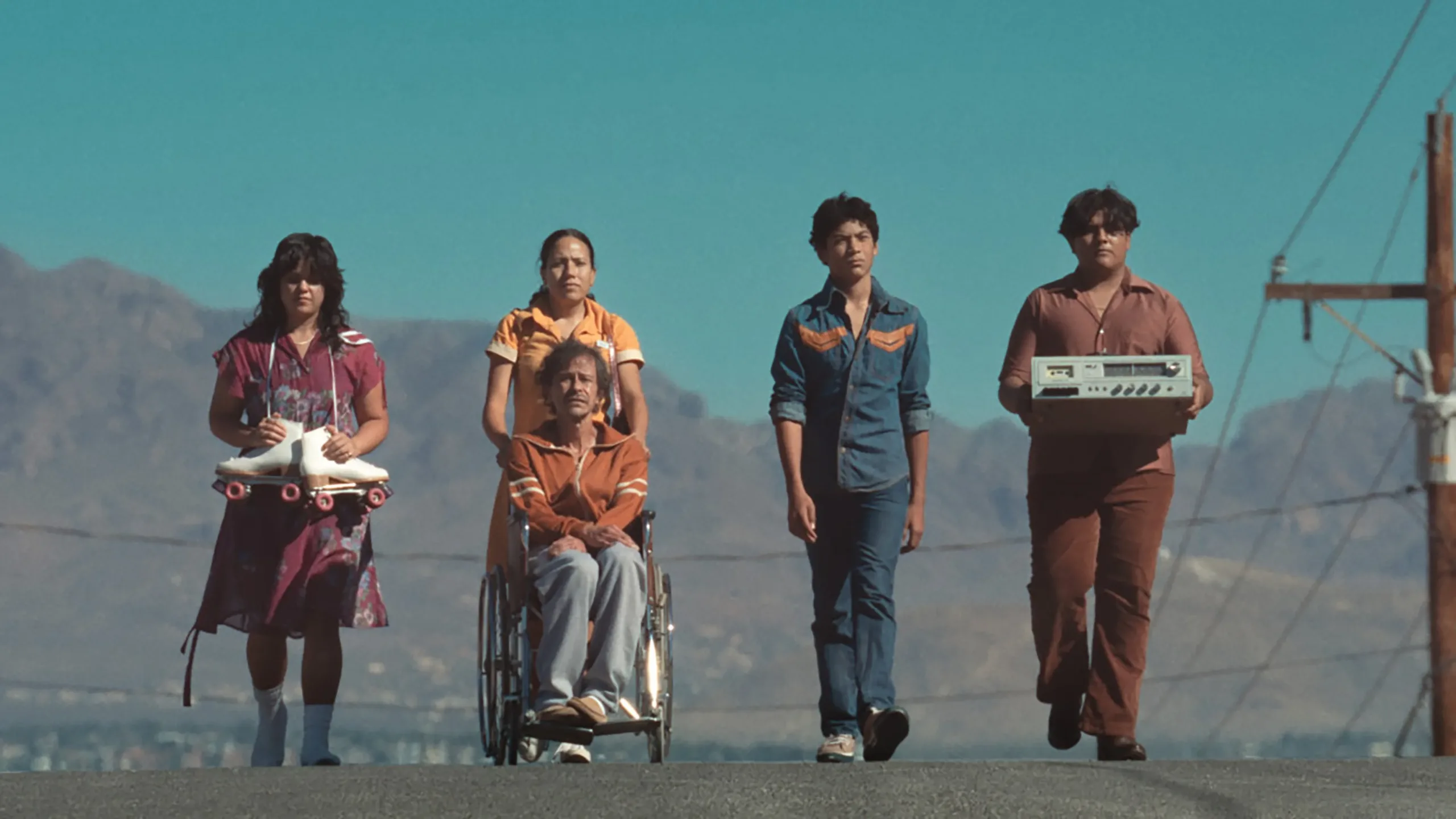

Fourteen-year-old Olmo López occupies a quiet battleground between childish yearnings and adult obligation. In the waning light of a 1979 New Mexico afternoon, his father’s body—withered by multiple sclerosis—lies tethered to a bed that has become the axis of the family’s survival.
His mother, hauling trays at a diner to keep three months of rent at bay, and his sister, lost to roller-rink reveries, can’t always answer the summons of duty. Olmo, then, becomes both nurse and mechanic: coaxing wires into a broken stereo (the family heirloom and his ticket to Nina’s party), all while wrestling with impulses both hormonal and heroic.
This film hums with the tension of poverty and immigrant perseverance—each creak of the trailer door a reminder of doors unopened elsewhere. (One can’t help but recall other “outsider” tales from the late ’70s—think grainy news footage of rust-belt towns—even as Olmo’s world feels secluded.)
Moments of slapstick—the mattress swap that turns solemn—orphan-wake detours heighten Olmo’s sensibility. He reacts with the muteness of a philosopher and the gawk of a kid who still can’t light a cigarette. Director Fernando Eimbcke and co-writer Vanesa Garnica sculpt these slices of life into what might be called “responsibiliphobia”: that acute dread of stepping up too soon. Short scenes. Long shadows. This is a portrait of liminal ages, where freedom tastes like transistor dust.
Circuitry of a Coming-of-Age
In 1979’s sun-bleached fringes of New Mexico, rows of manufactured homes sit like sentinels to economic precarity (the oil crisis still echoing off distant horizons). Olmo López’s neighborhood is not a postcard of Manifest Destiny but a microcosm of immigrant persistence, where English and Spanish flicker in half-spoken conversations and every broken appliance tells a story of scrimped savings.

A weekend dawns, and Olmo’s father—stricken with multiple sclerosis—becomes the unwitting catalyst. With Cecilia clocking extra shifts and Ana lost in roller-rink whirlwinds, Olmo inherits the role of makeshift caretaker. He’s fourteen, yet thrust into a familial crucible that rivals any industrial drama of the era.
The promise of a stereo at Nina’s party sparks what might be termed “mechanico-dependency”—Olmo’s bid for agency through circuitry and solder. Under Nestor’s hawkish tutelage, every capacitor resists repair with symbolic stubbornness (the family itself feels similarly fragile). When the stereo finally crackles to life, it doesn’t just riff on Slade or Saturday Night Fever; it channels a teenager’s hope that small triumphs can outpace adult disappointments.
Emboldened, Olmo steals moments to resurrect his mother’s battered car—part joyride, part existential revolt. But the night’s crescendo arrives at the wake: an impromptu dance-floor duel, followed by the gut-punch of discovering Nestor in a hospital bed. One beat, and the party’s euphoria curdles into guilt so palpable it might as well be solder burns on Olmo’s fingertips.
Home again, the López clan reassembles—no neat bows, but a fragile truce between duty and desire. Olmo’s gaze shifts. He’s tasted freedom, felt its price. No filler. Eighty-four minutes of lean storytelling—deadpan humor punctuating tender drama, each scene a transistor in the film’s tight electrical circuit.
Embodied Resistances: Characters & Performances
Olmo López emerges as a cipher of adolescence’s push-pull: his gaze alternates between dreamy flirtation with Nina and the steely determination of a reluctant caretaker. Aivan Uttapa’s performance is a study in tonal dissonance—boyish yearning punctuated by sudden flashes of responsibility (a phenomenon one might call “caretaker vertigo”).
His awkward gait—shoulders curved like failing circuitry—speaks volumes about how a young body can feel both too light for gravity and too heavy with duty. In three keystone moments—the patience-testing stereo repair, the liberating car ride, and the wake-scene apparition—Uttapa channels the epochal tension of late-1970s America, where the promise of freedom clashed with the shackles of socioeconomic constraint.
Gustavo Sánchez Parra’s Nestor is more than a bedridden patriarch; he is a weathered embodiment of pride and disenfranchisement. His electronics lessons serve not only as plot device but as allegory: the fragile solder joints mirror the tenuous bonds of immigrant families. Parra’s small gestures—an abrupt glare at a misconnected wire, a faint, begrudging smile—map the gradient between bitterness and buried affection.
Andrea Suárez Paz inhabits Cecilia’s exhaustion with dignified restraint. Her body language (the slight slump of a shift-worn waitress) conveys a lifetime of unacknowledged labor. Here, “breadwinner resilience” isn’t a slogan; it’s a lived experience etched into every crease of her brow.
Rosa Armendariz’s Ana pulses with teenage revolt: roller-skate wheels echo the cyclonic energy of second-generation frustration. She delivers sardonic retorts with the precision of a sniper—comic relief that undercuts maternal strain.
Diego Olmedo’s Miguel is Olmo’s expressive foil—the extroverted echo to his introspective core. His unabashed zeal (and those red Tony Lama boots) ground the film’s emotional axis. Melanie Frometa’s Nina appears like a half-remembered dream. Limited screen time, yes; yet she crystallizes Olmo’s adolescent compass, pointing him toward both desire and disillusionment.
On the margins, Uncle Julio’s brief tenure as adult ally underscores generational disconnect, while the neighboring wake attendees—silent witnesses to mortality—anchor the narrative in communal solidarity. Each supporting presence reminds us that personal rites of passage unfold within a broader social tapestry, where liberation and obligation forever vie for the same space.
Sunlit Minimalism and Deadpan Beats
Fernando Eimbcke’s direction feels as if someone pressed “pause” on grand gestures (and then quietly winked). His brand of humor—deadpan but never dry to the point of aridity—lifts everyday tedium into something almost sacred. Long takes on Olmo tinkering with the stereo recall post-war Italian neorealism, where the rubble of society becomes a stage for human resilience. Yet here, the debris is transistor dust and sagging trailer roofs, a subtler ruin that mirrors late-’70s economic malaise (cue news reels of stagflation and shrinking wages). No sugarcoating. Adolescence and hardship collide without fanfare.
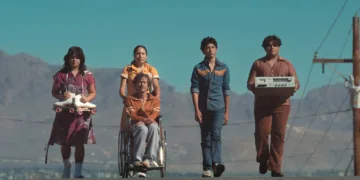
Carolina Costa’s cinematography bathes each frame in natural light—turquoise skies that feel half-forgotten dreams and sun-baked earth tones that could be a metaphor for cultural erasure (or cultural persistence). Interiors are cramped; exteriors, vast. The contrast frames Olmo’s internal tug-of-war between confinement and escape.
Eimbcke’s editing treats each scene as a half-breath rather than a gasp. Pauses stretch just long enough for dry humor to seep in—Olmo’s sputtering stereo crackle, the silent stares he shares with Nina—before snapping back to narrative propulsion. There’s no fat here. Every transition, every cut, propels a theme or a character arc.
Production design and costuming ground the film in tactile authenticity. Those red Tony Lama boots aren’t a fashion choice; they’re Olmo’s armor. The analog stereo components—buttons, knobs, tangled wire—become relics of pre-digital defiance.
Eimbcke avoids emotional sugar rushes. Instead, he offers a slow drip of tonal shifts. Warm nostalgia exists alongside economic strain. Adolescent thrill coexists with familial obligation. And in that overlap, the film stakes its claim on cultural memory—one measured shot at a time.
Thresholds of Memory and Obligation
Olmo’s passage from childhood whimsy to mature empathy unfolds like a rite of passage distilled into a single evening. The wake sequence—half-remembered songs drifting through dim halls—operates as a symbolic baptism into mortality (and responsibility), forcing Olmo to reckon with the fragility of life before he even cracks 15.
Family duty in this film feels like an undertow. Caretaking isn’t an afterthought; it’s the water in which these characters swim. In immigrant households, obligation often arrives without invitation, and Olmo’s father–son dynamic captures that tension: the adolescent craving for independence clashes against a sense of “responsibilitide” (a portmanteau for the heavy surge of obligation).
Memory here is selective. Scenes replay with adolescent hyperbole—every failed wire soldering feels like a small apocalypse—yet adult hindsight later softens the edges. Nostalgia, then, becomes a double agent: it colors youthful trials as epic sagas even as it smooths out the jagged corners of regret.
The film’s implicit reflection on immigrant experience emerges through everyday exchanges: Spanish murmured over breakfast, English muttered under breath, cultural overlaps forming a quiet code. Economic strain seeps into every frame—rickety trailers, secondhand stereo parts—suggesting resilience as a cultural inheritance.
Dry humor undercuts sorrow. Olmo’s “cringe comedy” moments—like his fumbling flirtation with Nina—aren’t played for ridicule but for affectionate recognition of adolescence’s absurd stakes. And when laughter fades, sorrow lingers just long enough to register that childhood’s end isn’t a neat break but a messy overlap. In balancing these tones, the film stakes a claim on cultural memory—an artifact of working-class adolescence that might spark empathy across languages, generations, and socioeconomic divides.
Sunlit Ruins & Sonic Echoes
Fernando Eimbcke’s lens embraces natural light as if it were a fragile artifact—each frame bathed in turquoise mornings and ochre afternoons that recall both Manifest Destiny postcards and the desolation left by post-oil-crash America. Wide desert vistas (wide as a manifesto) contrast sharply with intimate interiors where every crack in the trailer wall whispers of economic precarity.
The color palette—muted earth tones interrupted by neon scars—operates like selective memory (neon as nostalgia, earth as endurance). Period music isn’t mere ornamentation. Obscure Mexican pop tracks slip in like cultural émigrés, disco classics channel communal rebellion, and Slade’s anthemic “Cum on Feel the Noize” arrives as a working-class battle cry. Giosuè Greco’s score, on the other hand, trades grandiosity for sparse piano chords and playful string motifs—a “restraintcore” approach that underscores the film’s low-budget ethos.
Sound design turns mundane objects into protagonists: the stereo’s crackle, the skateboard’s rolling wheels, distant train horns (America’s iron arteries). These diegetic details build an “echo-memory,” where each clang and hiss anchors us in Olmo’s world.
Production design thrives on the tactile: a patched mattress that could tell ten lifetimes, faded wallpaper, roller-rink neon that hints at dreams half-forgotten. Costume and hair complete the tableau—high-waisted jeans, graphic tees, and those red cowboy boots standing in for youthful armor. Empty spaces and ambient residue. This is cinema as cultural excavation, unearthing stories buried beneath sand and static.
Calibration & Resonance
Eimbcke’s latest offering excels in empathic precision: each family moment unfurls with unhurried care, the period detail so vivid it verges on “time-capsule fidelity” (yes, I just coined that). Uttapa’s Olmo and Sánchez Parra’s Nestor anchor the emotional core, their chemistry akin to a soldered joint—flawed but indispensable.
Yet the humor occasionally overstays its welcome. A gag about roller-skates spins into near-cringe territory, and a sudden tonal dip toward solemnity can feel jolting. Still, those jolts often mirror real-life ruptures—so perhaps they belong.
Viewed alongside Duck Season and Club Sandwich, Olmo reveals Eimbcke’s evolving focus on marginal lives. Where his early work mined gentle absurdity in suburban ennui, this film places immigrant struggle front and center (a political echo of late-1970s America’s socioeconomic tremors).
It sits comfortably alongside modern coming-of-age pieces that refuse tidy resolutions—think Moonlight’s quiet revelations. For viewers who cherish slice-of-life drama, Olmo speaks across languages and generations: a universal plea for empathy when youth collides with duty.
Full Credits
Director: Fernando Eimbcke
Writers: Fernando Eimbcke, Vanesa Garnica
Producers: Dede Gardner, Jeremy Kleiner, Eréndira Núñez Larios, Michel Franco
Cast: Aivan Uttapa (Olmo), Gustavo Sánchez Parra (Nestor), Diego Olmedo (Miguel), Andrea Suárez Paz (Cecilia), Rosa Armendariz (Ana), Humberto Castro, Valentín Mexico (Tio Julio), Melanie Frometa (Nina Sandoval)
Director of Photography (Cinematographer): Carolina Costa
Editor: Mariana Rodríguez
Composer: Giosuè Greco
The Review
Olmo
“Olmo” captures the sharp edges of adolescence and the gentle weight of family duty with equal measure. Its spare humor, evocative period details, and sincere performances transform a simple coming-of-age tale into a quietly powerful portrait of working-class resilience and youthful longing.
PROS
- Empathetic depiction of family dynamics under strain
- Authentic late-’70s New Mexico atmosphere
- Aivan Uttapa’s nuanced portrayal of adolescent turmoil
- Deadpan humor that feels genuinely affectionate
- Lean 84-minute runtime with no narrative fat
CONS
- Occasional comic beats that overextend their welcome
- Brief tonal shifts can feel abrupt
- Limited screen time for some supporting characters
- Subtle political context may be too muted for some viewers