








![Kingdom Hearts Collection [I-III] Review](https://gazettely.com/wp-content/uploads/2026/10/Kingdom-Hearts-Collection-I-III-1-360x180.webp "Kingdom Hearts Collection [I-III] Review: KHII Holds Steady as Newer Entries Fluctuate 33")





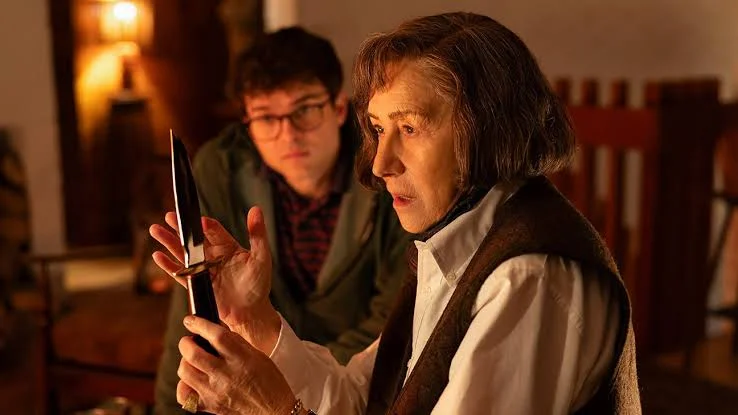

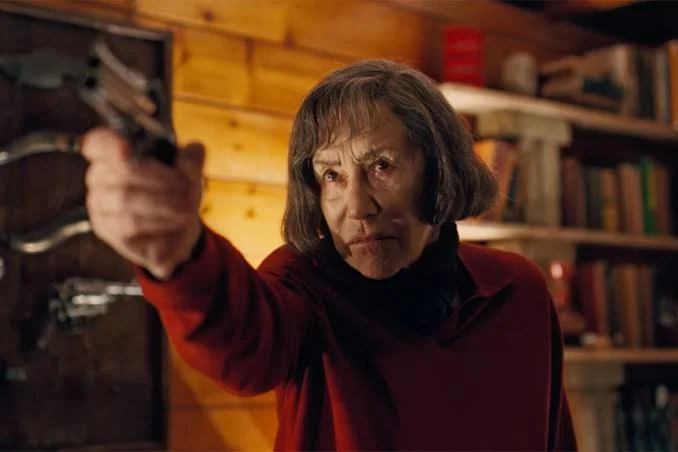
Patricia Highsmith keeps arsenic in the kitchen, knives on the wall, snails in a tank, and a blank sheet of paper in her typewriter. One of these objects is supposed to be frightening. A Talent for Murder spends much of its running time changing its mind about which one.
Anton Corbijn’s film, adapted by Joanna Murray-Smith from her play Switzerland, imagines Highsmith near the end of her life in 1995, barricaded inside her Swiss home and refusing to produce another Tom Ripley novel. Her publisher sends Edward Ridgeway, a young employee played by Alden Ehrenreich, to change that. The previous emissary apparently never made it back. Edward still knocks on the door.
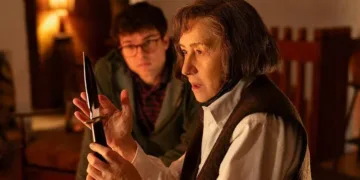
Helen Mirren’s Highsmith initially treats him as something between an inconvenience and laboratory equipment. She mocks his appearance, questions his sexuality, insults his intelligence, and tests how much discomfort he will absorb before retreating. Mirren does very little to soften the cruelty. Her gaze fixes on Edward with the concentration of somebody trying to decide where to make the incision, while the cigarettes, alcohol, poisons, and weapons turn the house into an extension of her imagination. It is tempting to call this a battle between predator and prey. That lasts about fifteen minutes.
Edward is too adaptable for the designation. He arrives disheveled and deferential, but Ehrenreich gradually removes the harmlessness without performing some dramatic transformation. He simply changes the amount of himself Edward chooses to show. Flattery gives way to professional confidence.
Politeness becomes provocation. When he tells Highsmith that her recent books have failed to match her earlier success, the insult lands because it exposes the contractual absurdity connecting them: she despises the publishing machine that needs Ripley, yet she also needs somebody willing to treat her as a writer rather than a monument. Call it the Ripley leakage problem. Once a character built around imitation and reinvention enters the conversation, everyone nearby begins to look suspiciously performed.
The film understands this wonderfully during its best passages. A breakfast prepared beside an ominously visible bottle of poison becomes funny because Edward knows exactly what Highsmith is doing, while Highsmith knows that he knows. The threat survives anyway. Corbijn stages several similar moments with an almost mischievous horror rhythm, letting Mirren appear unexpectedly or allowing the camera to linger on a weapon long enough for the object to become a joke about its own obviousness. Highsmith has constructed a home where every prop looks capable of murder. Edward keeps sitting down.
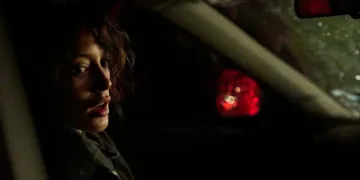
Their conversations eventually produce what the publisher wanted: an idea for another Ripley story. Edward supplies material from his encounter with Clementine, a young American he met on the train into Switzerland, and Highsmith begins transforming the material into fiction. Ehrenreich then reappears inside the imagined story as a sleek Ripley-like predator pursuing another version of Clementine, still played by Olivia Cooke, amid the wealth and shadows of Rome.
Here the film becomes clever in a way that initially deepens its central question. Edward already seemed to be modifying himself according to his audience. Giving Ehrenreich a second incarnation makes that suspicion visible. The modest editor acquires posture, confidence, immaculate clothes, and the moral emptiness associated with Highsmith’s most famous creation. Cooke’s Clementine splits too, existing as a real woman Edward encounters in Switzerland and as material being rewritten inside Highsmith’s emerging novel.
The fiction begins eating reality. Or perhaps reality was performing fiction first. That uncertainty gives A Talent for Murder its strongest idea, then starts causing trouble. The film gradually divides its attention among Highsmith and Edward constructing the novel, Edward’s encounters with the real Clementine, and the stylized Rome narrative. Each strand reflects another, but reflection is not the same thing as escalation. The more time Corbijn spends inside the invented Ripley story, the clearer it becomes that the sharper drama remains back in Switzerland.
I initially thought that was deliberate. Highsmith creates seductive murder stories, so perhaps the artificial smoothness of Rome is meant to expose how fiction beautifies predation. Robbie Ryan’s cinematography supports that reading. Switzerland has a colder, harder Alpine quality, while Rome slips into velvety darkness and elegant interiors. Dimitri Capuani’s Swiss house feels accumulated rather than designed for seduction: wood paneling, paperwork, weapons, canned soup, smoke, and the physical debris of somebody who has turned isolation into routine.
But the invented narrative eventually asks for investment rather than interpretation, and there the argument weakens. Edward’s fictional seduction of Clementine has style, yet the actual mechanics are familiar. The movie keeps leaving its richest relationship to dramatize a lesser story supposedly produced by that relationship. That is a peculiar form of narrative self-sabotage: the frame becomes livelier than the picture.
Mirren’s absence is especially noticeable because her Highsmith gives the film its ugliest energy. Murray-Smith allows her racism, antisemitism, homophobia, and generalized contempt into the room, though the screenplay sometimes converts viciousness into theatrical wit before its implications can fully settle. Mirren prevents total caricature through concentration rather than sympathy. This woman watches people because she may need them later, perhaps for a story, perhaps for something worse.
Ehrenreich has the harder task. Edward must remain readable enough for the film’s reversals to matter and unreadable enough for the possibility of Ripley to hover around him. He handles that contradiction with tiny adjustments. The nervous editor and the imagined predator are visibly related, yet the difference between them never depends on some grand actorly flourish. One man appears to have discovered what the other already knew: personality can be wardrobe.
By the late stages, the film openly encourages a stranger possibility. Edward may be less a conventional visitor than an emanation of the character Highsmith cannot escape, a final confrontation between an author and the psychopath she gave cultural life. The film never locks that interpretation into place, which suits its preoccupation with invention, projection, and identity. A tidy explanation would probably diminish it.
Still, ambiguity cannot generate danger by itself. A Talent for Murder keeps assembling knives, poison, guns, seductions, doubles, disappearances, and stories inside stories, yet very little lands with the vicious snap promised by its setup. Corbijn keeps tugging at the rug instead of pulling it. The blank page remains, and it may be the most dangerous object in Highsmith’s house: the one asking her to invent another person. Edward arrives hoping to fill it. By the time he has helped her do so, the unsettling question is no longer who created whom. It is why either of them needed the distinction.
A Talent for Murder had its world premiere at the Toronto International Film Festival in September 2026 before its theatrical release. The psychological thriller follows a young publisher’s emissary who visits reclusive author Patricia Highsmith in Switzerland to convince her to write one final Tom Ripley novel.
Where to Watch A Talent for Murder (2026) Online
Full Credits
Title: A Talent for Murder
Distributor: Bleecker Street
Release date: September 10, 2026 (Toronto International Film Festival) / October 23, 2026 (US)
Running time: 1 hour 30 minutes (90 minutes)
Director: Anton Corbijn
Writers: Joanna Murray-Smith
Producers and Executive Producers: Gabrielle Tana, Mickey Liddell, Pete Shilaimon, Troy Lum, Andrew Mason, Jim Robison, Kurt Martin, Carolyn Marks Blackwood, Karl Spoerri, Andrea Occhipinti
Cast: Helen Mirren, Alden Ehrenreich, Olivia Cooke, Juliet Stevenson, Brid Brennan
The Review
A Talent for Murder
A Talent for Murder is sharpest when Highsmith and Edward sit across from each other and turn conversation into psychological blood sport. Mirren supplies the venom, Ehrenreich supplies the uncertainty, and Corbijn gives their duel enough visual menace to make a bottle of poison feel almost conversational. The problem arrives when the film keeps leaving that room. Its metafictional layers are smart, sometimes elegantly so, but the imagined Ripley material rarely matches the danger of the people inventing it.
PROS
- Helen Mirren’s vicious, controlled Highsmith
- Ehrenreich’s slippery dual performance
- Strong Highsmith-Edward power struggle
- Effective Swiss/Rome visual contrast
- Smart identity and authorship ideas
CONS
- Rome storyline weakens the central duel
- Twists rarely land with real force
- Metafiction sometimes feels mechanically clever
- Clementine material is less gripping
- Highsmith’s prejudice can become theatrical shorthand