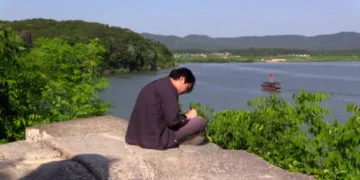



















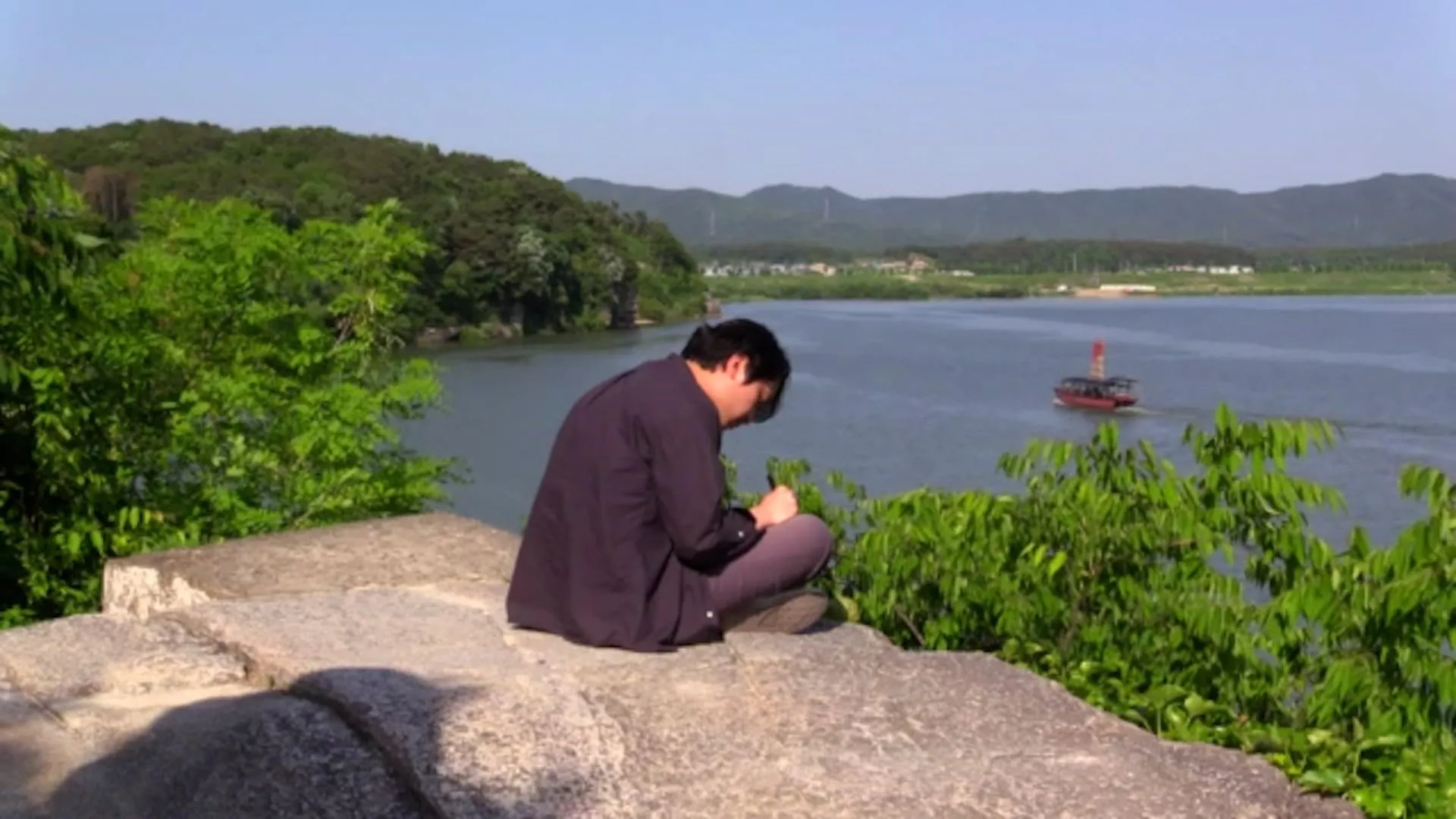

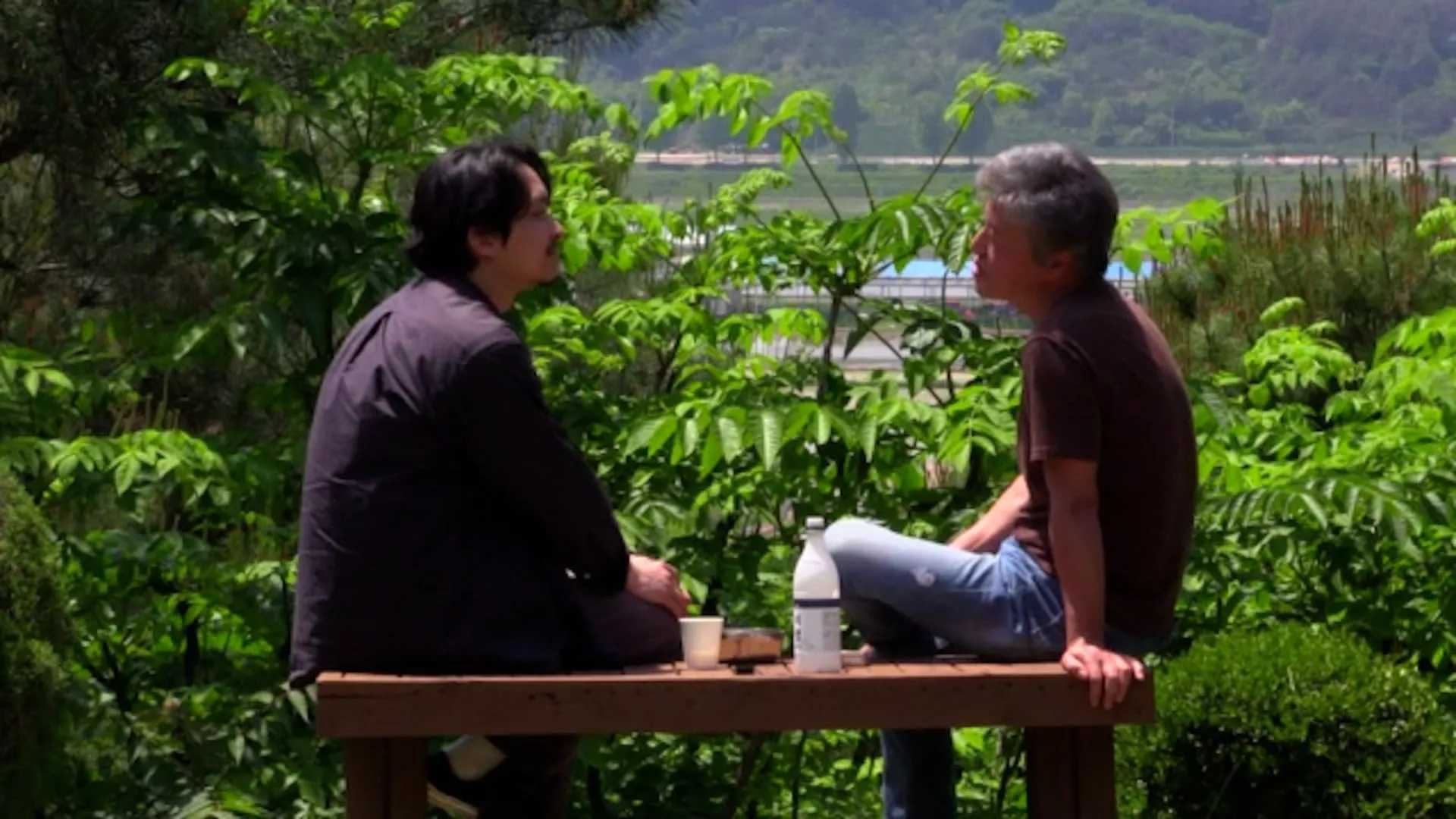
What Does That Nature Say to You unfolds across eight unmarked chapters, guiding us through a single day in which poet Donghwa journeys from his cramped Seoul life to the crest of Junhee’s family estate. The film uses a deliberately blurred lens, an optical metaphor for the poet’s own partial sight, both literal and existential.
Bits of conversation drift like smoke—cigarette breaks by an ancient temple, a midday meal at a bibimbap stand, the ritual of garden wandering—measured yet uneasy, as if reality itself hesitates to reveal its full shape. Father-in-law Oryeong’s casual charms mask a silent examination; sister Neunghee’s barbs expose the gulf between aesthetic idealism and inherited privilege; mother-poet Sunhee remains absent yet felt in every quiet corner.
In its spare imagery, the film becomes a meditation on perception: how we reconstruct the self through fragmented glimpses of place and language. Each crash zoom is a jolt, a reminder that beneath courteous banter lies the demand to justify existence. Art emerges here not as refuge but as a mirror—it distorts and demands clarity in the same breath. One wonders: can you ever truly see another, or only the reflections of your own uncertainty?
Fragmented Time, Unfolding Moments
Hong Sang-soo divides his film into eight unlabelled chapters, each a self-contained breath in a single, tense exhalation. Chapter breaks arrive without fanfare—one moment Donghwa navigates the driveway, the next he’s in the garden’s half-shadow—inviting us to sense shifts in mood as though we were stumbling through his blurred vision. These discreet seams between episodes become emotional fault lines: a smile in one, a glance of doubt the next.
The entire story unfolds within twenty-four hours, a compressed span that intensifies every glance, every hesitation. We experience real time when the camera lingers on cigarette smoke curling skyward. Then, in a blink, the scene jumps ahead—lunch has ended, the temple’s stone lotus doors stand open—and we’re jolted forward. These deliberate ellipses whisper of memory’s unreliability, reminding us that what’s omitted can speak as loudly as what remains.
Key moments take on ritual weight. Chapter 1 greets us with a tentative welcome—Donghwa’s posture taut, an unseen question framed in his very stance. In Chapters 2 and 3, garden paths and a shared cigarette become curious rites of passage: the car’s battered chrome gleams like a relic, connecting man, machine and terrain.
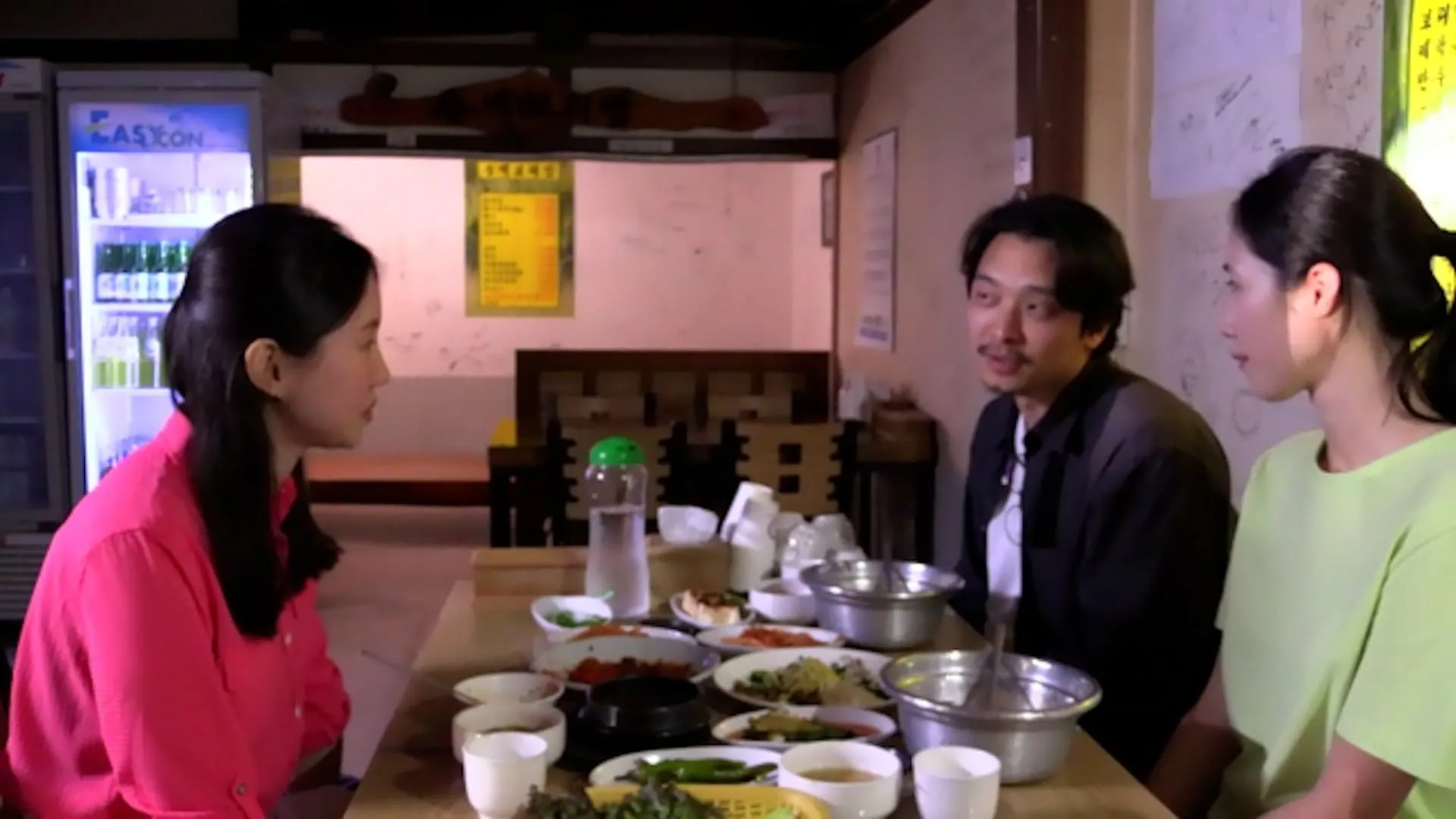
Chapters 4 and 5 shift to communal companionship undercut by pointed inquiries, Neunghee’s questions slicing through polite air. By the time dinner arrives in Chapters 6 and 7, alcohol layers itself over conversation, loosening tongues while tightening unspoken demands. The final chapter leaves us stranded in ambiguity, a farewell echoing across empty rooms.
Long, unbroken takes invite a detached observation, as if we hover at the edge of each moment. Silence falls like dusk, intensifying the spaces between words. Then, in sudden accelerations—a snap zoom, a brisk cut—the film jolts us out of complacency, insisting we witness revelation as it fractures the frame. Through these rhythms, Hong transforms the mundane into something uncanny, a portrait of time itself bending beneath the weight of human expectation.
Echoes Behind the Mask
Donghwa drifts through the frame like a verse half-formed—his professed devotion to poetry rings hollow when tested by Junhee’s kin. In static, unguarded shots he stands ramrod-straight, as if bracing against an unseen gale; by dinner’s end his shoulders slump, words slurred into brittle admissions.
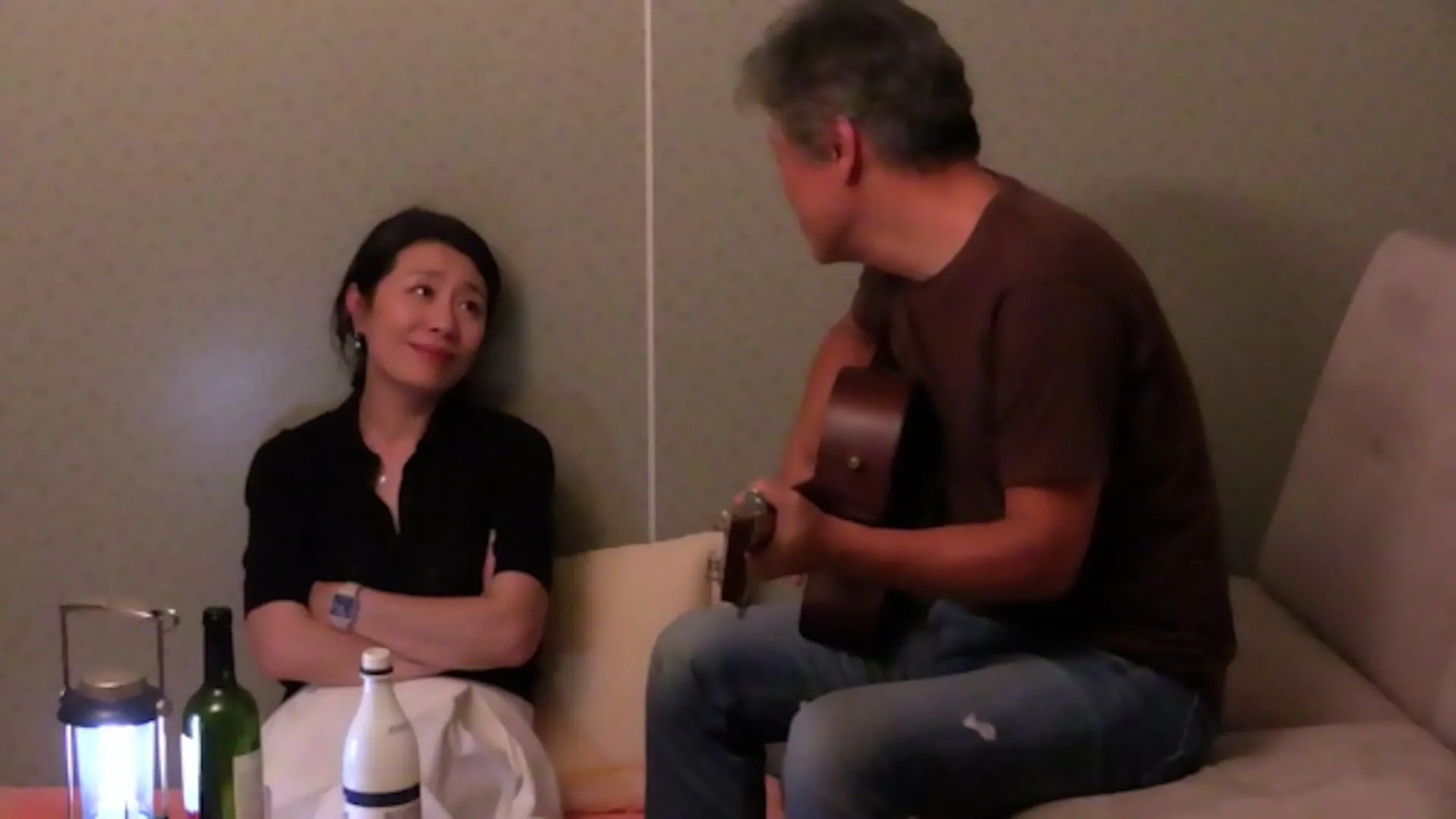
His lofty platitudes (“A life devoted to beauty…”) fracture under Neunghee’s relentless scrutiny, revealing a man grasping at ideals he cannot fully inhabit. Confidence on the road gives way to trembling vulnerability in the candlelit dining room.
Junhee moves between them both, tethering filial duty to romantic loyalty. She guides her sister and boyfriend to the temple with quiet resolve—an act of agency that betrays a restless hope for harmony. Yet in her pale smiles and sideways glances, you sense the ache of divided allegiance. After the final course, she offers Donghwa a soft touch across the tablecloth, an unspoken apology for trials he didn’t choose.
Oryeong arrives as the archetypal “cool dad,” his laughter warm and measured, but every refill of makgeolli carries weight. His fascination with Donghwa’s battered car is more than idle curiosity: it signals a generational lens through which he judges worth. Hospitality slips into examination with each toast, the father’s blessing conditional on revelations Donghwa cannot yet furnish.
Neunghee stands sentinel at the gate of propriety, her melancholic aura hinting at private grief. She mocks his frugality, citing his attorney-father’s fortune as evidence of an unearned independence. Her questions cut like a scalpel, driving him to the film’s emotional precipice.
Sunhee’s absence is its own performance; the matriarch’s pending arrival haunts every empty chair. In the hushed post-dinner appraisal—her voice heard but unseen—we glimpse her unvarnished verdict, a sidebar to Donghwa’s public undoing.
As Hong’s repertory ensemble weaves familiar rhythms, power oscillates around the table. At times the father’s ease dominates; elsewhere the sister’s barbs hold sway; always the mother’s unseen gaze shapes the outcome. Their collective chemistry lends an improvisational truth to each exchange, a fragile lattice of intimacy and judgment.
Blurred Mirrors and Fractured Frames
Hong Sang-soo’s choice of lo-fi, soft-focus video turns every image into an echo of Donghwa’s partial sight. Edges dissolve in a gentle haze, as though the world itself resists definition. Viewers find themselves squinting at garden paths and temple steps, drawn into a shared vulnerability: what does it mean to perceive when reality slips through your fingers?
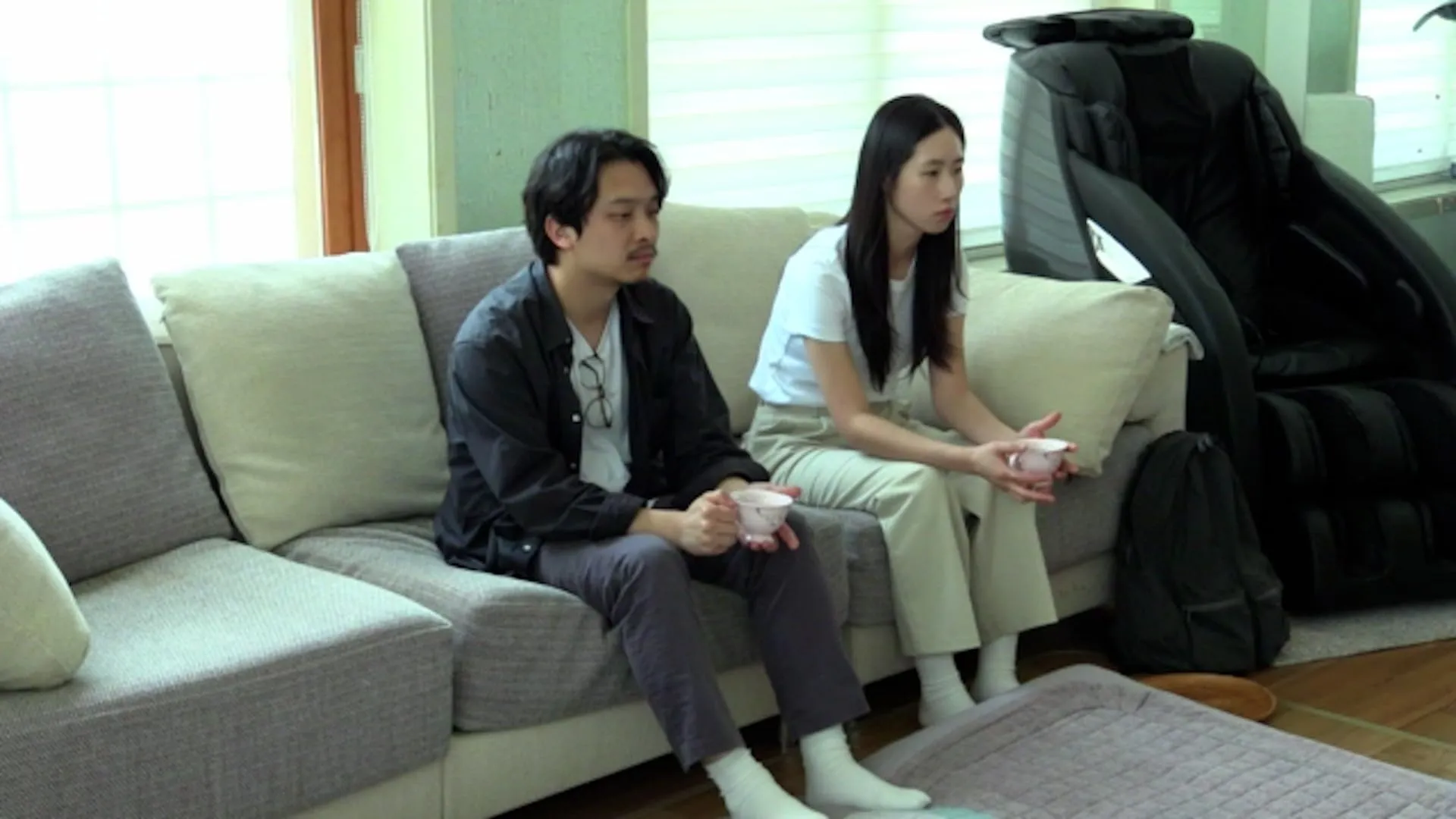
Most scenes unfold from a fixed tripod’s neutrality, the frame holding its ground while conversations swirl within. Then, without warning, the camera lunges forward in a crash zoom or sweeps laterally in a sudden pan—a jolt that fractures calm. These movements feel like pulses of raw emotion, reminders that beneath everyday courtesy there lurks an undercurrent of unspoken strain.
At times we occupy an objective vantage, watching figures drift across Oryeong’s hillside estate. In the next instant, framing shifts through a car window or temple arch, pulling us into Donghwa’s private gaze. A rusted Kia Pride becomes a looking glass; sunlight slants across its battered hood like memory’s crease. The dinner table, with its neatly placed bowls and chopsticks, turns into an arena where seating order and eye lines reveal the family’s unspoken hierarchies.
Light itself speaks. Natural daylight burns through branches, lending the garden an otherworldly glow. Indoors, lantern warmth casts amber pools on receding faces, heightening the distance between what is said and what is felt. Overexposed skies bleed into muted earth tones, as if the film’s palette were a thermometer of emotion—the higher the glare, the colder the doubt.
Sonic Shadows: Sound Design & Music
A hush falls over Oryeong’s garden before a single word is uttered—rustling leaves and distant temple bells form a naturalistic tapestry that draws us into Donghwa’s fractured awareness. Dialogue is captured with intimate clarity, each breath and stutter preserved against the ambient wash, as if Hong refuses to let cinematic polish mute human fragility.
Sparse musical motifs appear like unexpected jewels. Hong’s own compositions emerge only at pivotal junctures—a simple flute phrase when Donghwa first steps into sunlight, a lone piano chord as he falters under Neunghee’s gaze—binding chapters through melodic echoes rather than through grand orchestration. These delicate refrains feel existential in their restraint, asking whether art can ever fill the crevices of our doubt.
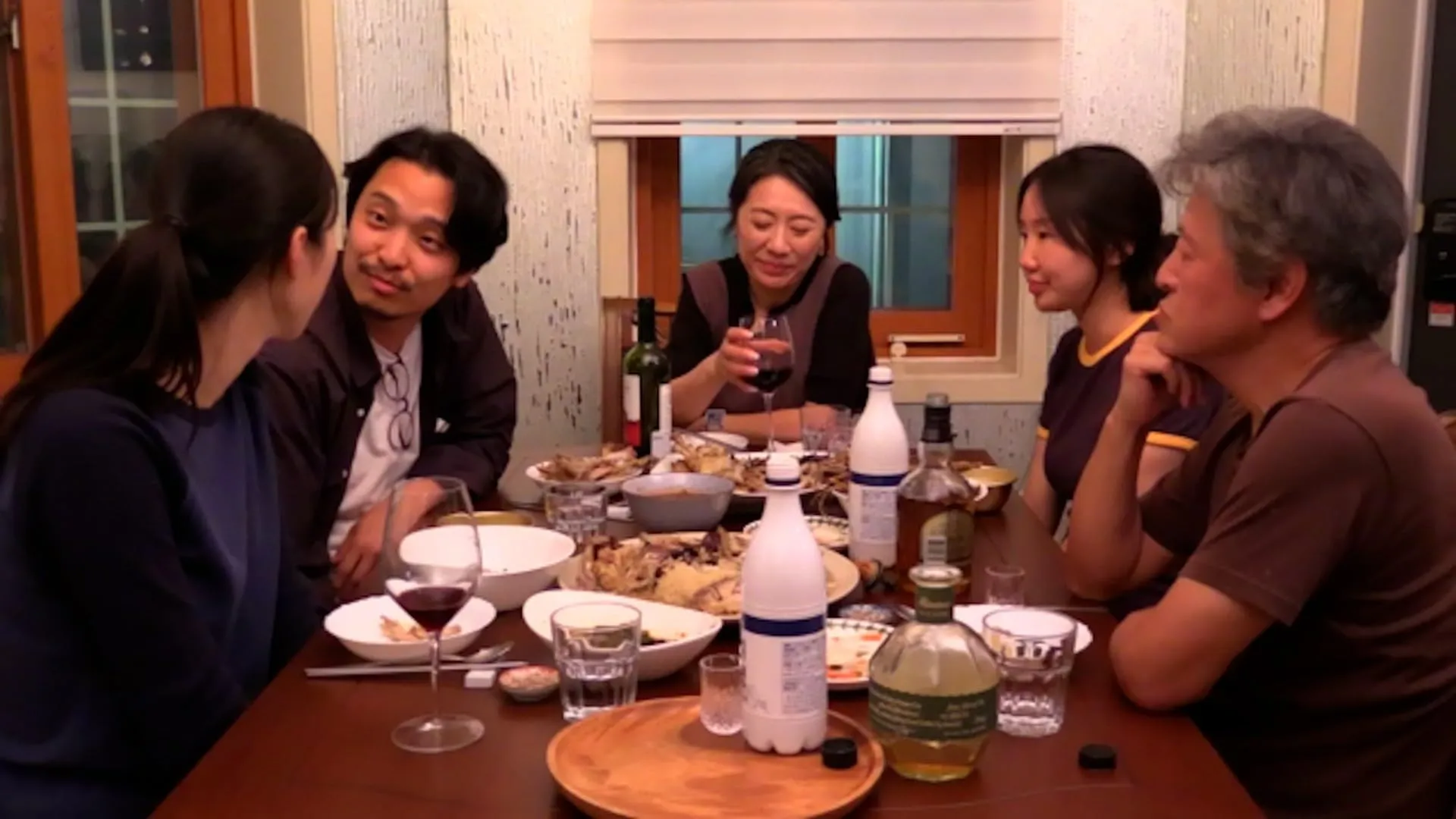
Silence acts as pressure, an unspoken interrogation that grows heavy at the dinner table. Pauses stretch into uneasy voids, amplifying every scratch of chopsticks. When voices overlap—parents chiding, siblings prodding—the resulting cacophony becomes its own language of discomfort.
Diegetic sounds take on allegorical weight: the slow pour of makgeolli becomes an invitation to truth, the engine’s idle hum a reminder of journeys not yet taken. Temple chants drift in and out, a spiritual counterpoint to familial scrutiny, suggesting that the real ceremony unfolds within. Subtle sound bridges and abrupt cuts mark chapter boundaries, guiding our ear as much as our eye through this shadowed exploration of perception.
Symbols of Sight and Stricture
In Hong Sang-soo’s film, the battered Kia Pride becomes more than a vehicle—it stands as the poet’s austere manifesto against inherited privilege. Donghwa’s refusal of parental support echoes his belief that art must arise from self-denial rather than comfort. Yet the film’s soft-focus aesthetic reveals the price of seeking clarity: a blindness to one’s own faults.
The estate’s garden and memorial tree stand as silent monuments to devotion and loss, their stillness offering a momentary calm before the temple’s stone portals confront us with existential questions. Makgeolli and whiskey pour like philosophical elixirs, eroding polite façades until a drunken outburst strips discourse to its raw core.
Each wobble of the frame implicates us in Donghwa’s faltering gaze—how much can be known when every image trembles? Crash zooms and lingering shots suggest that authenticity itself is a perilous pursuit, each revealed truth inviting deeper uncertainty. Nature in this film is never neutral; every leaf and temple bell poses a question the soul must answer alone.
Resonant Echoes and Cultural Undercurrents
Parent-in-law gatherings here brim with subtle unease, a familiar tension anyone meeting a partner’s family will recognize. Hong juxtaposes heartfelt laughter and unvoiced judgments to reveal Korean hospitality’s double edge. In his thirties, Donghwa confronts the classic strain between artistic calling and societal benchmarks: the poet seeks meaning beyond market value, yet treads uncertain ground.
Expectations around marriage loom, pressing on fragile ideals. Within these intimate gatherings, the familiar contours of custom reveal themselves as both comfort and constraint. Compared to his lo-fi experiment In Water and reflective In Our Day, this film sharpens Hong’s formal daring, carrying forward his archetypal wanderers and chance encounters.
Its presence in Berlin’s competition underscores how its quiet radicalism can enthrall festival audiences while whispering of broader appeal. The finale’s unresolved hush leaves an open invitation: each viewer must weigh the nature of love and identity through their own lens. These lingering questions resound long after the screen fades.
Full Credits
Director: Hong Sang-soo
Writer: Hong Sang-soo
Producer: Hong Sang-soo
Cast: Ha Seong-guk, Kwon Hae-hyo, Cho Yun-hee, Kang So-yi, Park Mi-so
Director of Photography (Cinematographer): Hong Sang-soo
Editor: Hong Sang-soo
Composer: Hong Sang-soo
The Review
What Does That Nature Say to You
Hong Sang-soo’s film submerges the mundane in existential undercurrents, its blurred optics and elegant silences revealing both the fragile core of human aspiration and the shadows of unspoken expectation.
PROS
- Atmospheric visual approach underscores theme
- Naturalistic dialogue deepens immersion
- Subtle sound design enhances emotional texture
- Performances convey hidden tensions
- Chapter structure invites thoughtful reflection
CONS
- Unhurried pacing may feel slow to some
- Soft-focus imagery can obscure detail
- Minimal plot progression might seem meandering
- Key motivations left ambiguously sketched