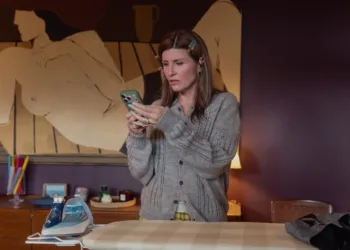










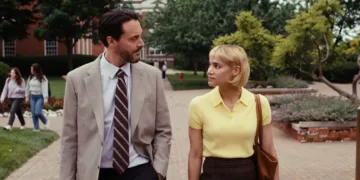














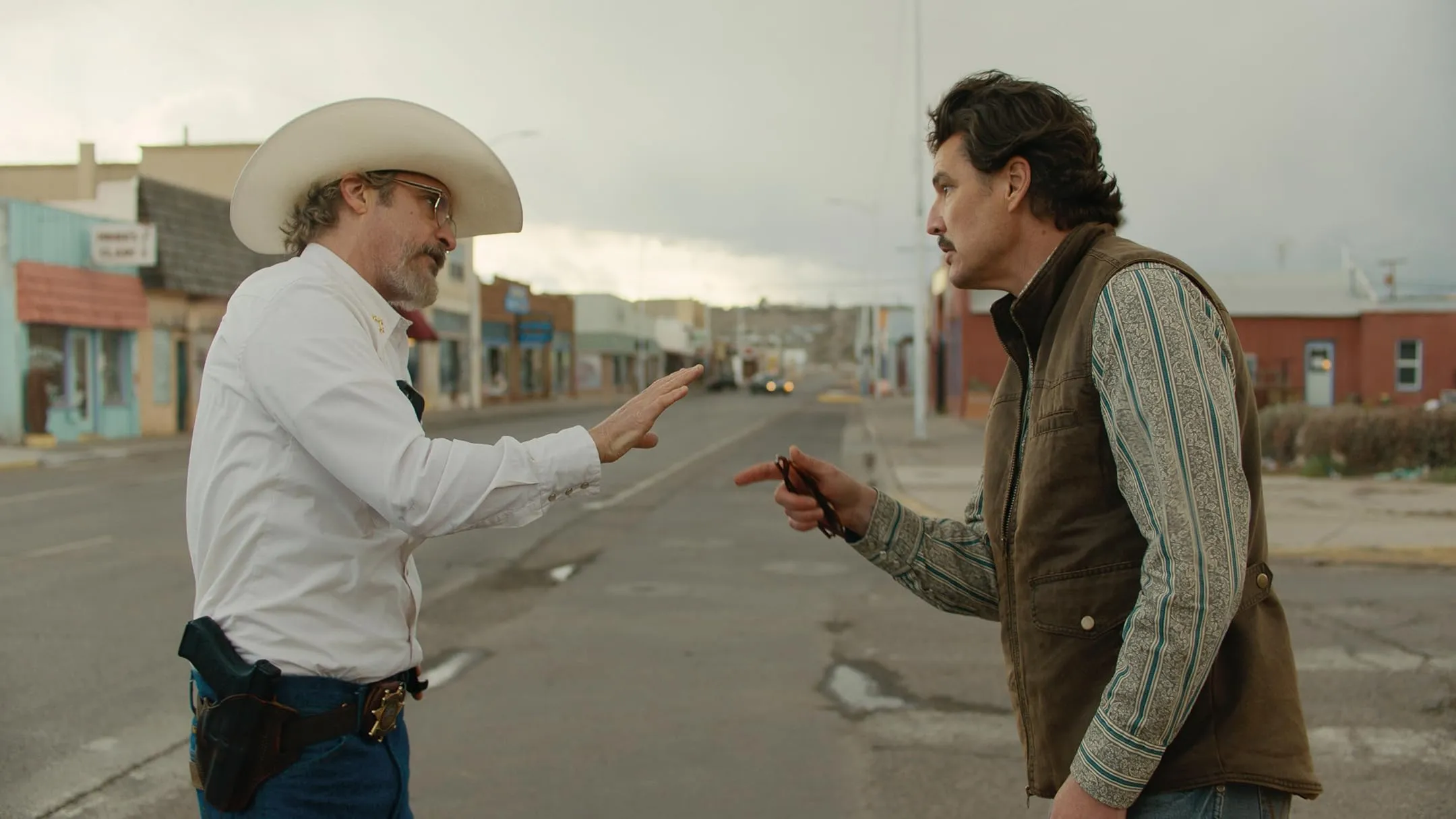

Ari Aster’s Eddington drops us into late May 2020 in a dust-choked New Mexico town where the wildfire panic of COVID-19 meets taut Western convention. Here, Sheriff Joe Cross (Joaquin Phoenix) refuses a cloth mask with the same stubborn pride as a gunslinger holsters his revolver, standing in stark relief against Mayor Ted Garcia’s (Pedro Pascal) precise public-health edicts. In this crucible of fear, rumors mutate into rallying cries, and neighbors who once shared water spouts now trade barbs at six feet of distance.
Cross’s wife, Louise (Emma Stone), hovers between fragile recovery and creeping disillusionment, prodded by her conspiracy-fixated mother Dawn (Deirdre O’Connell). Into this maelstrom strides Vernon (Austin Butler), a charismatic stranger peddling borrowed trauma and empty solace. Their intersecting paths spark a campaign of viral rhetoric, fracturing loyalties and igniting protests that split the town clean down its unpaved main drag.
Aster fashions a canvas that veers from dark comedy to neo-noir thriller, painting political spectacle in shadowy canyons and fluorescent grocery aisles. The film’s scale feels intimate yet epic, inviting us to witness not just a community’s descent but our own mirror-image wrestle with truth, trust and the perilous lure of simplified certainty.
Dust and Disbelief: A Neo-Western Canvas
Eddington unfolds like a meditation on frontier myth, retooled for the age of viral panic. The film’s bones are pure Neo-Western: sunbaked streets, a lone sheriff’s silhouette against peeling adobe walls, an isolated ranch house perched like a sentinel over cracked earth. Dust drifts through nearly every frame, turning every breath into an act of defiance—much as Sheriff Joe Cross’s bare face becomes a flag in the crusade against masking.
Late May 2020 hangs over the town like an unshakeable haze. Storefront windows display half-hearted signs demanding six-foot spacing, while faded protest placards sag on rusted stakes. Social-distancing tape flutters in hot wind, a flimsy boundary marking the front line in a silent war. Crowds gather only online: livestreamed town-hall meetings flicker on phones, their digital glow a strange comfort in the vacuum of empty streets.
Ari Aster weaves real-world tremors—lockdown dread, the resurgence of Black Lives Matter—into the warp and weft of his Western tapestry. When placard-wielding youths choreograph their demonstrations in the dying light, the mood shifts from dusty comedy to uneasy suspense. Wide-angle shots recall classic standoffs at high noon, but once those placards give way to gunshots, genre expectation fractures. Comedic jolts of conspiracy-fuelled absurdity bleed into tense sequences of moral unraveling, as if the film itself cannot decide whether to draw its six-shooter or hoist a megaphone.
In Eddington, frontier justice is repurposed: the open range becomes a stage for modern mistrust. Masks and megaphones replace colt irons and Winchester rifles, but the primal ritual remains—two adversaries facing off beneath a scorching sun. Aster harnesses these visual motifs not as homage but as indictment, revealing how swiftly civic order cannibalizes itself when certainty evaporates. By midpoint, the satire’s sharp edges curve inward, and violence arrives not as spectacle but an inevitable punctuation in a town starved of shared truths.
Fractured Acts in a Sun-bleached Drama
Eddington’s narrative scaffolding follows a deliberate three-act arc, each segment prying open the town’s fragile veneer. In Act I, Sheriff Joe Cross stakes his defiance on bare breath and barefaced conviction, rejecting masks as he rejects caution. The film eases into its premise with scenes of imaginative absurdity—Joe’s squad car plastered with anti-mandate slogans—yet every comic flourish hums with latent tension.

Act II escalates when Joe trades his badge for a campaign button, thrusting the mayoral race into the crosshairs of social-media rumor mills. Viral conspiracies ripple through printed flyers and smartphone clips taped to lampposts, infecting church pews and kitchen tables alike. As agendas clash, the narrative pacing snaps between fevered debates and perfunctory domestic quarrels, thriving on dissonance.
By Act III, the film fractures into protest-fueled unrest. Placard-wielding marchers converge on empty streets while desert dust settles over bolt-action rifles. Aster choreographs the showdown with the precision of a dance—guns drawn like reluctant partners—before tension shatters into gunfire echoing across canyon walls.
At its core, the story interrogates truth versus perception. Misinformation becomes a contagion, reshaping loyalties and erasing familiar contours of trust. The lawman’s uniform, once a symbol of order, morphs into a banner rallying dissent—an authority figure transformed into the very agitator he once restrained. Isolation seeps into every frame: fractured households, abandoned saloons and the cavernous hush of sand-blown byways mirror the characters’ emotional desolation.
Recurring motifs tighten this thematic web. Masks slide from physical shield to emblem of collective fear, their fabric creased with silent accusations. Social-media sound bites—snatches of conspiracy theories spun by Louise’s mother—resonate like ghosts, haunting living rooms and town halls. The desert landscape looms as a silent witness, its vast expanse amplifying solitude and underscoring the chasm between individual and community.
Aster’s pacing wields tonal turns like a scalpel: sudden silences stretch longer than gunshots, ambient wind intrudes on heated exchanges, and every rhythmic cut heightens the sense that this town, its relationships and its truths, stand on the brink of unraveling.
Faces of Fracture: Performances in Collision
Joaquin Phoenix’s Sheriff Joe Cross is a study in taut transformation. His asthmatic caution blossoms into stubborn defiance, each breath a wager against the invisible enemy. Phoenix threads subtle humor through Joe’s grassroots campaign—misspelled placards wobbling on a bullet-riddled truck—yet never undercuts the character’s desperation. As protests surge and alliances shift, Phoenix charts Joe’s evolution from duty-bound lawman to impassioned populist, his voice wobbling between sincerity and veiled menace.
Pedro Pascal’s Mayor Ted Garcia radiates practiced calm, a technocratic dreamer hawking an AI data center as salvation for a struggling town. Pascal shades every public address with hints of doubt—tightened jaw, quicksilver flick of the eyes—suggesting personal stakes that echo his rivalry with Joe. Their shared past ripples beneath each confrontation, lending gravity to debates that might otherwise collapse into caricature.
Emma Stone and Deirdre O’Connell form a fragile axis at the film’s emotional core. Stone’s Louise drifts on the margins of reality, her brittle composure cracking under the weight of unspoken trauma. O’Connell, as Dawn, scrawls conspiracy manifestos across kitchen counters, her fervor both comic and chilling. Together they embody how fear fractures family bonds, their scenes oscillating between domestic intimacy and conspiratorial fever dream.
Austin Butler’s Vernon arrives like a campfire myth—smooth, magnetic, but hollow at the core. His underwritten arc hints at a potent charisma that turns therapeutic promise into manipulative spectacle, fracturing more than Louise’s psyche.
In the supporting cast, deputies Guy and Michael stand at diverging moral crossroads as protests ignite, each performance underscoring how institutional roles warp under pressure. Local youths swept into Black Lives Matter demonstrations become conduits for swirling ideologies, their idealism colliding with lived violence.
Moments of raw humanity—an exhausted dialogue behind closed doors, a stolen glance across a makeshift barricade—jolt the satire into urgent relief. While a few figures verge on broad gesture, the ensemble’s chemistry largely sustains the film’s tension, reminding us that beneath every slogan and standoff lies a fractured person reaching for solidarity.
Sunlight and Static: Crafting a Sonic Frontier
Darius Khondji’s lens bathes Eddington in relentless sunlight, each frame scorched by natural light that amplifies both the town’s physical barrenness and its emotional desiccation. Wide vistas recall classic Western standoffs, the horizon pushed to the edges of the frame so isolation feels monumental. Intimate interiors, meanwhile, are lit with muted warmth—dust motes drifting through a window’s slatted beam—reminding us how easily domestic calm fractures under collective panic.
Lucian Johnston’s editing navigates the film’s tonal seesaw with precision. Heated debates snap into quiet tableaux of domestic tension as though a scalpel has cleaved the scene, then shift again to cross-cut protest footage and campaign rallies that ratchet urgency by tallying each face in the crowd. Rhythm becomes a character: breathless sequences that mirror viral virality, followed by pregnant silences that echo the desert wind.
Production design lays bare the town’s frayed resources. A once-thriving grocery store stands partially boarded up, its shelves half-stocked, its checkout counter wrapped in yellow tape. Campaign signage—hand-lettered slogans on weathered plywood—leans against adobe walls, while homemade masks in a spectrum of faded fabrics become an emblem of communal fear. Sheriff Cross’s branded jacket and deputy uniforms feel utilitarian, as if authority itself is in short supply.
The score by Bobby Krlic and Daniel Pemberton weaves haunting Western guitar riffs into ominous electronic pulses, forging a sonic dialect that underscores each tonal shift. Ambient desert wind seeps beneath dialogue, distant sirens punctuate quiet moments, and snippets of viral-clip sound bites slip into conversations like intrusive thoughts. Across visuals and sound, the film constructs a mosaic of fragmentation—every echo and shadow reinforcing an atmosphere where certainty has been left choking in the dust.
Mirror of a Nation in Uproar
Eddington casts the pandemic as a modern plague, its impact measured less in viral counts than in fraying trust. Aster frames mask mandates and lockdown edicts not as public-health measures but as lightning rods for collective anxiety. Town halls dissolve into echo chambers where social-media fumes stoke conspiracy theories, printed flyers circulating like pamphlets in an ideological pamphlet war.
Against this backdrop, racial tensions ignite with the arrival of a local Black Lives Matter chapter. Aster’s lens splices images of peaceful protest with tense exchanges at grocery aisles, exposing how performative zeal can mask the deeper ache for justice. Activists wield megaphones as talismans of virtue, yet their fervor collides with law enforcement’s rigid protocols, underscoring the gulf between moral conviction and lived experience.
In parallel, the proposed AI data center metamorphoses into a symbol of extraction—technology pitched as progress yet threatening to drain scarce water from parched wells. Economic desperation and environmental stakes entwine, revealing how external interests exploit local vulnerability.
No character emerges wholly blameless. Sheriff Cross, the town’s supposed guardian, trades his badge for campaign promises; youth activists sometimes mimic slogans without grasping their weight. Aster avoids moral absolutes, instead staging a mosaic of shared culpability that mirrors national discourse lurching between outrage and apathy.
By leaving his film’s verdict unresolved, Aster provocatively invites debate rather than dictating it. Eddington itself becomes a battleground—its standoffs and broken alliances reflecting our fragmented media feeds. Viewers are compelled to navigate the same labyrinth of half-truths and contradictions that ravaged Eddington, ensuring the film’s echoes reverberate far beyond its desert streets.
Echoes of Empathy Amid Chaos
Amid the clamor of mandates and megaphones, Eddington delivers moments of raw tenderness. In a hushed kitchen scene, Louise and Joe exchange a glance thick with unspoken fear, forging a fragile alliance when the town outside unravels. Joe’s public bravado—placards flapping on his bumper, voice booming at rallies—collides with private vulnerability in these quiet vignettes, reminding us that courage often hides behind exhaustion.
Tension snaps like barbed wire in the grocery-store altercation, where a simple mask dispute ripples into collective panic. That microcosm of mistrust crescendos into the film’s climactic shootout, each gunshot echoing personal betrayals more than political standoff.
Aster peppers the narrative with comedic jolts—misspelled slogans scrawled on plywood, a shouted campaign slogan mangled into absurdity—yet the laughter that follows is uneasy, cracking open space for reflection rather than relief.
Long after the final frame, the film lingers as a time capsule of 2020’s anxieties: viewers will debate who “won” Eddington’s standoffs and at what human cost. For a writer expanding this critique, lean into the interplay of satire and sincerity, spotlighting the silent domestic moments and the grocery-store clash as emotional anchors that root the film’s broader themes in lived experience.
Full Credits
Director: Ari Aster
Writer: Ari Aster
Producers: Ari Aster, Lars Knudsen, Ann Ruark
Cast: Joaquin Phoenix, Pedro Pascal, Emma Stone, Austin Butler, Luke Grimes, Deirdre O’Connell, Micheal Ward, Clifton Collins Jr., William Belleau, Cameron Mann, Matt Gomez Hidaka, Amélie Hoeferle
Director of Photography (Cinematographer): Darius Khondji
Editor: Lucian Johnston
Composers: Bobby Krlic (The Haxan Cloak), Daniel Pemberton
The Review
Eddington
Eddington harnesses frontier imagery and modern anxiety to stage a relentless cultural meditation. Phoenix’s raw defiance, Pascal’s measured authority and Stone’s quiet fragility inhabit a world teetering between satire and tragedy. Its tonal leaps can feel uneven, but its searing portrait of collective distrust lingers long after the credits.
PROS
- Joaquin Phoenix’s magnetic performance anchors the film’s moral complexity
- Darius Khondji’s sun-drenched cinematography amplifies emotional isolation
- Bold fusion of Western tropes with pandemic-era satire
- Sound design integrates Western riffs and electronic pulses for heightened tension
- Sharp social commentary that provokes debate
CONS
- Tonal shifts can feel abrupt, undercutting narrative cohesion
- Overabundance of thematic threads leads to moments of narrative clutter
- Some supporting characters verge on caricature
- Extended runtime strains the film’s satirical momentum
- Underwritten subplots dilute emotional focus