














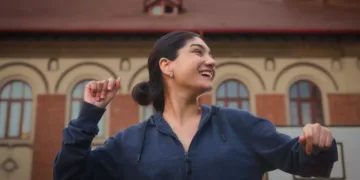









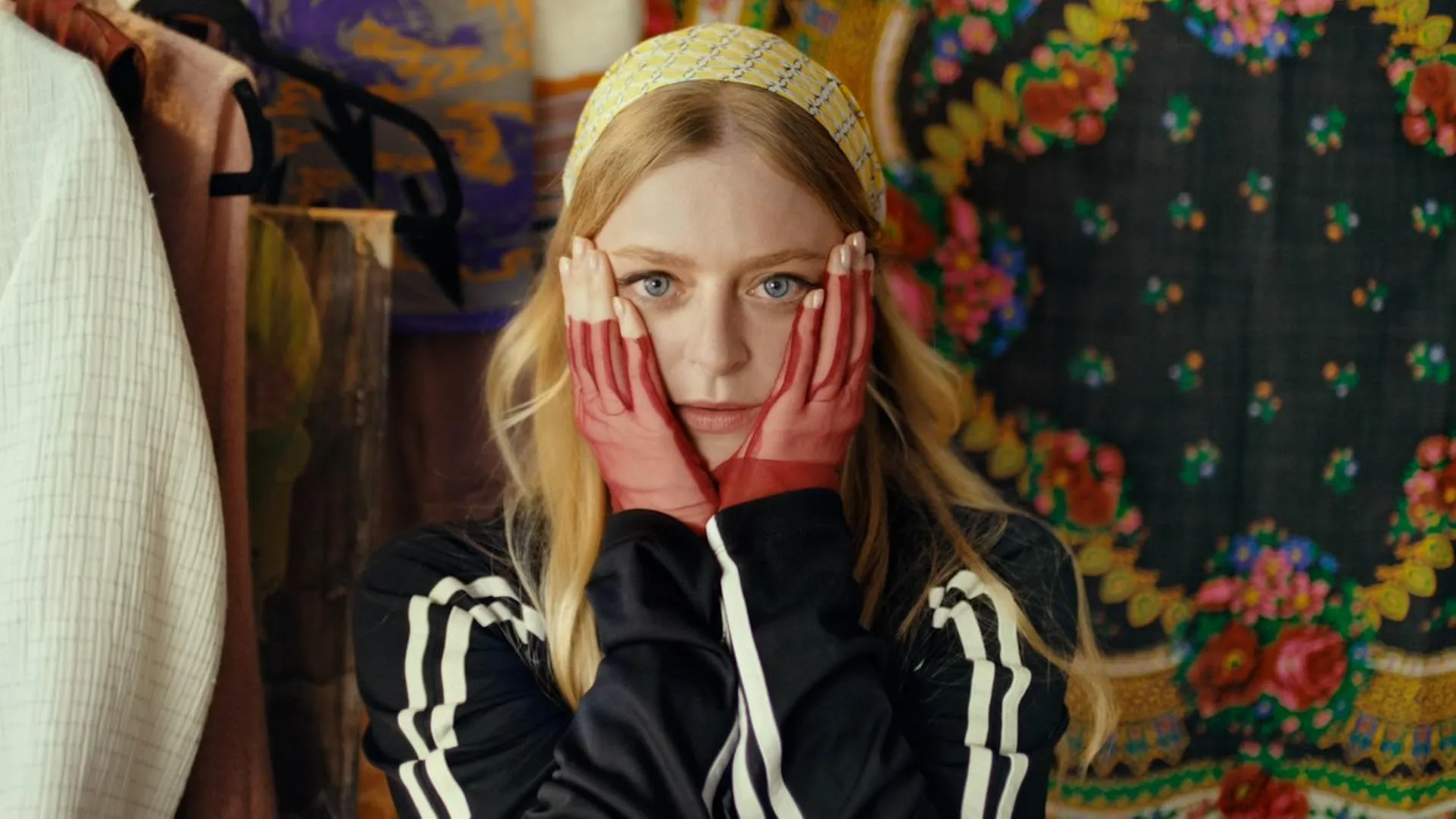

From the moment Margarita Levlansky leans into the camera—fabric scraps strewn around her like battlefield detritus—we sense a collision between yearning and obligation. Here is a second-generation Russian American, sewing machine barely functional, yet bristling with dreams of fashion glory (and rent checks).
Margarita’s West Hollywood apartment feels less like a home than a pressure cooker: grandmother Gita’s colorful demands, father Samuel’s stoic regret over a prison sentence for health-care fraud, brother Nerses’s quiet solidarity. Into this crucible steps Slay, Serve, Survive, a reality-TV gauntlet that values tear-stained backstories over raw talent. Margarita’s ticket in? A video that showcases family chaos rather than couture prowess.
Nastasya Popov makes her debut here, casting Anna Baryshnikov in her first lead role. Popov’s eye for both absurdity and tenderness sets a tone that alternately pinches you with satire and soothes you with family warmth. There’s wit—deadpan at times—but also a recurring question baked into every patchwork dress and confession-booth confession:
Blueprint of Ambition and Exposure
In Act I, we’re invited into Margarita’s world (or what passes for “home” in a cramped West Hollywood flat). Her sewing machine coughs more than it stitches; she survives by peeling designer labels and reattaching them like literary plagiarists swapping bylines. Gita, the grandmother, bursts in with theatrical gusto, while Samuel carries the weight of a medical-fraud conviction—an overlooked footnote in the American Dream manuscript. Nerses hovers at the periphery, a silent witness to family friction. Then Nicol appears via a grainy home-audition tape, spotting “clickbait sorrow” before couture skill.
By Act II, Slay, Serve, Survive unfurls like a carnival mirror: the host’s glittering sneer, judges riffing as if on fast-food reviews (Saweetie and Julia Fox analogues gleefully lampoon themselves). Margarita scrambles under ticking clocks, transforming scraps into sartorial essays—each garment demanding a tear-jerking backstory. Here the film invents its own term, the “authenticity-industrial complex”: a system where suffering is currency and vulnerability, a commodity. Margarita’s creative impulse clashes with Nicol’s directive to mine deeper family drama—an ethical tug-of-war played out in runway gauntlets.
Act III crescendos with a prison-uniform reimagining: orange jumpsuit meets high-fashion deconstruction, a visual manifesto referencing Samuel’s past. The aftermath is familial schism (public pain versus private dignity), forcing Margarita into her final reckoning. Will she sell her narrative or shield her kin?
Throughout, Popov alternates vérité lenses—raw, unpolished confessionals—with slick multi-camera competition montages. The result is a flickering dialectic between spectacle and intimacy, comedy and conscience—an uneasy marriage that feels both discordant and, paradoxically, inevitable.
Spectacle and Substance: Reality’s Mirror
Popov courts discomfort with her portrayal of reality-TV’s “sob-story economy”—an ecosystem where human suffering is auctioned for ratings (and ad dollars). Producers salivate over tear-jerking footage, privileging melodrama above Margarita’s genuine talent. This critique echoes the 19th-century freak-show phenomenon, when spectacle trumped dignity, reminding us that our hunger for voyeurism has deeper roots than we care to admit.
The film hammers home how trauma becomes a consumable product. A confession booth isn’t catharsis here; it’s a sugar-coated trap. Margarita’s vulnerabilities are reframed as “narrative couture,” each thread of family hardship spun into runway-ready drama. Viewers might laugh—dryly—at the absurdity, yet cringe when they recognize their own social-media scroll habits mirrored on screen.
Tension simmers between her off-camera creativity and the on-camera persona she’s coerced to perform. What began as earnest design work mutates under studio lights into a parody of authenticity. There’s a parallel to postmodern art, where the artist’s life eclipses the artwork itself. Here, the art is literally her life.
Against the backdrop of the American Dream, Margarita’s immigrant journey nods toward historical tales of bootstrapped success (think turn-of-the-century garment districts). Yet Samuel’s medical-fraud conviction undermines that myth: systemic barriers lurk behind every promise of opportunity. To then commodify his hardship for a cash prize—a lifeline with a catch—itself becomes a harsh allegory for modern capitalism’s moral compromises.
Popov also scrutinizes artistic integrity versus market logic. Fashion should be personal revelation; instead, it’s reduced to headline-grabbing backstories. The film’s meta-commentary could spark real-world industry introspection: will we champion design skill, or remain fixated on the tear-jerker origin tale?
Family loyalty underpins it all. Intergenerational bonds sustain Margarita but also tether her decisions. Old-World traditions clash with New-World ambitions in every patchwork dress she creates—each stitch carrying ancestral weight. In this tug-of-war, the movie suggests that identity is both a sanctuary and a battleground.
Portraits in Fabric and Flesh
Anna Baryshnikov’s Margarita unfolds like a tension-filled tapestry (one that’s both threadbare and ornate). She begins as a wide-eyed underdog, stitching dreams on a balky machine, and ends as something akin to a self-aware auteur—designer of her own narrative. Baryshnikov toggles between oddball comedy (see her frantic tag-relabeling caper) and unguarded sincerity in near-equal measure. Each patchwork dress she wears acts as sartorial footnote, charting her psyche’s transitions: bright swatches denote hope, muted scraps hint at doubt.
Galina Jovovich’s Gita is the film’s unfiltered impulse—comic catalyst and emotional anchor. When she barges into Margarita’s audition tape demanding “close-up,” it’s not just humor; it’s a demand for agency. In that moment, Gita becomes the engine of “Grandma Realness,” predating and outshining any drag-race cliché. Her exuberance reminds us that truth, however messy, can’t be repackaged without cost.
Mark Ivanir imbues Samuel with palpable gravity. His pride fractures under the weight of a medical-fraud conviction, yet he carries a flicker of hope—like steel under rust. The runway twist that references his prison jumpsuit yields one of the film’s most poignant exchanges: daughter and father, united by exposed vulnerability, share a rare moment of mutual understanding.
Nerses Stamos’s Nerses remains a quiet ledger of morality. He barely speaks, yet his presence compels attention—silent solidarity as a form of protest. There’s narrative potential in his reluctance: might his own creative stirrings become a subplot in a sequel we’d actually want?
Camila Mendes’s Nicol oscillates between mentor and mercenary, coining what I’d call the “compassion-commodity paradox.” Her ice-queen pragmatism masks a shrewd eye for drama, positioning her as both tempter and therapist in Margarita’s moral crucible.
The supporting designers—Jung-soo’s minimalist zeal, Malcolm’s Bauhaus bravado—exist less as fully fleshed people than as satirical doppelgängers, reflecting our genre’s obsession with archetypes. And real-life cameos (a Julia Fox stand-in, a Saweetie riff) elevate the lampoon, reminding us that on their stage, authentic identity is always negotiable.
Symphony of Satire and Sentiment
Nastasya Popov’s debut feels like a cultural heirloom reimagined in neon lights—hers is a personal history grafted onto high-voltage satire. She channels her Russian-American pedigree into scenes that pulse with kinetic energy, then pivots suddenly to hushed, living-room confessions (as if reality-TV and family drama had an uneasy truce).
Editing carries its own heartbeat. One moment, staccato reality-show montages slam into us—rapid cuts, buzzer sounds, applause tracks—then dissolve into wide, lingering shots of Margarita hunched over a sewing machine. The collision underscores a truth about modern life: we sprint through headlines only to crave moments of slow reflection.
Popov leans into reaction shots in confessionals, framing Margarita’s smirk or Gita’s indignant glare with almost anthropological rigor. These glimpses crystallize irony better than any overt gag.
Tone is always on a tightrope. Farce and empathy entwine so closely that you sometimes forget which you’re experiencing. Abrupt shifts can jar—yet they mirror how social media jerks us from meme to memoir in seconds. At its best, this “messy tonal collage” (my coinage) feels eerily apt.
She seduces us with camp, then yanks us back to raw humanity. Self-aware humor—like a wink to the fourth wall—reminds viewers they’re complicit in the spectacle. And complicity, Popov suggests, is the real runway we’re all strutting.
Frames of Function and Fantasy
The Los Angeles flat Margarita shares with her family resembles a couture coffin—tight quarters, peeling wallpaper hinting at rent arrears, and the skeleton of an unfinished house in the background (a visual pun on broken promises). Then the film snaps to the Slay, Serve, Survive soundstage: spotless white floors, neon accents, an industrial-chic playground for manufactured emotion.
Costume designers Natasha Simchowitz and Sophie Kay deserve a medal for Margarita’s “Old World trash and treasure” wardrobe. Every patchwork dress reads like a diary entry—polka-dot scraps beside velvet heirlooms. The judges and fellow contestants, by contrast, sport hyperbolic ensembles: think runway-ready Renaissance fair meets fast-fashion critique. It’s wardrobe as caricature.
Cinematographer Beatriz Aramburo wields two visual languages. Home scenes adopt a hand-held vérité approach: jittery, intimate, as if we’ve trespassed on private life. Competition sequences, in contrast, resemble a multi-camera reality broadcast—slick, rehearsed, blurring the line between candid and constructed.
The color choices amplify the divide: muted sepia tones in familial moments give way to oversaturated primaries under stage lights.
Symbolism thrives in the details. A sewing machine’s close-up becomes a heartbeat—staccato rhythms echo Margarita’s anxious creativity. Mirrors recur (in confessionals and apartment walls), reflecting not just faces but forged personas. In each framed reflection, we glimpse the tension between art made for self and art made for spectacle.
Echoes, Edits, and Ethical Ripples
Sound in Idiotka functions as more than background—it’s a commentary track on authenticity’s theater. Playful piano motifs punctuate design challenges, likening each stitch to a Beethoven scherzo gone rogue. In family scenes, a solitary cello theme weaves through dialogue, evoking 19th-century salon intimacy (the kind Tolstoy might’ve scored if he’d lived to see TikTok).
Diegetic textures—sewing machines’ sputters, camera shutters snapping, audience applause swelling—bridge Margarita’s private world and the spectacle she’s drawn into. These sounds aren’t neutral; they underscore the commodification of personal struggle, much like early radio serials broadcasting real-life tragedies for ratings in the 1930s.
Editing blends bumps and smooth cuts with deliberate unevenness. One moment, reality-show cheers and buzzer blares slam you like a carnival ride; the next, voices in hushed apartments slip in, creating an “audio hangover” (my new term for post-binge disorientation). Transitions can feel abrupt—mirroring how social-media scrolls jolt us from family grief to viral challenge in seconds. Yet that very jolt becomes part of the film’s point: life as a patchwork of sound bites.
These technical choices amplify Idiotka’s central query: at what point does life’s soundtrack become a marketable product? Popov’s debut stakes its claim in conversations about media ethics and immigrant stories, reminding us that every edit, every amplified snare drum, carries cultural weight.
Full Credits
Director: Nastasya Popov
Writers: Nastasya Popov
Producers: Nastasya Popov, Tess Cohen, Camila Mendes, Rachel Matthews, Saba Zerehi
Cast: Anna Baryshnikov, Camila Mendes, Julia Fox, Benito Skinner, Saweetie, Owen Thiele, Galina Jovovich, Mark Ivanir, Nerses Stamos, Ilia Volok, Gabbriette, Zack Bia, Shaun Brown, Jake Choi, Marcelo Tubert, Gigi Zumbado
Director of Photography (Cinematographer): Kristen Correll
Editors: Taylor Mason, Rob Paglia
Composer: Ian Hultquist
The Review
Idiotka
Nastasya Popov’s Idiotka marries biting critique of reality entertainment with genuine family warmth, its uneven rhythms reflecting our own media‐saturated lives. The energetic satire and heartfelt performances (especially Baryshnikov’s) make for a compelling debut, even if tonal shifts sometimes jar. It’s a promising new voice in independent cinema.
PROS
- Sharp satire of reality-TV mechanics
- Genuine warmth in family interactions
- Anna Baryshnikov’s layered lead performance
- Costume design that mirrors Margarita’s inner life
- Inventive blend of vérité and studio cinematography
CONS
- Abrupt tonal shifts can be jarring
- Several supporting characters feel sketch-like
- Pacing wobbles in the second half
- Satirical edge softens as the drama deepens
- Subplots get shortchanged by the 82-minute runtime