





















Andre Gaines’s The Dutchman unfolds like a ghost story pressed into modern steel—an adaptation of Amiri Baraka’s incendiary 1964 play that pulses with new urgency. On screen, the legend of a doomed encounter surfaces in jerking subway lights and hushed therapy rooms, directed with a fierce intimacy that feels both ritualistic and raw.
This is a psychological thriller possessed by surreal echoes. Gaines drapes each scene in a film‑noir palette: cold steel grays of the train car, sudden crimson of an apple, and fleeting glimmers of a Harlem fundraiser. Yet the true menace resides in the mind. The narrative slips between reality and dream, haunted by whispers of ancient racial wounds and private betrayals, as if the past tugs at every frame.
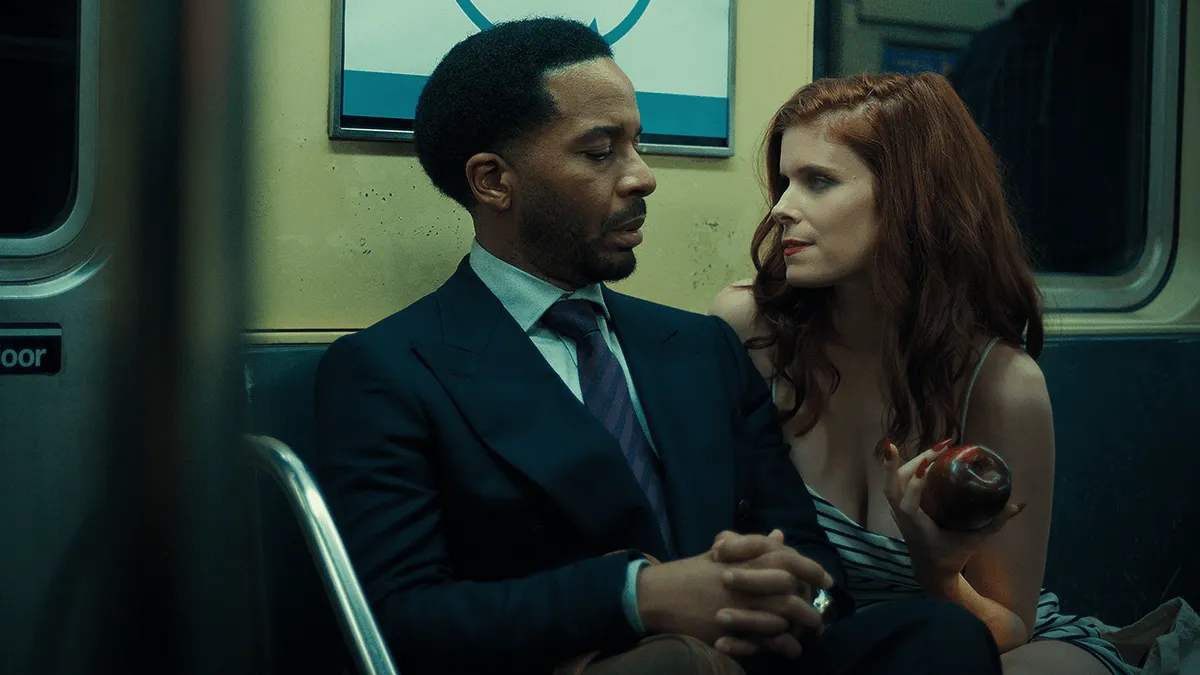
At its heart stands Clay (André Holland), a Black businessman whose marriage to Kaya (Zazie Beetz) teeters on the brink. Their couple’s therapy session opens the fissure, laying bare his distrust and her wounded candor. Into this breach steps Lula (Kate Mara), a white stranger who disturbs his carefully curated world. She carries an apple—the fruit of temptation—and a promise of ruin.
What follows is an evening‑long spiral: Clay’s resolve tested on rattling tracks, in shadow‑drenched apartments, and finally among the glittering congregation of his own community. Every encounter drips with philosophical tension—who claims ownership of another’s soul?—while the film’s meta‑narrative slyly reminds us that art can both foretell and imprison.
Heading: Recasting a Ghost on Modern Tracks
Andre Gaines undertakes an act of resurrection, summoning Amiri Baraka’s Dutchman—a 1964 one‑act that detonated norms within the Black Arts Movement. In its original form, two figures in a subway car grappled with white‑Black power, their terse dialogue laced with contempt and confession. That landmark shock still crackles, an incision in the era’s polite narratives.
Why return to this train? The film insists that history’s collisions repeat: Civil Rights and Black Power gave way to Black Lives Matter, yet the undercurrents of violence and alienation persist. Gaines reopens the wound, shifting scenes above ground—from rattling railcars to the night‑lit streets and glittering Harlem gatherings—so that Baraka’s pressure‑cooked tension can breathe in a world of smartphones and stalled promises.
At the eye of this reinvention lies a story‑within‑a‑story. In couples therapy, Clay is handed a copy of Dutchman and told to literally read his fate. That meta twist unsettles expectations: the play haunts the characters as much as their own selves. We watch men and women forced to reconcile art’s prophecy with personal agency, and wonder whether free will is ever more than a fleeting collision between pages and flesh.
Gaines expands the canvas. Where Baraka confined us to two voices, here Kaya’s wounded honesty, Dr. Amiri’s eerily calm prescriptions, and Warren’s political fervor thicken the plot. Economic dreams of Harlem revival collide with the specter of racial trauma. Yet each addition risks softening Baraka’s edge—therapy rooms threaten to translate metaphor into lecture, and a fundraiser scene veers toward spectacle rather than grit.
Still, certain reinventions sing. Lula’s apple becomes a living symbol of forbidden knowledge; shifting backgrounds echo Clay’s fracturing mind. When the film lets its silences speak—camera lingering on a trembling hand or distant subway rumble—it taps the same raw nerve Baraka first exposed. Other moments strain under self‑aware weight, as if the adaptation hesitates between homage and reinvention, never fully certain which path to claim.
Echoes of Dread in Motion
The film opens in a cramped therapy room where Clay’s silence speaks volumes. His shoulders slump beneath Kaya’s accusation of betrayal, every pause thick with unspoken grief. The air feels electric, as if their words might shatter the thin glass between honesty and self‑deception.
Then comes the subway car, a space both mundane and menacing. Lula appears like a specter, dragging Clay into her orbit with a single “Hello” and the glint of a red apple. That fruit hovers between Eden’s promise and damnation, a quiet herald of the violence to come.
Their conversation crackles, alternately teasing and savage. Time fractures: a glance stretches into eternity, then snaps away. Camera angles cut off Clay’s view of the tracks, disorienting us as if we, too, might step into an abyss on the next train. Sudden jarring sounds—metal screech, a heartbeat‑thud—jolt you out of complacency.
By the midpoint, the ride detours to Lula’s apartment. Walls close in, shadows pool. She whispers a threat: a false claim that could ruin him. His panic is a storm—mind racing, memories colliding—showing how easily power can invert in the shape of prejudice.
At the Harlem fundraiser, masks fall. Clay stands under warm light but feels colder than ever. Faces blur into a crowd hungry for spectacle. Lula prowls the edges, exposing his private terror on a public stage. The scene crescendos in tight close‑ups of Clay’s petrified eyes, as if asking: who observes the observer?
When the final notes fade, Clay’s fate hangs in limbo. The film refuses tidy resolution, echoing Baraka’s original fatalism. Dreamlike passages drift back—train wheels clattering in the distance, the apple’s red glow—a reminder that some journeys loop endlessly.
Pacing lurches between taut urgency and languid reflection. Moments of stillness hold their breath, then shatter into rapid montage. At times the rhythm nearly stalls, trapped by its own meticulous dread, but those silences can cut deepest, leaving you suspended between dread and revelation.
Specters Worn in Flesh
Clay moves through this world like a man half‑awake, his rigid composure fracturing under pressure. Holland’s gaze—steady, then quivering—betrays an inner schism reminiscent of Du Bois’s double consciousness: a soul split between his public ambition and private grief. In subtle shifts—a clenched jaw, an inhale held too long—he suggests a mind perpetually at war with itself. His restraint carries the weight of existential dread, as if every unspoken thought could topple his carefully erected façade.
Lula drifts into Clay’s orbit like a dark comet, brilliant yet perilous. Mara’s voice slides between sweet invitation and veiled threat, a cadence that unsettles trust. The red apple she brandishes becomes a talisman of forbidden knowledge, its glossy skin reflecting societal taboos and mortal temptation. Her movements are calculated poetry: a foot placed just so, a smile edged with malice. In her presence, power shifts—colors bleed, and Clay’s equilibrium dissolves.
Kaya’s honesty cuts sharp. Beetz imbues her with raw immediacy, her confession of infidelity both confession and challenge. She stands as the catalyst who shatters Clay’s illusion of control, forcing him to confront emotional abysses he’d long ignored. Her pain is tangible, a mirror showing us how love can wound and reshape identity.
Dr. Amiri presides with measured calm, an oracle whose counsel both soothes and unnerves. Henderson layers gravitas with a sly undertone of menace—his questions feel like philosophical traps. When he hands Clay the play, the gesture blurs therapy into prophecy, mindscapes bleeding into myth.
Warren (Aldis Hodge) embodies the promise of collective uplift, his political fervor underscoring Clay’s isolation. Each supporting figure—friends at the fundraiser, strangers on the street—echoes Clay’s fractured psyche, amplifying the sense that every relationship is a mirror reflecting his deepest fears. In this constellation of performances, identity becomes a haunted house, every room revealing a new specter of the self.
The Alchemy of Sight and Sound
Frank G. DeMarco’s lens traps the viewer in a shifting realm of confinement and release. In the subway car and Lula’s apartment, frames feel compressed—as though walls inch closer with each heartbeat—while exterior shots of Harlem’s streets and the fundraiser exhale in expansive long takes. Mirrors and shards of glass multiply Clay’s reflection, fracturing his identity into uneasy fragments. Off‑axis compositions tilt the world sideways, evoking the vertigo of sudden insight or impending collapse. When the palette drifts from the subway’s icy blues to the warm glow of lamplit gatherings, it marks an emotional temperature change: dread crystallizing into social theater.
Every set pulses with paradox. The subway car is built with uncanny precision—rattling handrails, worn seats textured by anonymous journeys—yet background elements subtly warp, as if the world itself breathes. The party venue, unspecific in era, blankets us in a timeless ambiance. Here, laughter and polished attire feel like a veneer over unspoken fears.
Editing threads together the film’s psychic geography. Suspense scenes snap forward in staccato bursts, heightening each startled glance. Then sequences stretch out: a lingering close‑up on Clay’s clenched hand, the needle of his anxiety visible in the tremor. Jump cuts slice through narrative continuity, pulling us into a dream logic where time loops back on itself. These abrupt ruptures suggest that memory and trauma cannot be neatly ordered.
Daniel Hart’s score hums with low‑frequency drones, a sonic undercurrent of existential unease. A ticking‑clock motif resurfaces, each click a reminder that reckoning approaches. City sounds—train wheels clattering, distant sirens—spill into the mix and then vanish, leaving pregnant silence. When Lula enters a space, we sense her power before she speaks: a sudden shift in ambient noise, as though the air itself recognizes her threat. Sound becomes a specter, guiding our fear as Clay’s psyche unravels.
Mirrors of Power and Prophecy
From 1964’s austere subway confrontation to Gaines’s expanded streetscape, the script insists that white‑Black tensions are not relics but ever‑present hauntings. Lula embodies both exotic allure and systemic threat, her very existence a reminder that Black bodies have long been objectified, weaponized, and feared. The collision of her predatory grace with Clay’s measured restraint lays bare the persistence of racial violence beneath the veneer of progress.
This film speaks in self‑referential whispers. By placing Baraka’s play in Clay’s therapist’s hands, Gaines turns art into a prophecy—its lines not merely spoken but enacted in real time. The “play within a play” makes every viewer complicit, watching Clay wrestle forces both personal and historical, as if our own gaze might tip the scales of his fate.
Clay’s struggle became a crucible of self‑knowledge. As shame and anger coalesce, his silence fractures, exposing hidden fissures of identity. Therapy scenes oscillate between sanctuary and interrogation, asking whether healing emerges from self‑directed insight or from the coercion of another’s interpretation.
Throughout, the question of agency looms. Does Clay choose his actions, or is he a specter bound by ancestral trajectories? The myth of the Flying Dutchman lingers: an eternal wanderer doomed by ancient tides. In this retelling, racial trauma repeats like waves, pulling Clay deeper even as he strives to break the current.
Symbols thread through every frame. The red apple glows with Edenic promise and forbidden knowledge, its sheen reflecting both temptation and condemnation. The train itself becomes a threshold—a place where past and future collide in the dark. Mirrors splinter Clay’s image into shards, each fragment a version of himself at odds with another. In these moments, the film asks whether identity is ever whole, or always a collection of fractured selves.
Echoes and Fractures
Gaines’s first foray into narrative filmmaking pulses with ambition even as it buckles under its own self‑awareness. André Holland delivers a performance of rare intensity, each micro‑expression a window into Clay’s crumbling resolve and his struggle with power and alienation. Frank G. DeMarco’s restless framing and Daniel Hart’s droning undercurrent showcase technical bravado that elevates every moment to a near‑mythic state. Beneath the shifting mise‑en‑scène, questions of race and identity echo like reverberations in an empty station.
At times the script over‑translates its symbolism—therapy sessions edge toward lecture, and detours into side characters dilute the central tension. Yet those who savor layered allegory and existential probes will find the film’s poetic darkness deeply rewarding. Theater aficionados and introspective viewers may embrace its philosophical depth. Fans of lean, conventional thrillers might feel adrift amid its self‑referential turns, lingering ambiguity, and uneven pacing that sometimes stalls the narrative’s urgent drive.
Serving as both tribute and warning, The Dutchman reveals that adaptation demands a delicate balance between fidelity and invention. Here, Baraka’s original fire coexists with Gaines’s bold vision, flanked by moments of brilliance and rough edges. Its uneven contours remind us that homage can fracture the source as much as it honors it. This film proves both the power and peril inherent in reimagining a classic.
Full Credits
Director: Andre Gaines
Writers: Amiri Baraka (original play), Qasim Basir, Andre Gaines
Producers: Jonathan T. Baker, Andre Gaines, Peter Graham
Executive Producers: Joshua Blum, Cassian Elwes, Devon Libran, Han West, Matt Rachamkin
Cast: André Holland, Kate Mara, Zazie Beetz, Stephen McKinley Henderson, Aldis Hodge, Lauren E. Banks, Lenny Platt
Director of Photography: Frank G. DeMarco
Editor: Joel Viertel
Composer: Daniel Hart
The Review
The Dutchman
The Dutchman conjures a haunting meditation on race and identity, powered by Holland’s taut performance and striking visuals, yet occasionally undone by over‑literal detours and uneven pacing. Its poetic ambitions and existential tremors reward those willing to embrace its disquiet, even as it falters in balancing homage with narrative drive.
PROS
- André Holland’s deeply resonant, micro‑nuanced performance
- Striking cinematography and sound design that heighten suspense
- Layered existential themes probing race, identity, and agency
- Inventive meta‑narrative framing that unsettles and provokes
CONS
- Occasional over‑explanation in therapy and subplot scenes
- Uneven pacing that stalls momentum in key moments
- Meta elements sometimes dilute raw emotional impact
- Expanded cast can distract from the central tension