






The film opens on a scorched horizon—an American warship’s experimental detonation off Tasmania triggers an EMP so powerful it halts half a million hearts (and brains) in an instant. In this bleak tableau, a handful of the dead “reboot” as vacant automatons: flesh-and-blood husks, occasionally lashing out with wordless violence.
Enter Ava Newman, a former physiotherapist turned volunteer in the Body Retrieval Unit. Her mission: navigate suburban ruins and bushland gravesites in search of her husband, Mitch. Alongside Clay, a leather-jacketed local with a taste for profanity (“Dead cunt goes here,” he quips), Ava traverses fire-scorched roads and quiet, debris-strewn homes. Later, the unsettling kindness of soldier Riley complicates her journey, raising questions of grief and human fallibility.
At once meditative and menacing, the film glues contemplative silences to sudden jolts of horror. You might call it a “grief-horror hybrid”—a term you’ll bookmark for pub quizzes. The narrative leans into ethical limbo: when does personhood end? And who gets to decide?
Tasmania’s rugged coastlines and verdant forests, now ashen and abandoned, frame this drama. Interiors feel intimate and hollow (a child’s tricycle among toppled furniture). The contrast between serene natural beauty and the mechanical brutality of the dead underscores a familiar historical irony: modernity’s greatest advances mirroring its darkest catastrophes.
Clockwork Cadence: Structure & Pulse
The film’s architecture unfolds in three clear movements—each one a swing of the pendulum between reflection and adrenaline. In Act I, catastrophe is introduced with clinical precision (think wartime dispatch, minus journalists). Ava’s recruitment into the Body Retrieval Unit feels procedural: paperwork, checkpoints, a flurry of sterile flares against Tasmania’s blackened horizon. These opening minutes hum with a bureaucratic dread that echoes real-world disasters—nuclear test cover-ups, pandemic task forces fumbling through statistics.
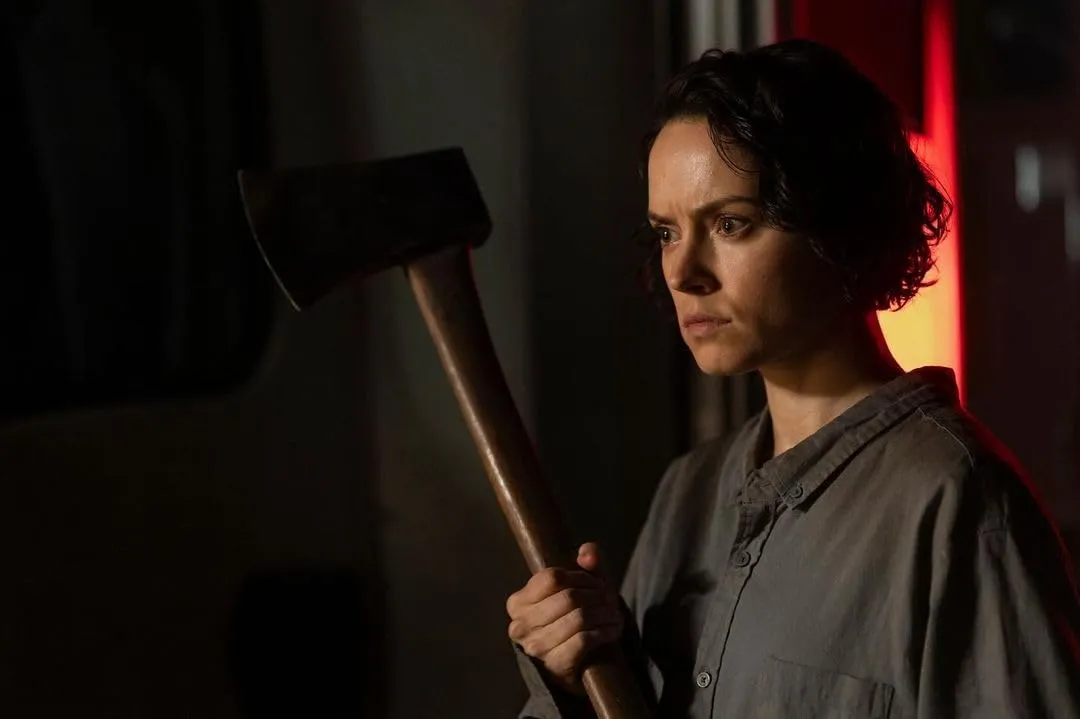
Act II loosens the screws. The southern trek grows thornier: undead sightings escalate from curious stares to flesh-rending lunges. Flashbacks surface here and there—moments with Mitch that hover like half-remembered dreams. Their timing can be frustratingly sparse, offering just enough context to raise questions about guilt and longing, but not always enough to answer them. (Yes, sometimes I wanted more than breadcrumbs.)
Then comes Act III: Riley’s intervention shatters the rhythm. What began as a quête for closure morphs into a confrontation with grief-stricken obsession. The final approach to the resort—the film’s climactic coda—unspools with a provocative tilt so sudden you’ll blink.
Quiet sequences linger—Ava alone in a living room, the only sound a distant drone. Then: a crash cut, a moan, and you’re sprinting again. The early scenes drag their feet (grief moves slowly), but once the undead bite choreography kicks in, the pace races. Traditional zombie set pieces arrive like familiar ghosts, pulling against the film’s more meditative heartbeat. Paradoxical, yes, but it’s this push-pull that gives the narrative its peculiar momentum.
Vestiges of Humanity: Grief, Ethics, and Memory
Ava’s quest isn’t fueled by survival instincts alone but by a tangle of love, guilt, and things left unsaid. The film treats unfinished business like a haunting currency—both the living and the undead haunted by obligations they can’t settle. (Call it “remainder grief syndrome.”)

When the dead reboot, they become silent witnesses: heads cocked, eyes vacant, jaws grinding in a grotesque vice. Are these beings still “people”? The camera lingers on them as if seeking traces of identity, only to be rebuffed by their base, violent impulses. It poses an ethical Rubicon: shoot first, ask questions never.
The bureaucratic machinery behind the catastrophe feels ripped from real headlines—cold protocols echoing nuclear cover-ups or flawed pandemic responses. A U.S. weapon test becomes scapegoat and excuse; Australian forces enforce brutal efficiency. Civilians bear the brunt, reminding us that ordinary people always pay for strategic blunders.
Yet the living prove no less hazardous. Clay’s rough humor masks self-preservation; Riley’s compassion curdles into obsession. Power under the pretext of “helping” mutates into something darker—a microcosm of how authority can exploit grief for control.
Memory and identity fracture like shattered glass. Zombies flicker between blank automatons and ghostly echoes of their former selves—an uncanny parallel to dementia’s mercurial clarity. In this landscape, “life” becomes a slippery concept: is it breath, blink, or the sum of our unfinished stories?
The film doesn’t hand you answers. Instead, it invites you to wrestle with the raw mechanics of loss—and that’s unsettlingly refreshing.
Portraits in a Fallout
Daisy Ridley’s Ava Newman navigates grief with the precision of a surgeon—fingers almost brushing a corpse’s cheek before she fires. Controlled desperation (a dance of clenched jaws and damp eyes) defines her. Ridley’s accent wavers—sometimes a slip, sometimes riveting—but it’s her silences that speak volumes.

Brenton Thwaites’s Clay storms into the frame like a guerrilla poet—motorcycle engine rumbling, one-liners sharper than shrapnel. He’s the foil to Ava’s restraint, the dark humor that cracks tension. Yet his loyalty feels opportunistic at times, as if trauma is his game and companionship mere collateral.
Mark Coles Smith’s Riley arrives with soldierly kindness—think humanitarian impulse gone haywire. His descent into grief-fueled madness evokes real-world PTSD nightmares, adding a tragically human carnage layer that outstrips even the undead. The moment he saves Ava, mask of empathy slipping—that’s your gut punch.
Secondary figures flicker in and out: a civilian clutching a child’s diary, a captain barking orders through a megaphone. Each leaves an impression of lives fragmented by policy and pulse. Military officers, all clipped language and rigid postures, recall Cold War drills—sterile commands drowning out personal loss.
Together, this ensemble forms a fractured mirror of society under catastrophe. Tension crackles between them—not just survivor’s guilt, but the friction of unspoken questions: Who deserves mercy? Who writes the history of disasters?
Performance synergy here is paradoxical: organic yet choreographed, raw yet meticulous. In their interplay, the film finds its emotional heartbeat—one that might just echo in our collective conscience.
Canvas of Collapse
Tasmania’s rugged coastline unfurls in sweeping aerials—beauty and doom entwined (think paradise lost, viewed from a drone’s indifferent eye). Aerial shots drift over jagged peaks, then plunge into the rusted frame of a school bus turned labyrinth of terror. In these vistas, nature’s grandeur becomes the stage for human folly.

Inside shattered homes, debris tells stories more eloquent than dialogue. A toppled crib, a wedding photo half-buried in ash—each tableau echoes real-world crises, from wildfire refugees to warzone ruins. Military checkpoints, ringed with razor wire and flares, resemble Cold War relics—aesthetic borrowed from history’s flashpoints.
Palette and light operate in uneasy harmony. Muted grays bleed into charred ochres; smoky skies press down like collective guilt. When flares bloom, they carve ghostly halos around corpses—soldiers’ flares or funeral candles, you decide. Flashlights reveal choking dust motes, transforming silence into a visible presence.
Camera movement is a dialect of urgency and stillness. Static wide shots linger on empty corridors—holding a breath before the next gasp. Slow tracks follow Ava’s retrievals, each step measured, as if weighty with moral consequence. Then, in undead encounters, handheld jostle and swooping drone create “panic-cam” immediacy (a term I’m filing under postmodern horror).
Symbolism seeps through the visuals: veiny, purple corpses mirror ecological decay; close-ups of grinding teeth become auditory afterimages. Wildlife carcasses along the road—kangaroos frozen mid-bound—underscore death’s indifferent sweep. Here, cinematography doesn’t just capture a story; it interrogates our complicit gaze.
Sonic Echoes of Oblivion
Chris Clark’s score often functions less like background music and more like an invisible narrator—an aural ghost whispering through silent tableaux. Sparse piano motifs reemerge in hushed refrains, tracing Ava’s grief (what I call “melancholy leitmotifs”). When the score swells, it does so with almost tragic restraint, underscoring key revelations rather than drowning them out.

The teeth-gnashing of the undead becomes the film’s unsettling signature. Those skittering, enamel-on-enamel shrieks could be mistaken for industrial machinery—an auditory reminder of factory-line death (echoes of wartime propaganda films, perhaps). After the EMP pulse, you’ll notice sudden audio dropouts: distant echoes one moment, nothing the next. That jarring void captures the film’s existential blackout.
Silence isn’t merely absence of sound; it’s a tactical device. Long stretches of quiet force attention inward—to character breaths, to the rustle of a corpse’s sleeve. Then, out of nowhere, a single guttural moan or metallic clang jolts the senses. It’s the sonic equivalent of hiding behind a door and having someone slam it open.
Layered within are environmental whispers: wind whistles through broken windows; distant fires crackle like suppressed outrage; military vehicles rumble, hinting at impersonal state power. Clark and sound designer Duncan Campbell bathe these elements in distortion and reverb, conjuring what I’d call “psychoacoustic haze”—a dreamlike tension that blurs memory and menace.
Audio cues shape the film’s heartbeat. A soft pulse might signal introspection; an abrupt shriek, the arrival of chaos. In weaving reflective drama and sudden horror, the sound design becomes its own unpaid character—haunting, essential, and eerily persuasive.
Final Reckonings: Power Plays and Missteps
The film earns its stripes with a genuinely fresh spin on zombie mechanics—an EMP-triggered outbreak (no moldy virus clichés here) and sporadic reanimation stages that feel less rote and more unpredictable. Moments of raw pathos lodge in the mind: Ava’s first corpse encounter, vacant eyes meeting hers in a silent standoff; Riley’s spiral from savior to threat, a performance that etches grief into flesh. And who could forget the bird’s-eye bus chase, which transforms a rusted vehicle into a claustrophobic labyrinth?
Yet the movie isn’t without its stumbles. Just when you’re admiring its novel setup, it lurches back into familiar territory—biting zombies that obey no clear contagion logic, as though genre habit kicked in mid-script. Philosophical musings hover tantalizingly close to profundity but sometimes slip into vagueness—big ideas dangling like loose wires. And that final coda? Ambitious, yes, but its provocations risk dissolving into muddle.
Still, the film’s mood—haunting, at times almost reverent—lingers. Ridley’s muted desperation, Thwaites’s off-kilter humor, the score’s ghostlike echoes: together, they forge an experience that’s equal parts reflective drama and jolting horror.
Viewers craving a character-driven twist on undead lore will find much to dissect here. It slots neatly alongside somber entries like Train to Busan or pandemic allegories of the past decade. A piece that unsettles as often as it intrigues—one you’ll revisit when pondering what it really means to bury not just bodies, but memories.
Full Credits
Director: Zak Hilditch
Writer: Zak Hilditch
Producers: Kelvin Munro, Grant Sputore, Ross M. Dinerstein, Joshua Harris, Mark Fasano
Executive Producers: Nathan Klingher, Ford Corbett, Ari Harrison, Jeff Harrison, Nicholas Erickson, Sean Fannan, D.J. Jiang, Ari Novak, Jeff Rice
Cast: Daisy Ridley, Brenton Thwaites, Mark Coles Smith, Matt Whelan, Kym Jackson, Deanna Cooney, Holly Hargreaves
Director of Photography (Cinematographer): Steve Annis
Editor: Merlin Eden
Composer: Clark (Chris Clark)
The Review
We Bury the Dead
We Bury the Dead stakes out a haunting middle ground between meditative grief drama and pulse-pounding horror, anchored by Ridley’s muted desperation, Thwaites’s dark levity, and a soundscape that feels alive. Its novel EMP premise and moments of genuine pathos outweigh occasional lapses into zombie-movie convention and a finale that trips over its own ambition.
PROS
- Innovative EMP-based zombie premise
- Haunting moments of pathos (first corpse encounter, Riley’s arc)
- Strong lead and supporting performances
- Striking Tasmanian landscapes and production design
- Rich soundscape that heightens mood
CONS
- Occasional retreat into familiar zombie clichés
- Unexplained undead bite mechanics
- Philosophical beats sometimes feel underdeveloped
- Finale’s provocative twist can confuse