





























War is the dissolution of maps, the erasure of lines we draw to make sense of the world. In the first moments of Russia’s 2022 invasion, such lines vanished around Kharkiv, and in their place, a raw, undefined space of violence emerged.
Here sat Feldman Ecopark, a human attempt to impose order on nature, a curated wilderness with 5,000 animal souls. Suddenly, this sanctuary became a prison twice over. Its fences, once for containment, were now an impassable ring of fire.
The animals, already captive to our curiosity, found themselves captive to our wrath, trapped in the crossfire of a conflict they could not comprehend. A small group of people looked upon this absurdity and chose to act.
An Unreasonable Devotion
What compels a person to run toward a fire that is not their own, to affirm life in a space consecrated to death? The film offers no easy answers, only portraits of an unreasonable, perhaps sublime, devotion. We watch the park’s founder, Oleksandr Feldman, a man who built a private Eden, now face its desecration. His response is not to flee but to deepen his responsibility.
He transforms his own palatial home into a chaotic ark, a desperate microcosm of order against the deluge. Is he preserving the animals, or is he preserving the last remnant of his own power to create in a world bent on unmaking? The film allows the question to linger. His few remaining employees mirror this strange fidelity. Their bond with the animals seems to be a silent pact, a relationship that exists outside the corrupting influence of human language and its wars.
They stay not for a salary, but for a shared, unspoken understanding. Then come the young volunteers, led by veterinarian student Tymofii Kharchenko. Theirs is the courage of the un-jaded, an almost naive impulse to do something against the overwhelming force of annihilation. Their phone cameras become weapons of witness, crafting a counter-narrative to the official story of destruction.
Yet this devotion demands a blood price. The mission claims six human lives. In one moment of terrible, poetic irony, a keeper is killed by the lion he fed for years, its wildness finally broken by the sound of bombs. The man is consumed by the very chaos he sought to soothe, a chilling metaphor for a world where all pacts are rendered void.
A Symphony of Madness
The park itself becomes a landscape of surreal horror, a garden of shrapnel where the only thing that blooms is ruin. The evacuation unfolds not as a plan but as a frantic, desperate performance on this stage. Here, the animal mind, a thing of pure instinct, is forced to confront the apex of human irrationality. Their terror is a clean, honest reflection of the surrounding insanity.
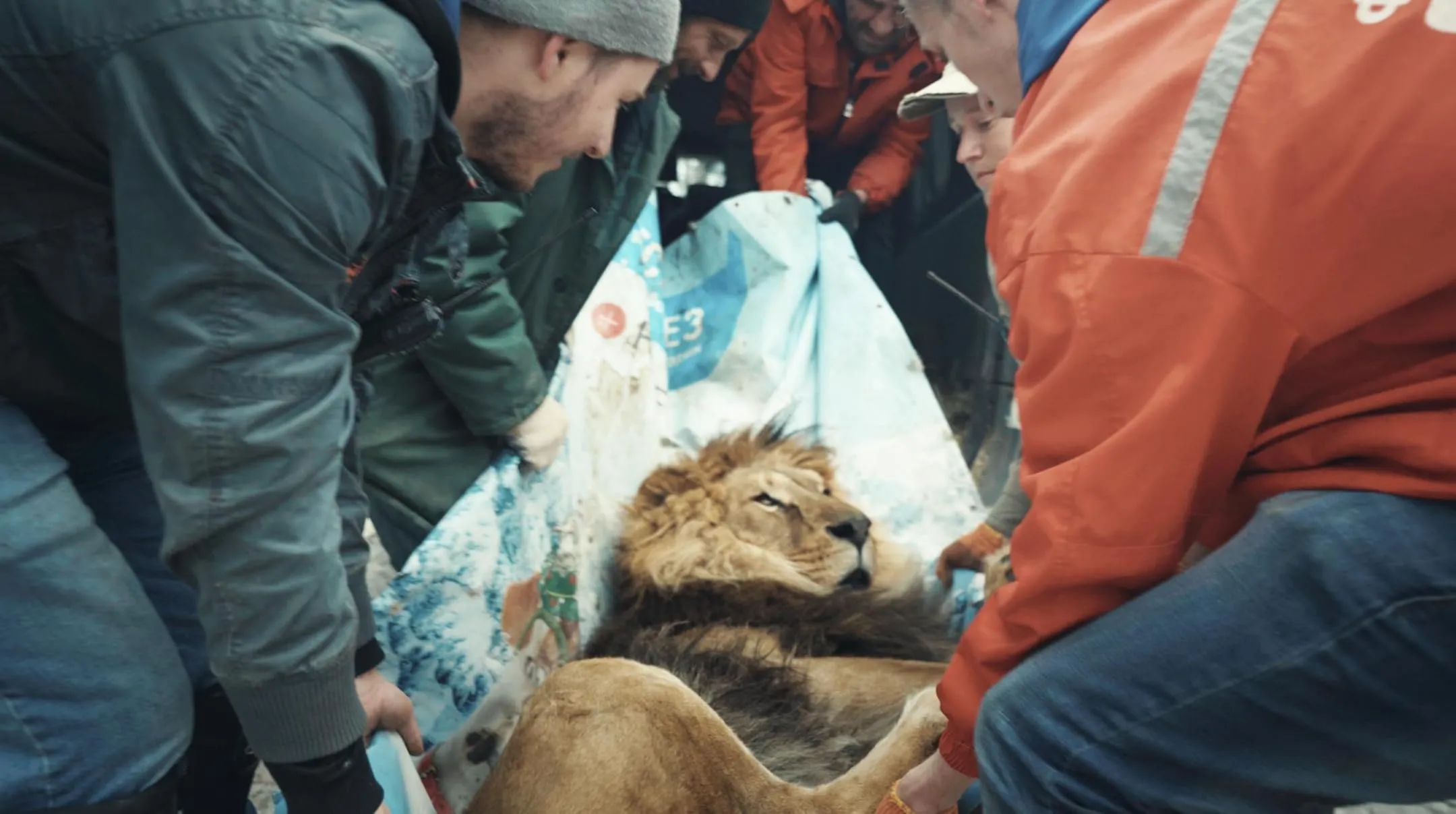
The film’s soundscape is a discordant symphony: the percussive blast of artillery shells answered by a chorus of panicked animal cries. Monkeys, their hearts literally giving out from the stress of the ceaseless noise, become silent casualties. Against this backdrop, the rescuers move through a fever dream. The challenge is not just logistical; it is existential. Sedating a bear or chasing a zebra while the sky falls feels less like a rescue and more like a ritual performed against the void.
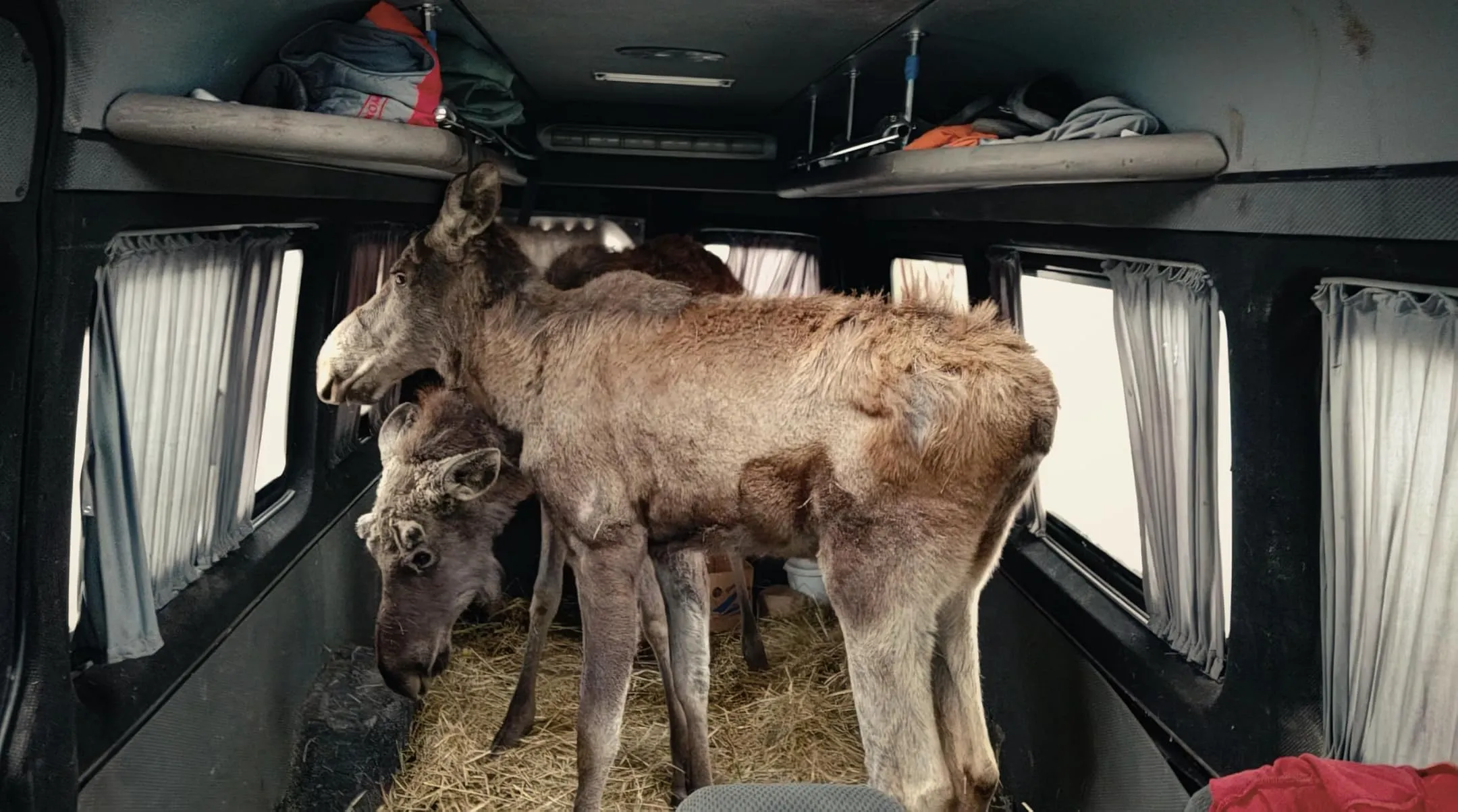
These scenes are punctuated by a grim, almost Beckett-like absurdity. Kangaroos stare blankly from the back of a van, creatures of the vast plain confined to a steel box, displaced from a world that no longer exists.
A tapir, an animal of ancient shyness, is led gently by the hand through the rubble—an act of trust so profound in a world of total betrayal that it feels both miraculous and insane. This is not levity. It is the complete breakdown of category and reason, a glimpse into a world where all definitions have failed. The phone footage captures this madness, projecting it outward as a plea for witness from the heart of the abyss.
The Cruelty and the Camera
The film is built from two distinct visual textures, two ways of seeing that create a disquieting whole. One is the raw, trembling view of a phone camera, the perspective of the body—intimate, subjective, claustrophobic. This is the truth of the trembling hand.
The other is the cold, sweeping gaze of a drone, the eye of an indifferent god observing the geometric patterns of ruin from a safe distance. This is the truth of the blueprint. The film forces the viewer to oscillate between these two modes, between feeling the terror and knowing the totality of the destruction. It becomes a moral artifact, a document that stages an ancient philosophical argument on a modern battlefield. It presents the starkest possible choice.
The act of rescue, of risking a human life for that of a wolf or a turtle, is an existential affirmation. It is a defiant declaration that life, any life, has a meaning that transcends circumstance. Then the film shows us the inverse, the other pole of human capacity: Russian soldiers methodically executing the small, tame creatures of a petting zoo.
This is not an act of war; it serves no strategic purpose. It is an act of pure nihilism, a violence that exists only to announce its own power to unmake. The film holds these two images before us—the hand that shelters and the hand that kills—and asks a silent, searing question about the nature of our species.
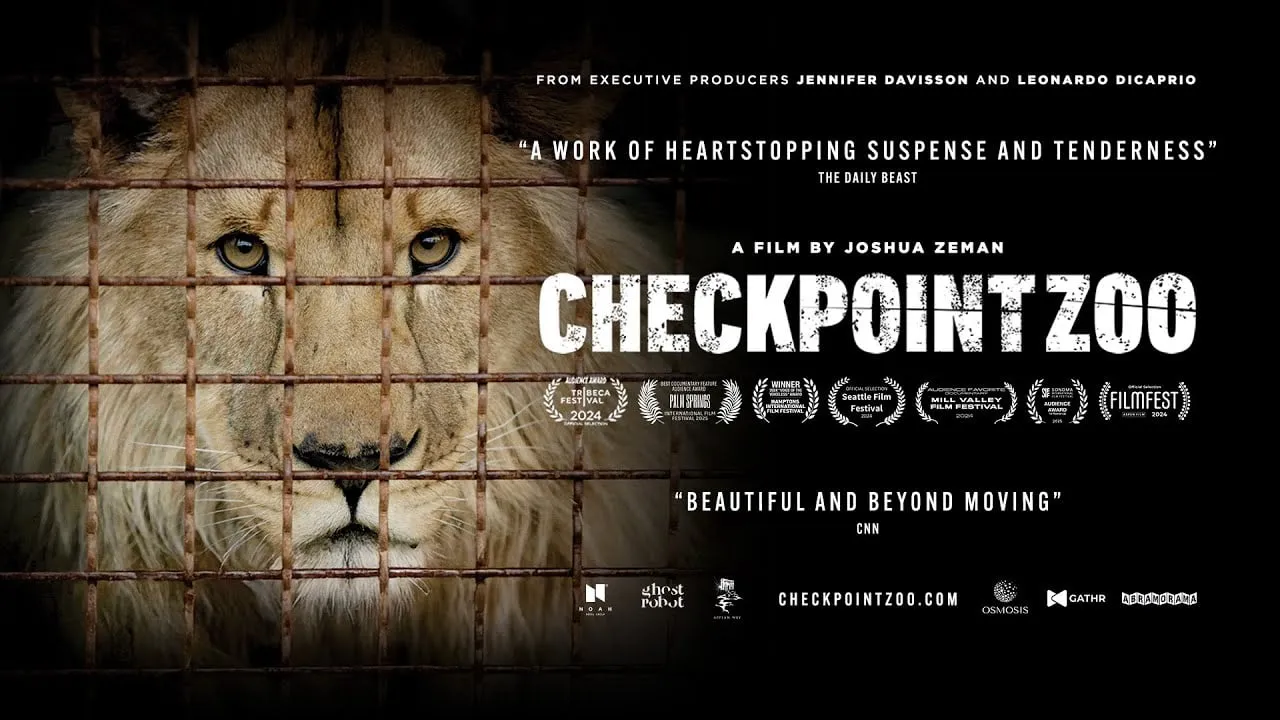
Checkpoint Zoo premiered at the Tribeca Film Festival on June 6, 2024, and will have a limited theatrical release starting on August 15, 2025.
Full Credits
Director: Joshua Zeman
Writers: Joshua Zeman, Daniel Lonsbury
Producers: Zachary Mortensen, Joshua Zeman, Ian Davies, Torquil Jones
Executive Producers: Shawn Singh, Barry Smith, Catherine Quantschnigg, Gabriel Clarke, John McKenna, Caitlin Colford, Leonardo DiCaprio, Bonamy Grimes, Jennifer Davisson, Phillip Watson
Cast: Oleksandr Feldman, Vadym Vorotynskyy, Vitalii Ilchenko, Svitlana Vyshnevetska, Andrii Tyvaniuk, Vitalii Sevelin
Director of Photography (Cinematographer): Nelson Hume, Olivier Sarbil
Editors: Cy Christiansen, Andrew Ford, Kelly Kendrick, Daniel Lonsbury
Composer: Anne Nikitin
The Review
Checkpoint Zoo
"Checkpoint Zoo" is not a film that offers comfort; it offers a profound and disturbing truth. It is a harrowing, essential document of human nature pushed to its absolute extremes. The film serves as a merciless mirror, reflecting both our capacity for a defiant, almost holy compassion and our devastating talent for nihilistic cruelty. It is a difficult, demanding, and unforgettable piece of cinema that lingers long after the credits roll, forcing a meditation on what it means to be human when the world has gone mad.
PROS
- A philosophically deep and emotionally resonant exploration of human nature under duress.
- Powerful, visceral filmmaking that skillfully blends raw phone footage with cinematic drone shots.
- The unflinching narrative of the rescuers provides a compelling, anchor of profound empathy.
- Presents an honest and brutal look at the forgotten victims of conflict and the absurdity of war.
CONS
- The content is extremely harrowing and may be too bleak or disturbing for some audiences.
- Its tight focus, while a strength, may leave some viewers wanting broader political context.
- The reliance on raw, amateur footage at times creates a jarring, albeit authentic, viewing experience.







