






























Documentaries often seek to uncover a single truth, but Zackary Drucker’s Enigma presents something far more potent: a story about two truths, two lives, and two radically different strategies for survival. The film introduces us to a pair of women whose paths allegedly began at the same revolutionary Parisian cabaret, Le Carrousel, in the 1950s.
On one side stands April Ashley, the pioneering model who lived a life of radical transparency, becoming a celebrated activist for trans rights. On the other is Amanda Lear, the glamorous disco queen and artist’s muse, a woman who has spent a lifetime wrapping her origins in a thick cloak of mystery. Enigma does not just recount their histories; it places them in direct dialogue, exploring the profound power each woman found in controlling her own narrative in a world that sought to write it for them.
The Price of an Open Book
The film anchors its emotional weight in the story of April Ashley, a figure of incredible resilience whose life demonstrates the high cost of candor. Drucker uses archival footage to piece together Ashley’s history, starting with a painful childhood in Liverpool, marked by confusion and brutal treatments meant to “cure” her.
Her discovery of Le Carrousel de Paris feels like a turning point—a sanctuary where she found not just a stage but a community that saw her for who she was. From there, her path seems meteoric: gender-affirming surgery in Casablanca and a successful career as a fashion model for Vogue. But the film makes clear that for every step forward, society pushed back twice as hard.
After being viciously outed by the press, her career crumbled. Later, an acrimonious divorce led to a court annulling her marriage, legally declaring she was not a woman. This personal devastation fueled her public fight, transforming her into a tireless advocate who was instrumental in the fight for the UK’s Gender Recognition Act. Her story is the film’s baseline for reality, a stark depiction of the price paid for living openly.
The Armor of Ambiguity
The documentary then pivots to its namesake, Amanda Lear, and the entire cinematic language shifts. The historical certainty of Ashley’s narrative gives way to a fascinating and tense contemporary dialogue between Lear and the director. In these interviews, Lear is a masterful performer.
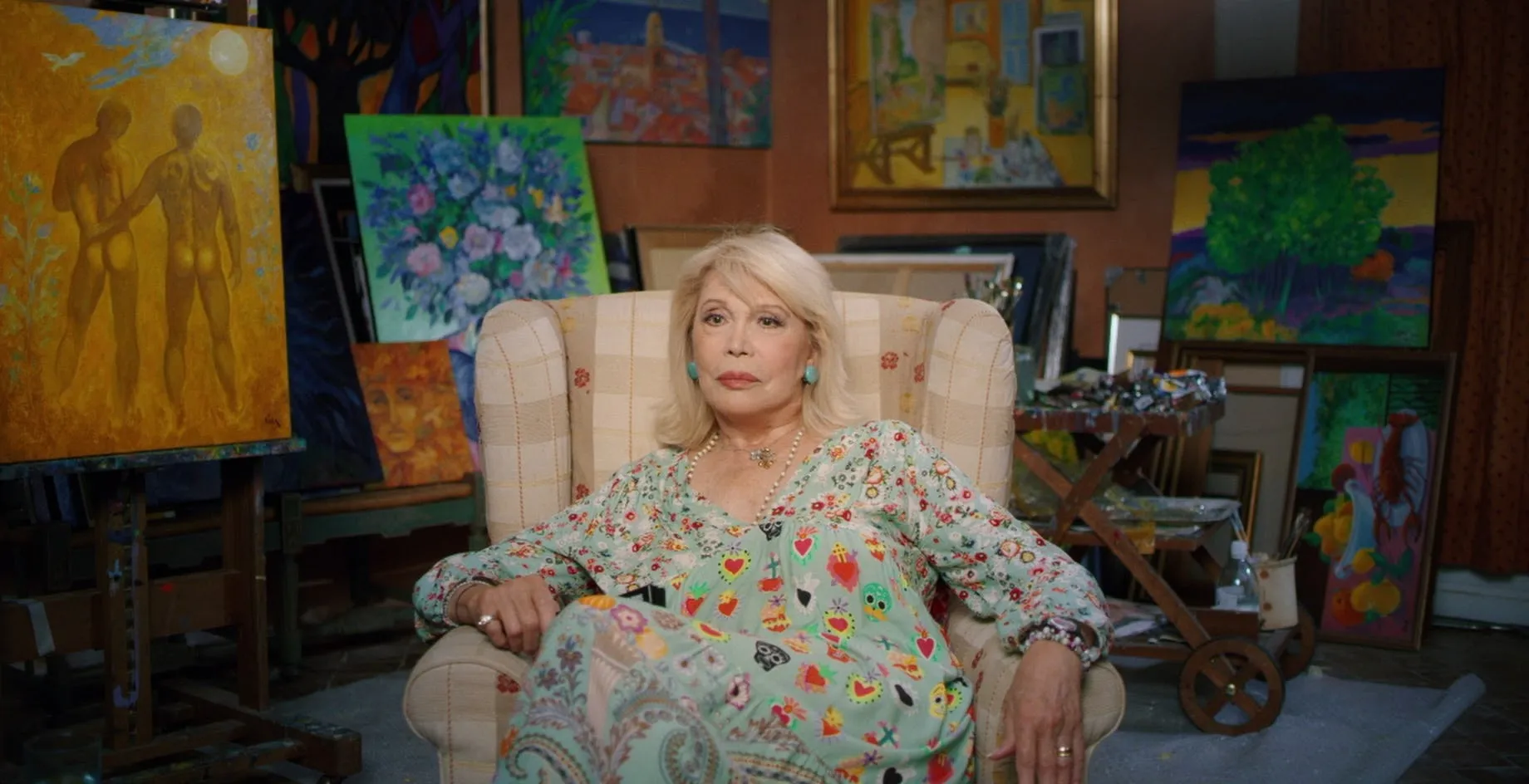
We see her public life as a model, a muse to Salvador Dalí, and a European pop star, but she staunchly refuses to acknowledge any life before fame. When Drucker presents evidence of her past as Peki d’Oslo, an artist from the Le Carrousel scene, Lear dismisses it with a wave of her hand. She insists she has forgotten; she claims no memory of the people or places that connect her to Ashley.
Her denials are so persistent they border on the theatrical. Yet, the film doesn’t frame this as a simple deception. Instead, it positions her evasiveness as a carefully constructed shield. Ashley was punished for her truth, but Lear thrived within her ambiguity, deflecting invasive questions from the media for decades. Her unwavering control over her own story becomes a different kind of survival tactic, a fortress built of mystery that no one could breach.
Defining One’s Own Legend
The structural brilliance of Enigma is in its refusal to pick a side. By placing Ashley’s painful honesty directly against Lear’s defiant obscurity, Drucker creates a powerful conversation about what it means to be a pioneer.
The difference in their choices illuminates the impossible situations that trans people have long faced. This reaches a potent peak when Drucker, herself a trans woman, tells Lear that she was a personal inspiration, that her mystique offered its own kind of hope. Lear remains unmoved, secure in the narrative she has maintained for over half a century.
The film doesn’t demand a confession from her. It suggests that Ashley’s public battle and Lear’s private defiance are both legitimate responses to a hostile world. One chose to change the world by revealing her truth, while the other protected her truth by changing her story. Enigma leaves you with a profound respect for the right of every person to forge their own legend.
Enigma premiered at the 2025 Sundance Film Festival on January 28, 2025. It was released in the United States on June 24, 2025, by HBO. “Enigma” is available for streaming on Max (formerly HBO Max). It can also be viewed on Apple TV, Amazon Prime Video, Hulu, and Sling TV.
Full Credits
Director: Zackary Drucker
Producers: Madison Passarelli, Noah Levy, Donovan Lovell, Stephen B. Strout, Douglas Banker, Alex Garinger
Executive Producers: Zackary Drucker, Dan Cogan, Liz Garbus, Jon Bardin, Kate Barry, Addison Mehr, Edward Sanders, Nancy Abraham, Lisa Heller, Tina Nguyen
Cast: April Ashley, Amanda Lear, Rebecca Root, Marie-Pierre Pruvot, Allanah Starr, Morgan M. Page, Dolly Van Doll
Director of Photography (Cinematographer): Clément Beauvois
Editor: Claire Didier
Composer: Danny Bensi, Saunder Jurriaans, James Newberry
The Review
Enigma
Enigma is a masterfully constructed documentary that forgoes easy answers in favor of profound questions. Its power lies in the structural decision to contrast two lives, presenting both radical honesty and defiant secrecy as valid, courageous forms of survival. By refusing to declare a single "truth," the film honors the right of every individual to write their own story in the face of a hostile world. It’s a thoughtful, resonant, and essential piece of filmmaking that examines the very mechanics of identity.
PROS
- Brilliant dual-narrative structure contrasting its two subjects.
- Deep, thoughtful exploration of trans identity, history, and survival.
- Fascinating and tense interview sequences with Amanda Lear.
CONS
- Pacing is slightly slow before the central focus on the two women solidifies.
- The direct questioning of Amanda Lear's identity might make some viewers uncomfortable.