































The architecture of a tragedy is often built from mundane details. For Jodi Huisentruit, a young television anchor in Mason City, Iowa, the day was June 27, 1995. She was running late for the morning news broadcast. At her apartment complex, the scene left little to interpretation: a bent car key, a pair of red heels, and other personal items scattered on the pavement.
The evidence pointed not to a person who had simply left, but to one who had been violently taken. From that moment, the case became a violent abduction, a painful question mark hanging over the small city. For nearly three decades, Huisentruit’s disappearance has remained an open wound for her family and community. Her body was never recovered; no one was ever charged.
Into this long silence comes Her Last Broadcast, a docuseries that proposes to re-examine the cold case, promising a fresh perspective animated by a seemingly new piece of information. The series invites us back to that June morning, asking us to look again.
Stretching the Narrative Thread
Every true-crime documentary must decide how to assemble its story from the fragments of the past, a task of narrative triage where every choice shapes the viewer’s understanding. This three-part investigation, directed by Maria Awes, makes a structural choice that has become common in the streaming era, but one that feels particularly ill-suited to the material at hand.
The story is methodically portioned out, with the first episode dedicated to establishing the victim’s life, the circumstances of her disappearance, and the initial confusion of the investigation. The subsequent episodes attempt to peel back the layers of the intervening decades. Yet, the narrative construction feels labored, less like a careful peeling and more like a deliberate stretching of thin material to fit a predetermined container.
The series gathers the essential voices: Huisentruit’s sister, JoAnn Nathe, provides the raw, emotional anchor, her presence a constant reminder of the human cost of this abstract mystery. Former colleagues from the KMIT news station offer professional context, painting a picture of an ambitious woman on an upward trajectory. Members of the Mason City Police, chiefly Investigator Terrance Prochaska, represent the official, procedural search for answers.
The editing juxtaposes these perspectives, but the effect is often one of repetition, not revelation. The narrative’s momentum stalls frequently. We are told about early persons of interest, such as John Vansice, a friend of Jodi’s, only for the thread to go slack.
Then, an episode later, the same thread is picked up again without significant new information, creating a circular logic that exhausts viewer patience. This structural inefficiency is amplified by a heavy reliance on dramatic reenactments. We see shadowy figures in parking lots and slow-motion shots of objects falling to the ground—visual clichés of the genre that serve as a narrative crutch.
When archival material is exhausted, these stylized scenes fill the space, but they do so with a manufactured tension that feels hollow. The decision to spread this story across three installments seems guided more by the content demands of a streaming platform than by the organic needs of the narrative itself. A story that could have been a taut, incisive ninety-minute feature instead becomes a meandering, multi-hour affair that mistakes duration for depth.
A Breakthrough Built on an Oversight
The central engine of Her Last Broadcast, the narrative pillar upon which the entire production rests, is a supposedly new lead. The story goes that a 2022 television special on the case prompted a witness, Jodi’s close friend Patty Niemeyer, to re-contact police with information about her ex-husband, Brad Millerbernd.
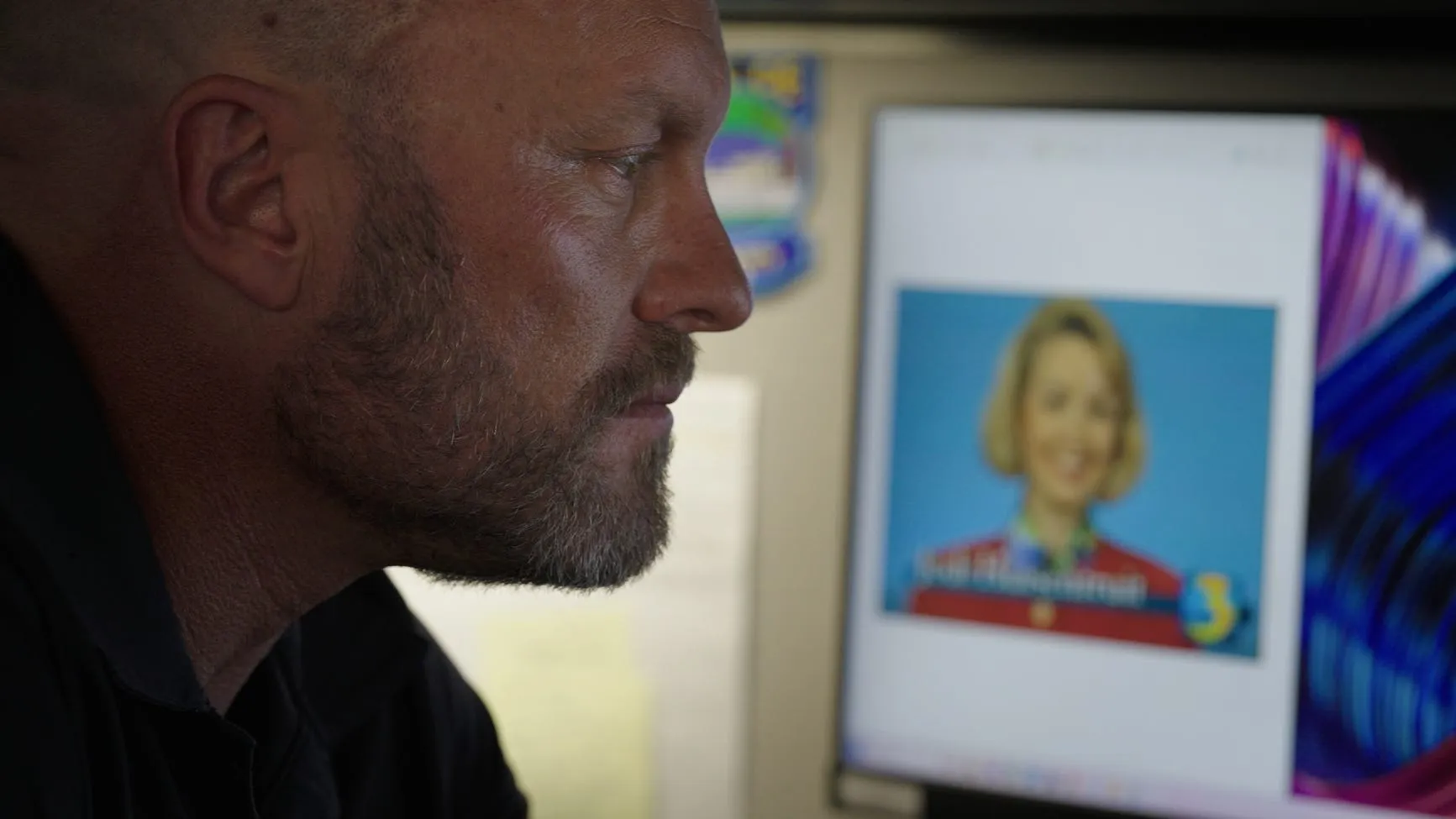
The documentary presents this as the critical development, the long-awaited crack in the cold case. The camera focuses intently on Investigator Prochaska as he explains the significance of this moment. His explanation, however, is where the series’ entire premise begins to unravel. He clarifies that the police department took Niemeyer’s second email more seriously because, this time, she explicitly stated she was Jodi’s “best friend.” The implication is stunning.
This is not a breakthrough. It is a quiet, almost casual admission of a startling institutional oversight, suggesting her initial tip five years prior was not given the attention it might have deserved because a key relationship detail was omitted or ignored. A robust journalistic inquiry would seize upon this detail, making it the central subject of investigation. It would ask why the system failed, what protocols were missed, and how a potentially vital lead sat dormant.
This series does not do that. Instead, it presents the moment at face value, framing it as a simple course correction rather than a symptom of a deeper problem. From that point on, the filmmakers align themselves completely with law enforcement’s current efforts. The documentary enjoys a remarkable level of candid access, creating a sense of close collaboration between the filmmakers and the police.
This relationship, while yielding intimate footage of the current investigation, sacrifices all critical distance. The narrative ceases to be an independent examination of the investigation and effectively becomes a promotional film for it. The series follows the shiny new object—the pursuit of Millerbernd—without looking back to ask tough questions about the messy, thirty-year history that preceded it.
This narrative choice prioritizes a simple, forward-moving plot over a complex, uncomfortable truth. The real story might not be about finding a killer; it might be about why one was never found. The documentary chooses the simpler, more conventional path, and in doing so, misses its chance to say something meaningful about the mechanics of justice and memory.
An Echo Chamber of Frustration
A documentary’s voice, the tone and perspective of its narrator, can be its greatest asset or its most profound weakness. Here, the on-camera narration by director Maria Awes is a significant and inescapable liability. The role of a narrator is to be a guide, to build atmosphere, to translate complex information with clarity and empathy.

The delivery in this series achieves none of these things. It is unnervingly flat, stiff, and robotic, possessing the stilted rhythm of a script being read from a teleprompter for the very first time. This stylistic choice is not merely awkward; it is fundamentally at odds with the gravity of the subject matter. It drains the story of its inherent tension and creates a distracting, almost surreal barrier between the viewer and the emotional core of the tragedy.
It is a profound artistic misstep that leaves the production feeling strangely amateurish and emotionally hollow. This critical production flaw compounds the series’ fundamental problem: its destinationless journey. After hours of speculation, after following investigators down a new path, the case remains stubbornly, painfully unsolved. There is no arrest, no discovery, and no justice for Jodi Huisentruit.
The series builds an expectation of revelation, leaning heavily on its promise of “new, groundbreaking information.” When it fails to deliver on that promise, the result is not poignant ambiguity but sharp frustration. This feeling is intensified by the production’s ethically questionable reliance on conjecture. The narrative points toward several individuals as persons of interest without presenting substantial, legally sound evidence against any of them.
It is a dangerous storytelling tactic that transforms a documentary into a forum for public suspicion, blurring the line between reporting a tragedy and potentially creating a new one for those caught in its speculative gaze. The flawed structure, the compromised focus, the poor narration, and the inconclusive finish are not separate issues.
They are all symptoms of a central failure: the documentary fundamentally misunderstands its own story. It sets out to be a procedural about a breakthrough. The real, more compelling story was about a thirty-year institutional failure, a community’s enduring grief, and the difficult nature of an unsolvable mystery. By chasing the wrong narrative, it completely fails to tell the right one, leaving its audience in a frustrating silence.
Her Last Broadcast: The Abduction of Jodi Huisentruit is a three-part docuseries that premiered on July 15, 2025, on Hulu.
Full Credits
Director: Andy Awes, Maria Awes
Producers: Ben Krueger
Executive Producers: Andy Awes, Maria Awes, Eamon McNiff
Cast: Terrance Prochaska, Maria Awes, Patty Niemeyer, Joan Nathe, Staci Steinman, Doug Merbach, Kristen Nathe, Amy Kuns
The Review
Her Last Broadcast: The Abduction of Jodi Huisentruit Review
Her Last Broadcast takes a genuinely haunting and compelling mystery and subjects it to a flawed and frustrating execution. While it succeeds in conveying the human tragedy of Jodi Huisentruit’s disappearance, the series is crippled by poor narration, a padded structure, and a questionable journalistic focus. It promises a breakthrough it cannot deliver, leaving the viewer with a sense of profound dissatisfaction that mirrors the cold case itself. The story is powerful; its telling is not.
PROS
- The underlying case of Jodi Huisentruit's abduction is inherently gripping and tragic.
- Features moving interviews with Huisentruit's family and friends, grounding the story with real emotion.
- Effectively illustrates the long-term impact an unsolved crime has on a small community.
CONS
- The director's narration is stiff and robotic, consistently undermining the series' tone.
- Its three-part structure feels stretched, with repetitive information used to pad the runtime.
- The narrative aligns too closely with law enforcement, failing to critically examine the thirty-year investigation.
- Ultimately offers no resolution or significant new insight, creating a deeply unsatisfying viewing experience.
- Engages in conjecture about persons of interest without presenting substantial evidence.







