

























![Kingdom Hearts Collection [I-III] Review](https://gazettely.com/wp-content/uploads/2026/10/Kingdom-Hearts-Collection-I-III-1-360x180.webp "Kingdom Hearts Collection [I-III] Review: KHII Holds Steady as Newer Entries Fluctuate 37")




Monster Island opens on a Japanese “Hell Ship” in the final, desperate days of World War II, a floating prison where conditions are grim. Onboard, a Japanese soldier named Saito, branded a traitor, finds himself shackled to Bronson, a defiant British POW.
Their mutual hatred is a palpable thing, a heavy weight between them as real as the iron chain on their ankles. When an Allied torpedo rips their world apart, they wash ashore on a remote island. Their war seems over, but a new one is about to begin. They quickly learn they are not survivors on a deserted rock; they are intruders in a hostile territory, and something primal has been disturbed by their arrival.
A Bond Forged in Blood and Mud
The film’s emotional anchor is the forced alliance between Saito and Bronson, and it’s in this dynamic that the movie finds its pulse. It’s a familiar trope, the “enemy mine” scenario, but its execution here feels refreshingly raw and physical.
The narrative smartly uses the chain that binds them as a constant, tangible metaphor for their conflict. In the beginning, every movement is a struggle, a clumsy tug-of-war. As they are forced to cooperate to climb a cliff or flee a threat, we see their rhythm sync up.
Their bond isn’t built on heartfelt speeches but is communicated through shared struggle, conveyed in desperate glances during a fight and the simple act of learning to anticipate each other’s next move. This reliance on visual storytelling is a huge strength.
Saito, played with a quiet weariness by Dean Fujioka, is a man who has already rejected the dehumanizing machinery of war. His status as a “traitor” comes from an act of empathy, making his eventual connection with Bronson feel like a natural extension of his core philosophy.
Opposite him, Callum Woodhouse’s Bronson is all pragmatic aggression, a soldier whose survival instinct is to fight first. His journey is one of slowly recognizing the man chained to him, not just the uniform he once wore.
The performances sell this non-verbal evolution beautifully. The film doesn’t waste time on deep character studies; instead, it uses these two as effective avatars for a simple, powerful idea: a common threat can expose a common humanity.
In Praise of the Man in the Suit
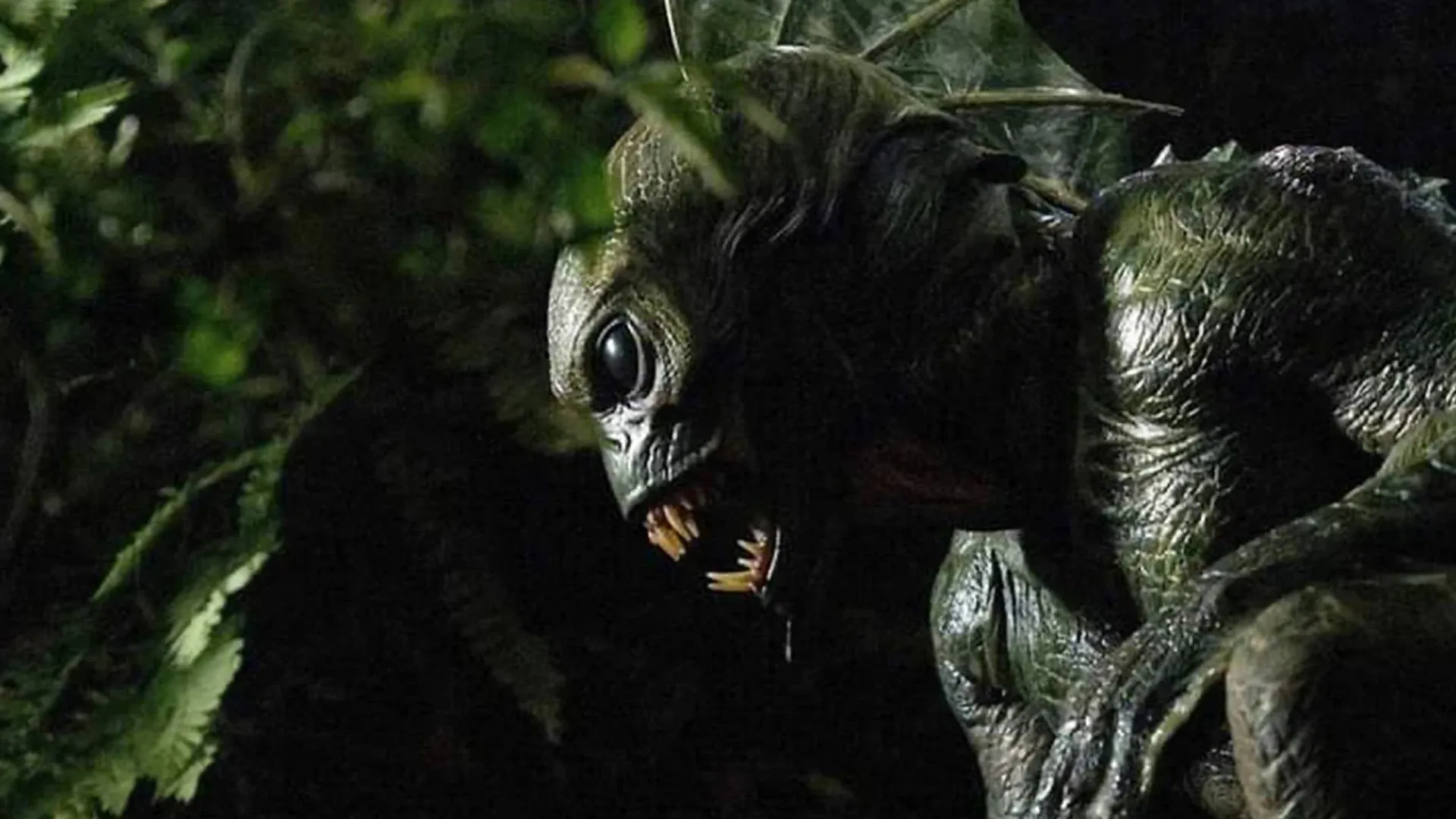
Let’s talk about the star of the show: the Orang-Ikan. In an era where digital monsters can often feel weightless and disconnected from their environment, director Mike Wiluan makes the brilliant choice to use a practical creature suit, and the film is immeasurably better for it.

This beast is a direct descendant of the Creature from the Black Lagoon, but reimagined with a mouth full of needle-sharp teeth and a far more vicious disposition. The artistry of the physical suit, worn with formidable menace by Alan Maxson, gives the monster a haptic quality.
You feel its weight as it crashes through the jungle, and you believe its power when it rips a man’s heart from his chest. The practical gore is equally satisfying, delivering a brutal, tactile punch that CGI rarely achieves.
The film’s confidence in its monster is evident in how it’s presented. The buildup borrows from classics like Predator, using stealthy underwater POV shots and a distinctive, chilling shriek that echoes across the island, signaling its presence long before we see it clearly.
But unlike many monster films that hide their creature until the final act, Monster Island brings its beast into the light relatively early. This decisive move shifts the tone from a horror of the unknown to a full-throttle action-survival film.
The Orang-Ikan becomes a legitimate third character, a territorial guardian defending its home from the wreckage of a human war that has washed up on its shores. This motivation, however simple, gives its rampage a sense of ecological purpose, making it a far more effective antagonist than a mere mindless killing machine.
A Lean Machine with a Sputtering Engine
Running at a brisk 83 minutes, Monster Island is built for speed, a quality that is both its greatest asset and its most significant limitation. The relentless pace creates a sense of breathless desperation that mirrors the characters’ frantic fight for survival, ensuring there is never a dull moment. However, this forward momentum comes at a cost.

The story sacrifices quieter moments that could have deepened the emotional stakes. A scene of the two men simply tending to their wounds or attempting to share a memory would have added considerable weight to their bond, but it would have broken the propulsive rhythm the film works so hard to maintain.
This trade-off is also clear in the technical execution. Mike Wiluan shows real cleverness in staging scenes on a low budget, particularly the chaotic, disorienting shipwreck that kicks off the action. Yet, during the island’s frantic combat sequences, the editing can become choppy.
The action is often fragmented by a flurry of quick cuts that happen a split-second too soon, denying the audience the full, cathartic impact of seeing a well-executed stunt or a grisly gore effect. It’s a frustrating choice that sometimes undermines the fantastic practical work on display.
The script is a familiar vehicle, moving in a straight, predictable line without any real narrative surprises. The film knows its appeal lies in visceral thrills, not intellectual depth. It’s a lean, unpretentious B-movie, a future cult classic for an audience that values bloody, old-school monster mayhem.
Monster Island debuted on Shudder in North America, the UK, Ireland, Australia, and New Zealand on July 25, 2025. You can watch “Monster Island” on Shudder or other platforms offering Shudder content.
Full Credits
Director: Mike Wiluan
Writers: Mike Wiluan
Producers: Eric Khoo, Freddie Yeo, Tan Fong Cheng, Fumie Suzuki Lancaster, Anthony Khoo, James Khoo, Ninin Musa, Yutaka Tachibana, Darryl Yeo
Executive Producers: Simon Crowe, Matthew Joynes, Anthony Khoo, Eric Khoo, Natalya Pavchinskaya, Grace Wu, Yoshi
Cast: Dean Fujioka, Callum Woodhouse, Alexandra Gottardo, Alan Maxson
Director of Photography: Asep Kalila
Editors: Lim Yen
Composer: Akihiko Matsumoto
The Review
Monster Island
Monster Island is a glorious throwback, a brutal and efficient creature feature that knows its strengths. While a shallow script and messy editing hold it back from true greatness, its outstanding practical monster and the raw chemistry between its leads deliver a satisfyingly gory ride for fans of old-school horror. It’s a film that delivers exactly what it promises: a lean, mean, monster-mashing good time.
PROS
- Outstanding practical creature design for the Orang-Ikan.
- Tangible, brutal, and gory action sequences.
- An effective and well-acted "enemies-to-allies" dynamic at its core.
- A lean, fast-paced story that never drags.
CONS
- The script is thin, predictable, and lacks narrative depth.
- Choppy and frantic editing can sometimes obscure the action.
- Character development is minimal beyond the central premise.







