













The endless ribbons of Southern California freeway, viewed from above, form a circuit board of profound loneliness. In this sprawling, sun-bleached noir landscape, individuals are merely points of light, their comings and goings a meaningless pattern until one light blinks out.
Or, far worse, begins to move with a predatory intelligence. Strange Harvest posits such a predator, a bogeyman for the cul-de-sac, a ghost story born from the very real anxieties of the Inland Empire. The film presents itself as a retrospective, a true-crime documentary revisiting the cold case of a killer christened “Mr. Shiny.”
We enter the narrative years after the fact, when a gruesome 2010 family murder, executed with chilling ritualism, signals the return of a phantom who had vanished for a decade and a half. The story is not merely a hunt for a man. It is a descent into a methodical madness, an attempt to find the horrifying logic within a seemingly supernatural design.
A Carefully Broken Mirror
Director Stuart Ortiz constructs his documentary illusion with the precision of a watchmaker, creating a diegetic world that feels unnervingly authentic. The film’s visual texture is a meticulous collage of media, a scrapbook of terror assembled from sources of varying fidelity.
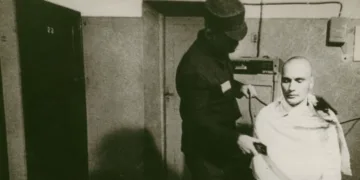
We are fed a diet of crisp, professionally lit talking-head interviews, which are then deliberately cross-cut with the degraded grain of archival news reports from the 90s. This is juxtaposed with the pixelated dread of a static security camera feed and the jarring, visceral panic of a police body-cam plunging into a dark home. The calculated degradation of these “found” materials creates a powerful verisimilitude; the stark contrast between the clean framing of the present and the raw, unpolished images of the past conditions the viewer to accept these windows into horror as truth.
The film’s most potent cinematographic trick relies on what it withholds. Static crime scene photographs—depicting blood-spattered walls or a strangely placed weapon—become expressionistic tableaus. The camera forces the audience’s own mind to paint the grisly details in the negative space, making our imagination an active accomplice in the horror.
Yet, the mirror cracks. A recurring use of artificial intelligence to generate family photos of the victims produces an uncanny sheen, a digital smoothness that sits at odds with the analogue grit of the rest of the production. The dead eyes and airbrushed perfection of these non-people momentarily break the spell, a uniquely 21st-century flaw in the art of illusion. It’s a ghost in the machine, but not the one the director intended.
Faces in the Static
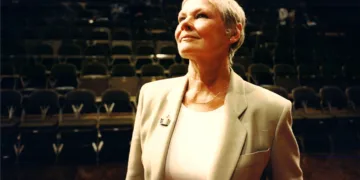
A film built entirely on recollection requires voices that can bear the immense weight of the past. The narrative is anchored by its two lead detectives, Virgil figures guiding us through this specific inferno with a palpable sense of exhaustion. Terri Apple portrays Detective Alexis Taylor with a bone-deep weariness, her hardened professionalism a clear shield built against years of witnessing the unspeakable.

Her posture is rigid, her tone flat when recounting horrific details, embodying the emotional cost of her profession in a way that feels utterly genuine. Opposite her, Peter Zizzo as Detective Joe Kirby offers a different, equally effective frequency.
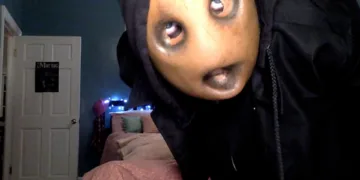
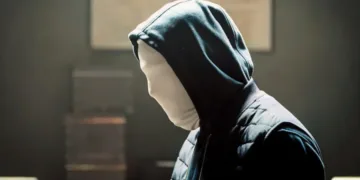
A slight stiffness pervades his delivery, an awkwardness that, paradoxically, sells his reality. He does not feel like an actor performing a cop; he feels like a real cop forced into the unnatural role of a media performer, physically bracing himself against the tide of memory. And then there is the profound absence at the story’s center: Mr. Shiny himself. Jessee J. Clarkson’s performance is one of pure, terrifying physicality, seen only in distorted clips and grainy reproductions.
He is a void, a phantom defined entirely by the scorched earth he leaves behind and the dread he inspires in others. His menace is built through secondary sources, making him a creature of pure reputation, a terrifying legend given form only by the fear he has cultivated. His silence is his power, making the rare moments we see his blank, masked form feel like witnessing a fundamental glitch in reality.
A Deeper Evil: Thematic Weight and Occult Lore
Beneath the procedural skin, the film’s heart pumps with a cold, cosmic horror. The killer’s lore is not the simple psychosis of a standard thriller but a chaotic, self-curated theology. His mythology is a frighteningly coherent system stitched together from celestial ambition and arcane cruelty.

His stated goal of summoning an otherworldly entity named “Kaliban,” his obsession with the esoteric 13th Zodiac sign of Ophiuchus, and his ritualistic murders—from bloodletting to a horrifyingly modern application of the Viking Blood Eagle—all point toward a mind operating on a different, terrifying wavelength. The violence is liturgical.
This is not the clean A-to-B logic of a police procedural but the alien reasoning of a Lovecraftian protagonist, one who has gazed into the abyss and cobbled together a belief system from the darkness staring back. This thematic depth, in turn, forces a moral inventory upon the viewer. By adopting the documentary format, the film implicates us in the ethically murky act of true-crime consumption. Are we honoring victims, or are we feeding the notoriety of monsters, granting them the very immortality they crave?
The film holds up a mirror to society’s fascination with the macabre, questioning our desire to give such creatures airtime. It’s a self-aware critique that offers no easy answers, instead leaving the viewer to grapple with their own complicity in the spectacle of suffering.
The Unresolved Chord
The film’s rhythm is a calculated assault, a carefully modulated pulse of dread and release. Long, quiet stretches of procedural interviews are deliberately punctuated by sudden, brutal flashes of shocking imagery. A detective’s calm monologue will be shattered by a jarring cut to a single, visceral crime scene photo, a technique that keeps the nervous system on high alert.
Ortiz understands the grammar of tension, starting with a deeply unsettling crime scene to establish a baseline of dread that never truly dissipates. The gore, when it appears, is not gratuitous spectacle but is framed as forensic evidence, its clinical, detached presentation making it somehow more nauseating. It is the narrative’s final act, however, that proves most divisive.
The documentary format, which is inherently backward-looking, denies the audience a conventional, present-tense climax. The resolution is ambiguous, a frustrating lack of catharsis that feels less like a narrative failure and more like a core thematic statement. It is as if the director wrote himself into a corner and then declared that corner to be the point of the exercise.
True cosmic horror, the film suggests, does not offer a neat resolution; it reveals that there was never any solid ground beneath your feet to begin with. A final, chilling post-credits scene serves as the story’s dissonant, unresolved chord—a quiet warning that the cycle is not broken and the darkness is always patient.
Strange Harvest premiered at Fantastic Fest on September 22, 2024, followed by screenings at Grimmfest (October 3), RAMASKRIK in Norway (October 17), and other festivals.
Full Credits
Director: Stuart Ortiz
Writer: Stuart Ortiz
Producers: Bruce Guido, Stuart Ortiz, Alex Yesilcimen
Executive Producers: Michael Karlin, David Karlin, Joseph Latorre, Bruce Guido, Leo DeLeon, Alex Yesilcimen
Cast: Peter Zizzo, Terri Apple, Andy Lauer, Matthew Peschio, Janna Cardia, Thomas Wolfe Jr, Tim Shelburne, Christina Helene Braa
Director of Photography (Cinematographer): Seth Fulleer
Editor: Stuart Ortiz
Composer: Sarah DeCourcy
The Review
Strange Harvest
A masterclass in verisimilitude, Strange Harvest builds a world of authentic, suburban dread with chilling precision. Its philosophical depth and meticulous craft are commendable, creating a truly unsettling piece of cosmic horror. While its deliberately ambiguous ending will frustrate those seeking easy answers and a few visual missteps momentarily break the spell, the film's unnerving atmosphere and intelligent critique of the true-crime genre are profoundly effective. It's a film that lingers like a cold spot in a familiar room.
PROS
- Meticulous and authentic recreation of the true-crime documentary style.
- Strong, believable performances that anchor the fabricated reality.
- Creates a genuinely unnerving atmosphere and palpable sense of dread.
- Intelligent thematic depth, exploring cosmic horror and the ethics of crime media.
- Effective use of suspense and impactful, psychologically disturbing imagery.
CONS
- The deliberately ambiguous and unresolved ending may be unsatisfying for many viewers.
- The use of AI-generated images for victim photos is a jarring technical flaw that breaks immersion.
- Its commitment to the documentary format results in a slow, methodical pace that may not appeal to all horror fans.