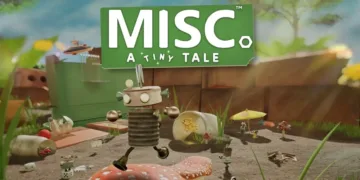























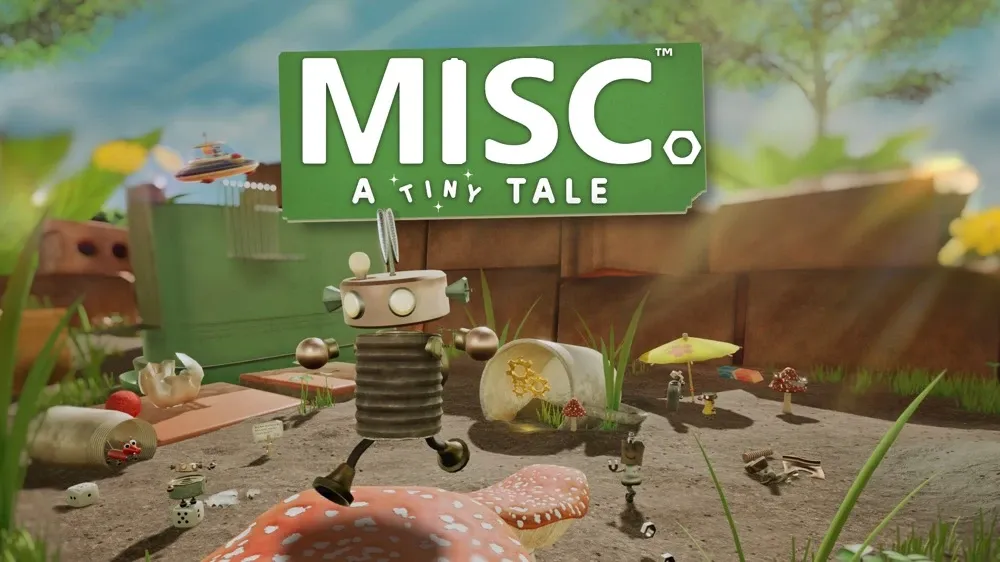

The allure of being a small actor in a vast, familiar world is a potent narrative trope, appearing everywhere from Japanese anime to European folklore. Misc. A Tiny Tale taps directly into this fascination. The game introduces us to Buddy, a diminutive robot, and his friend Bag Boy, whose quiet existence is shattered by a skyward explosion.
This event scatters golden cogs and refuse across their land. At Bag Boy’s behest, Buddy’s quest begins: to gather the cogs, repair the gates linking their communities, and assist the peculiar robots he meets. The initial presentation suggests a gentle, family-friendly adventure.
There are no true fail states, and the robotic “enemies” are more mischievous than menacing. This accessible entry point creates a comfortable space before the game reveals its more complex layers, presenting a seemingly simple journey that speaks a universal language of curiosity and aid.
The Choreography of Care
The game’s design is elegantly centered on a cycle of restorative actions, a gameplay loop that feels both familiar and purposeful. Players gather golden cogs, the primary keys for progression, but the path to acquiring them is paved with smaller, equally significant acts.
Cleaning discarded items—bottle caps, bits of plastic, forgotten scraps—and depositing them into a RECYC0TRON provides Buddy with bolts, the world’s currency. This system reframes the economic loops seen in countless games, transforming the often-abstract process of “grinding” into a tangible act of environmental stewardship. Every bolt earned is a direct result of making the world cleaner.
This currency is then used to purchase key items or fulfill the needs of other characters, weaving a system of commerce directly into a broader framework of social and ecological responsibility. This philosophy, where tidying and order are mechanically rewarded, shares a cultural lineage with Japanese design sensibilities seen in games that find zen in organization, yet Misc. applies it to a distinctly Western, post-apocalyptic landscape littered with the debris of a consumer society.
The platforming mechanics serve as the primary mode of interaction with this oversized world. Buddy’s movement is built on a foundation laid by the genre’s Japanese progenitors, most notably Super Mario 64. He possesses a responsive double jump and a forward dive that can be used to cross larger gaps, encouraging players to read the verticality of the environment.
A propeller function allows him to slow his descent, a crucial tool for correcting course mid-air and safely navigating precarious drops. This moveset is intuitive, yet it possesses a deliberate “floatiness” that distinguishes it from the tight, grounded physics of its influences. This quality can, at times, create a slight friction during the game’s more demanding, optional platforming challenges, where pixel-perfect precision is required.
These self-contained challenge courses, one hidden in each level, act as a pure test of mechanical skill, a nod to the arcade roots of the genre where mastery was its own reward, separate from the narrative journey. The inclusion of a stamina-based sprint, limited by a fast-draining battery, is a thoughtful design choice. It prevents players from simply rushing through the meticulously crafted spaces, forcing a more methodical and observational pace that complements the game’s exploratory spirit.
This spirit is best expressed through the level design, which turns mundane locations into sprawling playgrounds. One level, The Garden Village, transforms a simple flowerbed into a complex vertical space. Another, The Scorched Kingdom, recontextualizes an abandoned children’s playground as a vast desert of sandboxes and discarded toys, where cocktail umbrellas become trampolines and broken sieves become gateways to subterranean secrets.
An ice-themed level introduces a timed race, a classic platforming trial that tests the player’s command of the movement system under pressure. Each biome is constructed from the detritus of human life, a constant visual reminder of the world that came before. This technique, of finding the epic in the everyday, has strong parallels with cinematic traditions seen in films like Toy Story or The Borrowers, but here it serves a dual purpose.
It is not just about a shift in perspective; it is about engaging with the legacy of a departed culture, finding new use and beauty in its remnants. The quests reinforce this idea, often forming intricate chains of cause and effect.
A found paperclip becomes a tool for one robot, who in turn provides a shiny bottle cap, which is the exact treasure sought by another. This structure, while mechanically simple, builds a web of interconnectedness, transforming a series of fetch quests into a simulation of a functioning, interdependent community.
Post-Apocalyptic Whimsy and Its Anxieties
The world of Misc. is populated by a cast of characters whose designs are a testament to creative recycling. These are not sleek, futuristic machines but charmingly cobbled-together beings, each with a distinct personality. There is a robot made from a toothpaste tube, sentient castanets, and a would-be strongman named Herculas who delights in lifting iron bars.
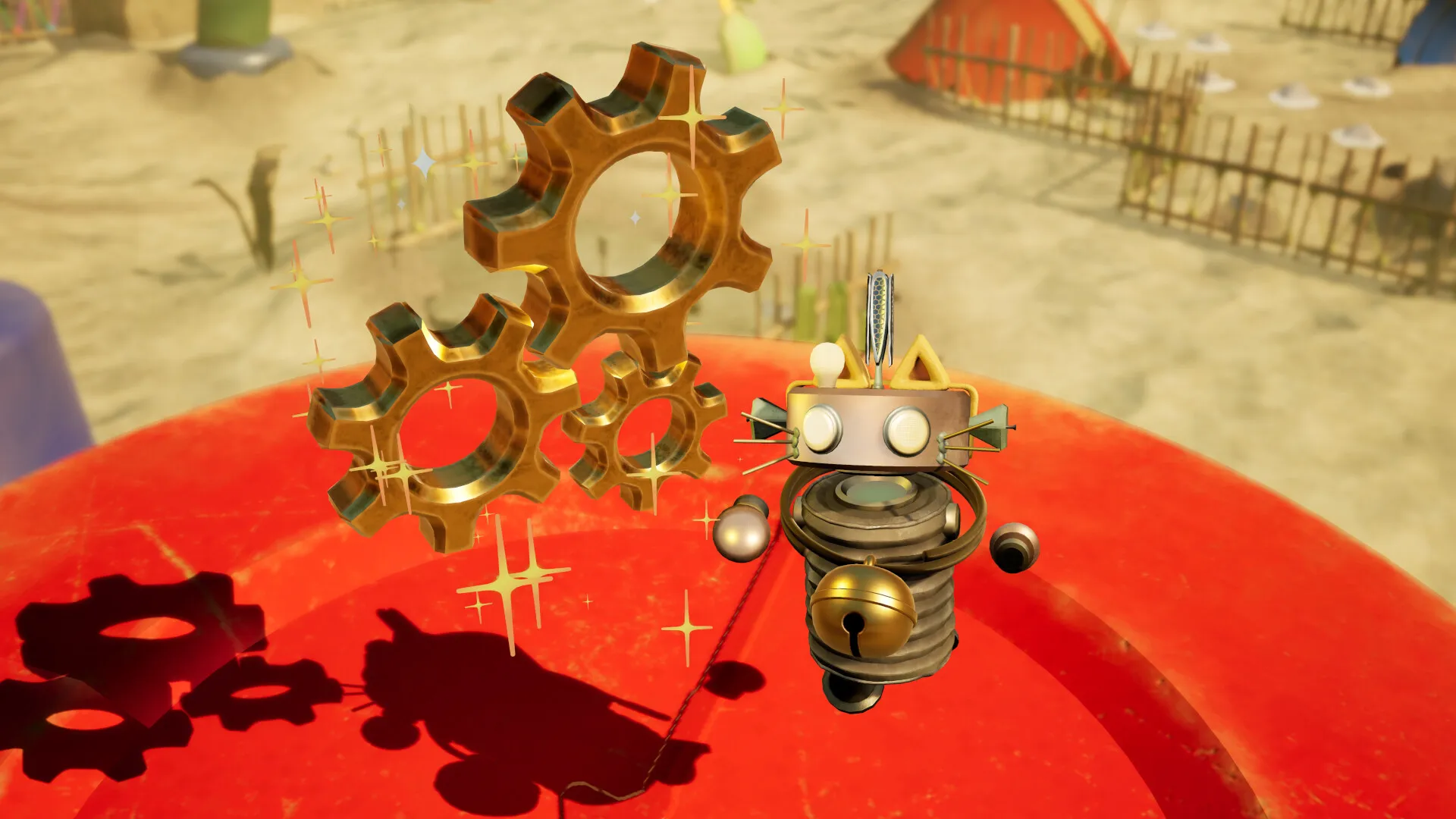
This “found object” or “bricolage” aesthetic gives the world a tangible, handcrafted feel, as if every inhabitant was assembled with care from the odds and ends of a lost civilization. At the center of the narrative is the relationship between the player-character Buddy and his friend Bag Boy.
Bag Boy, who conceals his face and feels like an outcast, is the catalyst for the adventure, yet his motivations are subtly shrouded in ambiguity. He embodies the “unreliable friend” archetype, pushing the narrative forward while simultaneously planting seeds of doubt, a dynamic that adds a surprising layer of tension to the otherwise cozy proceedings.
This tension is indicative of the game’s most ambitious quality: its dramatic tonal shift. The journey begins with the lighthearted, almost saccharine, charm of a children’s television program. The colors are bright, the music is cheerful, and the stakes seem comfortingly low. However, as the player progresses, the narrative gradually peels back this veneer to reveal a core of profound melancholy and psychological depth.
This pivot from G-rated whimsy to a more contemplative, emotionally resonant story is handled with remarkable grace. It mirrors narrative strategies employed in sophisticated global animation, from the films of Studio Ghibli to Pixar, where complex, adult emotions are often explored through a lens of childlike innocence.
The game does not shy away from difficult subjects, but instead uses allegory to make them accessible. Themes of depression, social anxiety, obsessive thought, and what it means to be an outsider are woven into the fabric of the characters’ stories and the state of their world.
This thematic richness elevates the game beyond a simple collectathon. The environmentalist message, for example, is more than just a background detail; it is the game’s central verb. The act of cleaning is a direct mechanical engagement with a core philosophical belief. This focus feels particularly resonant coming from an Australian developer, given the nation’s prominent and often fraught public discourse around conservation and climate change.
Interestingly, this message is complicated by the RECYC0TRON itself, which, as one review noted, will guilt-trip the player for using its “Trash Radar” to find the last bits of rubbish, calling it a form of cheating. This creates a fascinating contradiction within the game’s own ethos, questioning the line between asking for help and taking an easy way out. The most powerful theme, however, is the power of community as an antidote to personal despair.
The narrative consistently posits that healing comes not from solitary struggle but from mutual aid. By finding a lost item, clearing a path, or simply listening, Buddy’s actions directly alleviate the anxieties of others, and in doing so, strengthen the social fabric of their world. The story, guided by the cryptic notes of the mysterious “Sign Guy”—a figure who blurs the line between a character and a developer-insert—proves that even the smallest tales can grapple with the largest questions of existence.
An Aesthetics of Found Objects
The visual identity of Misc. A Tiny Tale is a carefully curated collage of cultural signifiers and imaginative reappropriation. Its aesthetic is rooted in the specific, yet speaks a universal language of nostalgia. The artists demonstrate a keen eye for turning everyday objects into memorable landmarks.
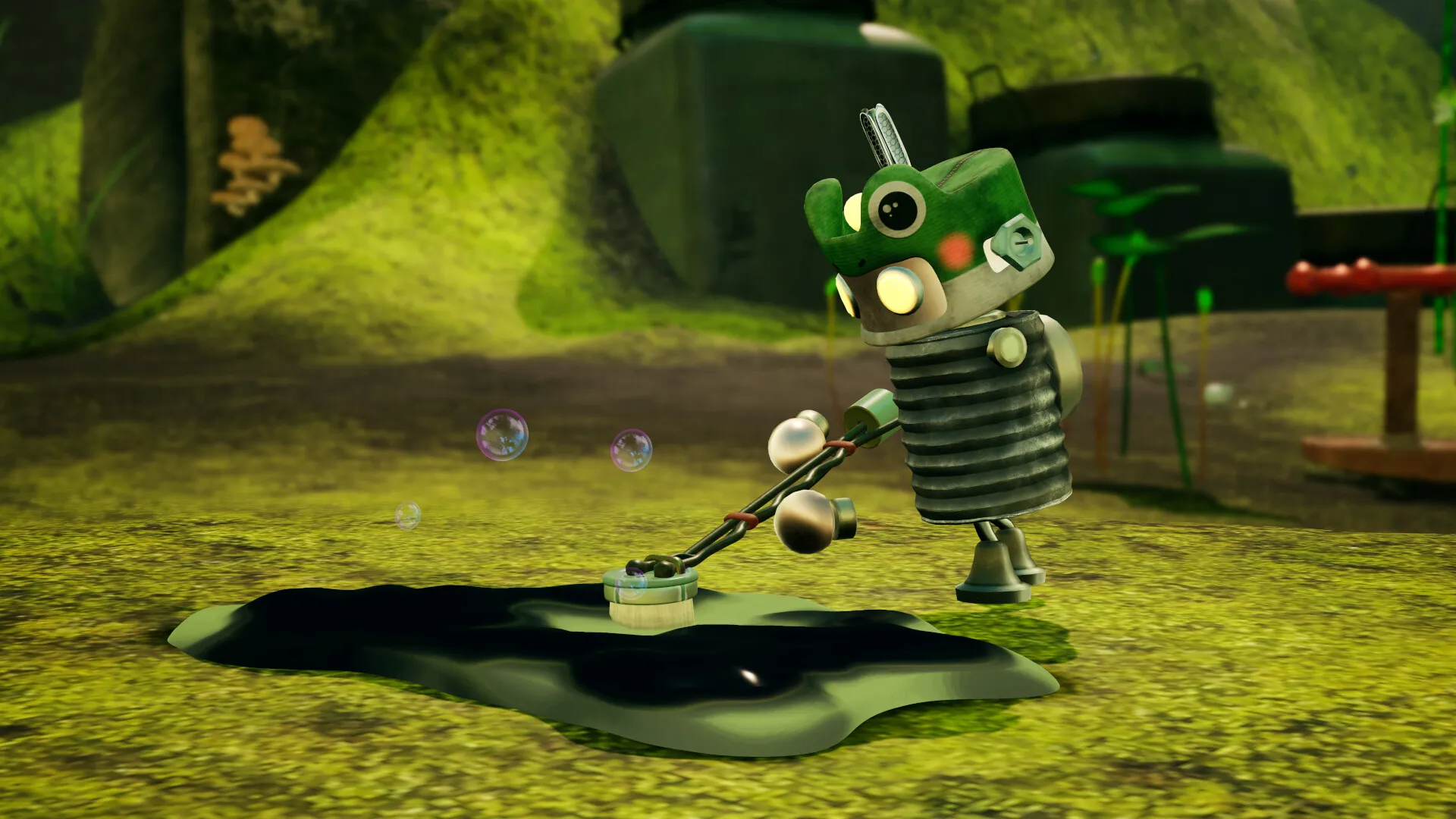
Buddy’s own bed is a discarded mobile phone charging brick, its two-pronged design an unmistakable nod to its Australian origin. A dilapidated green-and-yellow swing set, a staple of Australian parks, becomes a central feature in one of the game’s main areas.
These details ground the fantasy in a tangible reality, giving the world a sense of history and place that is often absent in more generic fantasy settings. This commitment to cultural specificity culminates in a gesture of profound importance: the game’s title screen explicitly acknowledges that it was created on the traditional lands of the Whadjuk Noongar people.
In the context of global game development, where placelessness is often the default, this is a powerful and necessary statement about history, heritage, and the land on which digital worlds are built. It represents a growing maturity in the medium, an understanding that even virtual spaces are products of a physical, culturally-specific place.
The audio design works in perfect harmony with the visuals to create a cohesive and immersive experience. The characters communicate through a charming lexicon of beeps, whirs, and expressive sounds rather than spoken dialogue.
This approach, harkening back to the narrative shorthand of early Japanese RPGs and popularized in modern lifestyle simulators like Animal Crossing, is a masterful stroke of localization. It transcends language barriers, allowing personality and emotion to be conveyed through tone and cadence alone, making the game universally accessible.
The musical score is similarly thoughtful, with each level featuring a unique theme that complements its visual design and emotional tone. The music in the garden level, for instance, is described as being in perfect harmony with the environment, while a notable questline involves helping a band rediscover their mojo, culminating in a full-fledged in-game concert. This moment, where the player’s actions result in a communal artistic performance, is a beautiful synthesis of gameplay and storytelling, celebrating the role of music in building community.
While the game is polished in many areas, certain design choices register as curious omissions or underdeveloped ideas. The absence of a central hub world, for instance, means that players select levels from a menu. This makes the experience feel more episodic, like turning the pages of a storybook, but it sacrifices the sense of an interconnected, explorable world that is a hallmark of the genre.
Similarly, the themed costumes Buddy acquires in each level are purely cosmetic, lacking any unique gameplay functions, which feels like a missed opportunity for deeper mechanical integration. The presence of passive “enemies” who can bump into Buddy but cause no actual harm creates a sense of tension without consequence, a “half-baked” idea that feels at odds with the game’s otherwise confident design. Even the title, Misc.
A Tiny Tale, is somewhat esoteric, its meaning only hinted at within the game itself. These are not damning flaws, but rather interesting points of friction that suggest a project with immense heart and ambition, perhaps constrained by the practicalities of a small development team. They speak to a game that prioritizes emotional resonance and thematic depth over strict adherence to every genre convention, resulting in an experience that is memorable for both its strengths and its endearing quirks.
The Review
Misc. A Tiny Tale
Misc. A Tiny Tale is a heartfelt and deceptively deep platformer that elevates the collectathon formula with a powerful emotional core and a distinct Australian identity. While minor mechanical shortcomings and some underdeveloped ideas slightly hold it back, its charming world, resonant narrative, and thoughtful exploration of complex themes make it a truly special indie title. It's a game with more on its mind than just collecting cogs.
PROS
- Deeply resonant story exploring mature themes with nuance.
- Charming "found object" art style and world design.
- Strong sense of cultural identity and place.
- Satisfying gameplay loop that rewards exploration and care.
CONS
- Lack of a central hub world makes the experience feel disconnected.
- Some gameplay ideas, like costumes and enemies, feel underdeveloped.
- Platforming can feel slightly floaty in precision-based challenges.