






















To watch Pierre Creton’s latest film is to accept an invitation into a quiet that breathes with the patience of geology. The air is still, the pace is that of a thoughtful country walk, and the world unfolds not in dramatic vistas but in the minute details of a single leaf or patch of soil.
We are guided by Mark Brown, an English paleobotanist whose life’s work is etched into the landscape of Normandy. His search for rare flora is the film’s simple premise, a premise that Creton uses not for a grand nature spectacle, but for something far more disquieting.
This is an intimate, nearly silent meditation on a man’s obsession, a life spent cataloging a world that existed long before us and will persist long after. The tranquility on screen is deceptive; beneath it lies the hum of deep time, a scale against which a human life appears as a brief, desperate flicker of light.
The Ghost in the Digital Record
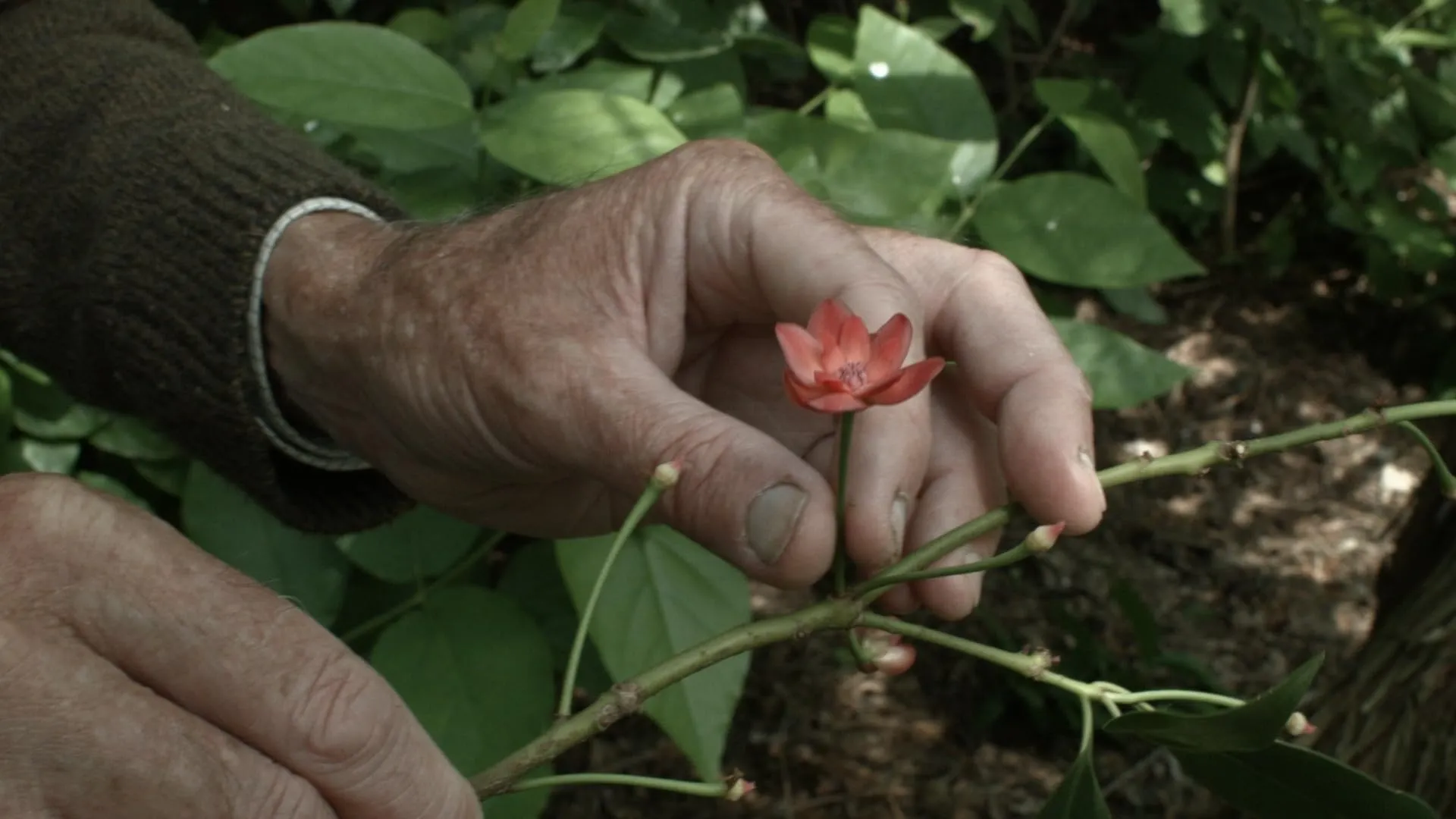
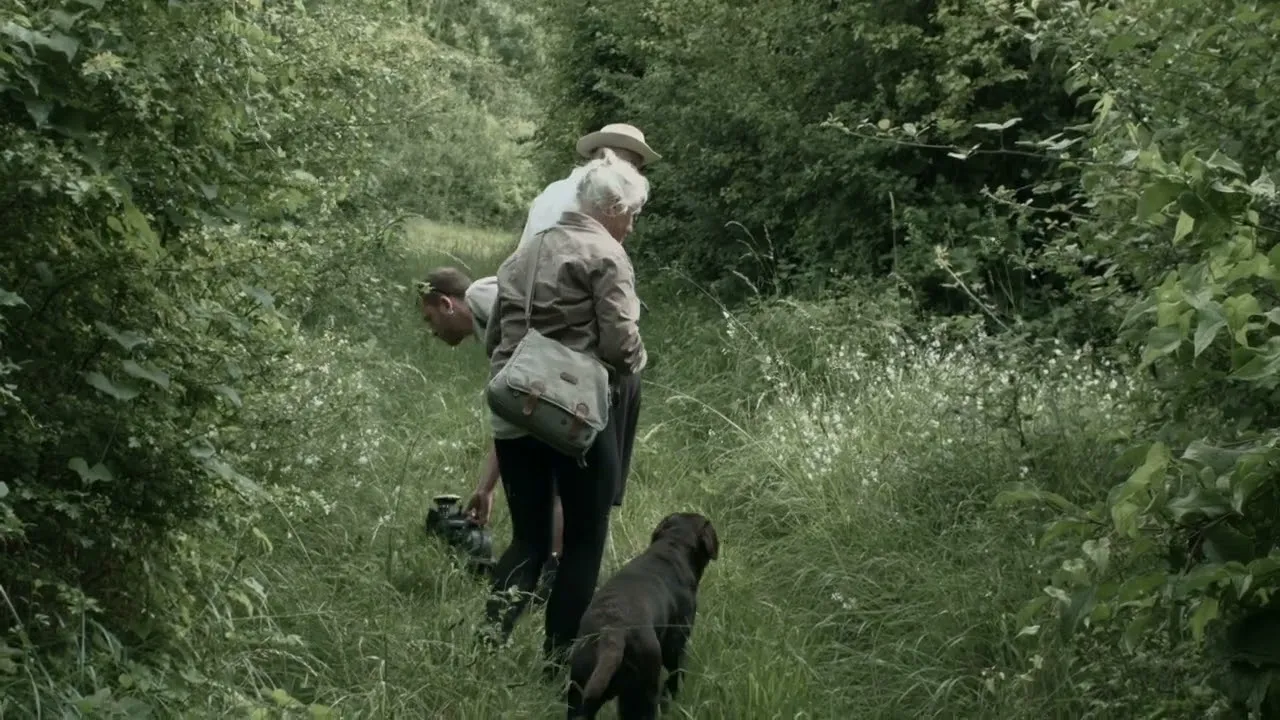
The film’s first movement, “The Shooting,” presents itself as a straightforward document. Shot with the cold immediacy of digital video, its clean, hyper-real images paradoxically highlight the futility of capturing a living moment. This section follows Brown and the filmmaking crew on seven excursions, each one a small pilgrimage.
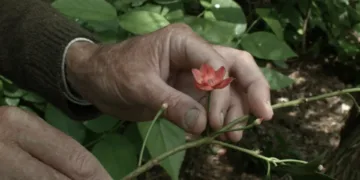
Brown is a vessel of knowledge, his speech a liturgy of etymology and soil composition. His fervor, however, transcends mere science. It is the devotion of a man who has found his anchor in the non-human world. When a rare flower brings him to the edge of tears, it is not simple sentiment. It is a moment of profound recognition, a man seeing his own fragility reflected in the delicate, transient life of a plant.
The vocabulary of botany feels insufficient for the pre-linguistic bond he displays. The film crew, ever present in the frame, is not just a technical apparatus. Their movements and whispered questions become part of the texture, implicating them in the search.
They are fellow pilgrims whose technology feels like a clumsy prosthesis for achieving the pure connection that Brown seems to possess. Their visible effort underscores the painful separation between humanity and the nature their project seeks to bridge.
The Stillness of Captured Time
Then, the world changes. The film’s second half, “The Herbarium,” abandons the digital present for the granular, breathing texture of 16mm film. The frantic search gives way to a gallery of stillness. Here are the plants, isolated from their world and elevated into objects of art.
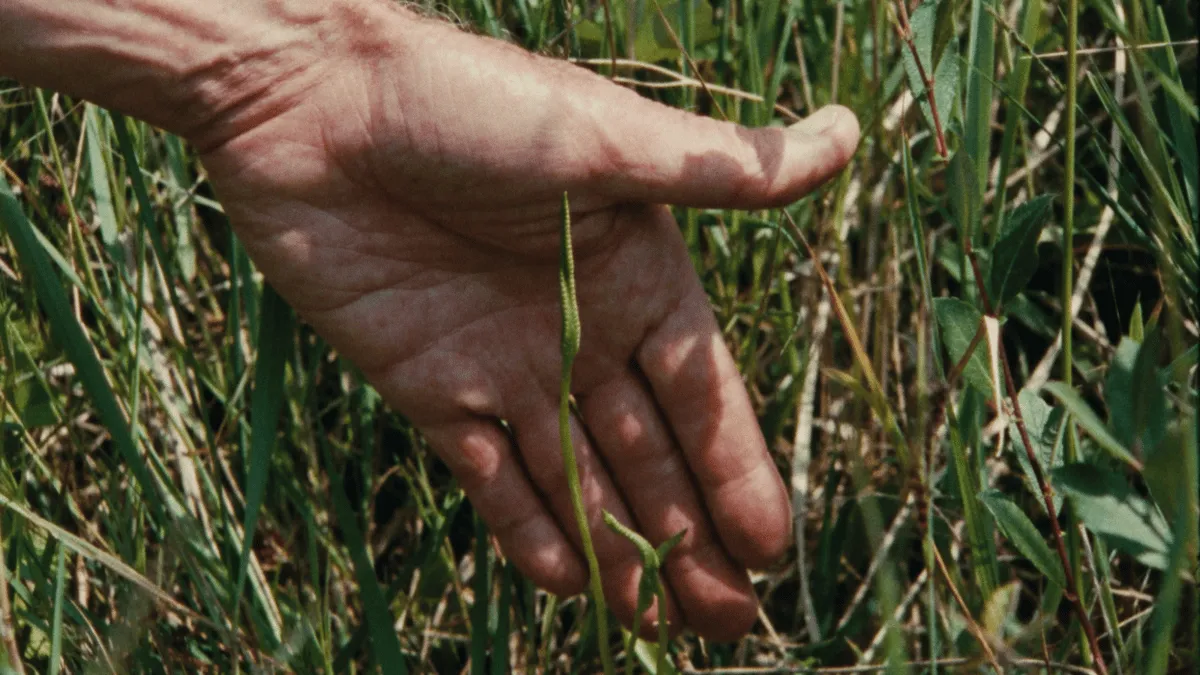
They are presented in static, painterly tableaux, their “souls,” as the film suggests, now captured for our consideration. Yet this immortality is an artifact, a human construction. The very act of preservation is a beautiful violence; in framing the perfect image, the living thing is severed from the wind, the earth, the cycle of decay.
Each carefully composed shot, while stunning, is a form of memento mori, a beautiful corpse. Brown’s voice returns, no longer in the field but from the disembodied, timeless space of a studio. His narration, now a calmer, more measured reflection, haunts these images like a memory layered over a dream.
The raw emotion is gone, replaced by a post-mortem meditation that creates a temporal gap between the voice and the image. The long-awaited reveal of a particularly significant plant arrives not with a shock, but with a gentle quietness. The release is subtle, suggesting the destination was never the point; the meaning was buried in the act of looking.
On Looking and Disappearing
The film’s dual structure is a philosophical proposition, a dialectic between the chaotic flux of lived experience and the ordered stasis of artistic representation. It asks where truth resides but offers no synthesis, leaving the tension unresolved for the viewer to hold. The humility it champions is a necessary response to a world that is ancient and indifferent.
Within Brown’s loving descriptions, one hears a quiet horror. The plants he seeks are relics, survivors from a time before human dominion, and their scarcity is a silent indictment. The film needs no images of industrial ruin; the absence of abundance speaks its own terrible truth. Brown’s gentle cataloging feels like the creation of an archive before an impending extinction, a final inventory of a world about to be lost.
This implicates us, the viewers. By watching, we participate in aestheticizing a living thing, turning a piece of the world into an object for consumption. The awareness the film offers is therefore double-edged, tainted with the melancholy of knowing that what we are seeing is already under sentence.
“7 Walks with Mark Brown” is a documentary film about a paleobotanist named Mark Brown who searches for native plants in Normandy to recreate an ancient garden. The film premiered at FIDMarseille on June 28, 2024, and had its US premiere at the New York Film Festival on September 28, 2024. The theatrical release in the USA was on June 20, 2025. It is distributed by Several Futures.
Full Credits
Directors: Pierre Creton, Vincent Barré
Writers: Pierre Creton, Vincent Barré
Producers: Arnaud Dommerc
Cast: Mark Brown, Pierre Creton, Vincent Barré
Director of Photography (Cinematographer): Pierre Creton, Antoine Pirotte, Sophie Roger
Editors: Pierre Creton, Vincent Barré
Composer: Sophie Roger
The Review
7 Walks with Mark Brown
A quiet, hypnotic, and deeply unsettling film, 7 Walks with Mark Brown is less a documentary than a philosophical meditation on time, observation, and our own fleeting place in the natural world. It trades narrative for a profound, contemplative stillness, demanding patience from its audience. The reward is a haunting examination of what it means to truly see, and the quiet horror of knowing that what you are seeing is already disappearing. It is a work of rare, challenging beauty.
PROS
- A profoundly meditative and patient atmosphere that encourages deep reflection.
- The two-part structure effectively contrasts the process of discovery with the act of artistic creation.
- Stunning 16mm cinematography in the second half presents nature with painterly beauty.
- Mark Brown is a captivating and deeply authentic central figure.
- Raises compelling philosophical questions about time, memory, and humanity's relationship with nature.
CONS
- Its extremely deliberate and slow pace may feel inaccessible or tedious to some viewers.
- Lacks any conventional narrative or dramatic conflict.
- The film's intellectual and existential themes can feel dense and demanding.