

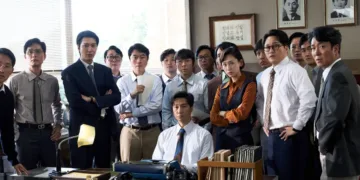

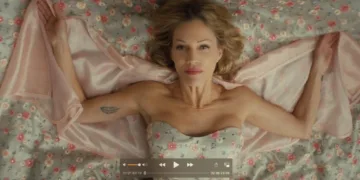










The air inside the world of After the Hunt is thin and pressurized, like a deep sea dive. The film immediately plunges you into the cloistered, intellectually supercharged environment of Yale University, a place where ideas are currency and reputations are everything. We meet Professor Alma Imhoff, played by Julia Roberts in a performance of tightly coiled intensity.
Alma is a formidable academic, chic and sharp, with her sights set firmly on a tenured position that feels like the culmination of her life’s work. The stage is set for a professional triumph, but a single conversation shatters the quiet ambition. After a faculty party hazy with wine and intellectual sparring, Alma’s star Ph.D. student, Maggie Resnick (Ayo Edebiri), arrives at her door with an accusation.
She claims that Alma’s closest colleague and friend, Hank Gibson (Andrew Garfield), sexually assaulted her. The accusation is a bomb, and Alma is standing at ground zero, caught between a decades-long friendship, a promising mentorship, and the career she has painstakingly built. The film becomes a tense exploration of loyalty, ethics, and the ideological battles that define our current moment.
Portraits in a Fractured Frame
At the film’s monumental center is Julia Roberts, giving a performance that redefines her screen presence with a bracing, unsentimental force. Her Alma Imhoff is a complex figure, a study in controlled contradictions. She is all sharp intelligence and professional polish on the surface, but Roberts reveals a messy, hard-drinking interior life fueled by a simmering ambition.
The performance is a masterclass in restraint. This is a role that feels miles away from her familiar persona, showing a brittle and often unlikable woman whose vulnerabilities are fiercely guarded. The mysterious stomach ailment that wracks her body with pain is a potent physical metaphor; it suggests a deep moral sickness within her environment, a repressed trauma that is literally eating her from the inside. Roberts uses a tense, rigid stillness to project Alma’s “coiled spring” intensity, so when her composure finally cracks, the fury is breathtaking.
Andrew Garfield’s Hank is her dynamic opposite, a charismatic academic peacock whose energy is performative and explosive. He is all unbuttoned shirts and chummy physicality, and Garfield plays him with a swagger that makes the accusations feel both plausible and deeply shocking to his carefully constructed world. His defense, that Maggie is a plagiarist lashing out, positions him as a modern victim of academic warfare.
Ayo Edebiri has the film’s most difficult task as Maggie, a character whose motivations are deliberately opaque. Edebiri navigates this ambiguity with incredible skill, presenting a young woman who is at once a credible victim and a “slippery” figure whose story has cracks. The screenplay loads her with identity markers—queer, Black, child of billionaire donors—that complicate her standing, making her both a protected and a targeted figure.
Surrounding them is a superb supporting cast. Michael Stuhlbarg is tragically brilliant as Frederik, Alma’s psychoanalyst husband. His quiet, doting nature curdles into a passive-aggressive resentment, punctuated by eccentric acts of domestic rebellion like blasting atonal music to disrupt tense conversations. He is an observer who can diagnose the world but remains mystified by his own wife. In a small but vital role, Chloë Sevigny’s jaded therapist Kim provides a weary, cynical voice for a generation that has already fought and lost these battles before.
Thematic Battlegrounds: Ideology and Ambiguity
After the Hunt wades directly into the choppy cultural waters of our post-#MeToo landscape, using the university campus as a petri dish for today’s most polarizing debates. The film is at its most interesting when it refuses a simple “he said/she said” structure, opting instead to operate in a messy ideological grey zone.

It suggests that objective truth might be an academic fantasy, especially when an accusation is filtered through personal bias, professional jealousy, and institutional politics. The story is less about solving a crime and more about dissecting the machinery of belief and the anatomy of a scandal. It is a cinematic reflection of our fractured public discourse, where empathy is often conditional and allegiance is predetermined.
The narrative is driven by the stark generational and cultural divide between the Gen X professors and their Gen Z students. Classroom discussions about the patriarchal sins of Homer are not just intellectual exercises; they are live-wire skirmishes in a larger ideological war. The script is saturated with the language of modern academia, debating concepts like performative discontent, virtue ethics, and the moral calculus of separating art from the artist.
The film also presents a complex ecosystem of privilege and power. It unpacks the various forms these forces take, from Hank’s institutional authority to Maggie’s social capital and immense family wealth. Alma wields the power of a mentor, yet she is rendered powerless by the institution’s fear of litigation. The film’s most unsettling idea is that every character in this elite world, regardless of their position on the social ladder, has constructed a narrative of their own victimhood to justify their actions and allegiances.
Guadagnino’s Authorial Stamp
Luca Guadagnino’s direction feels like a deliberate departure from the sensual, sun-drenched aesthetic of films like Call Me By Your Name. Here, his style is chilly and precise, creating a potent sense of psychological claustrophobia. The hallowed halls of Yale are transformed into a labyrinth of paranoia, shot with a stark, autumnal palette that feels emotionally muted.

Malik Hassan Sayeed’s cinematography is key to this atmosphere. His camera often isolates Alma with a shallow depth of field, blurring her surroundings into an indistinct threat. In moments of high tension, the camera becomes an agitated observer, stalking characters down hallways with a nervous energy that mirrors their internal states. It’s a visual language of imbalance and distrust.
The film’s most audacious gesture is its opening credit sequence. Seeing that white Windsor font on a black background, a direct homage to Woody Allen, was a strange experience in a packed theater. The choice feels like a calculated provocation in 2025, a way of immediately priming the audience for a story about accusation, reputation, and the murky space between an artist’s life and work.
The soundscape is equally confrontational. The score by Trent Reznor and Atticus Ross is one of their most abrasive, a far cry from their more ambient compositions. It is an intrusive, dissonant force, built from atonal piano stabs and sharp, industrial sounds. The music refuses to provide any emotional comfort, instead amplifying the feeling of a constant, low-grade panic that hums beneath the surface of every scene.
The Intellectual Labyrinth of the Screenplay
Nora Garrett’s debut screenplay is a work of immense ambition, aiming to capture a complex cultural moment with intellectual rigor. Its greatest strength is its nuance, but this is sometimes offset by a script that can feel arid and “overintellectualized.”

The dialogue is dense with philosophical concepts, and there are moments where the characters sound less like authentic people and more like articulate mouthpieces for competing academic theories. The film can occasionally feel like a Socratic dialogue or a thesis paper brought to life, a risk that comes with tackling such heady subject matter.
The story is structured less like a traditional drama and more like a mystery, consistently raising questions of guilt and intent. This approach is effective at building suspense, but it is complicated by several subplots, including Alma’s illness and a hidden secret from her past. These narrative threads are meant to add psychological depth, but they can feel like melodramatic flourishes that distract from the central conflict.
It is debatable whether the eventual revelations re-contextualize the present events in a satisfying way. The film’s most polarizing feature will surely be its refusal to provide a clean resolution. The ambiguous ending, which withholds a definitive answer about what happened, forces viewers to sit with their discomfort and examine their own biases. It is either a brave reflection of life’s frustrating lack of certainty or a frustrating narrative choice that constructs a compelling moral problem only to evade the responsibility of exploring its consequences.
After the Hunt is a psychological thriller film that had its world premiere out of competition at the 82nd Venice International Film Festival on August 29, 2025. Directed by Luca Guadagnino and produced by Amazon MGM Studios and Imagine Entertainment, the movie is scheduled for a limited theatrical release in the United States on October 10, 2025, before a wide release on October 17, 2025. It is expected to become available for streaming on Amazon Prime Video after its theatrical run.
Full Credits
Director: Luca Guadagnino
Writers: Nora Garrett
Producers and Executive Producers: Brian Grazer, Allan Mandelbaum, Luca Guadagnino, Jeb Brody, Daniela Venturelli (Producers), Karen Lunder, Nora Garrett, Alice Dawson, Justin Wilkes (Executive Producers)
Cast: Julia Roberts, Ayo Edebiri, Andrew Garfield, Michael Stuhlbarg, Chloë Sevigny, Lío Mehiel, Ariyan Kassam, Will Price, Thaddea Graham, Christine Dye, Burgess Byrd
Director of Photography (Cinematographer): Malik Hassan Sayeed
Editors: Marco Costa
Composer: Trent Reznor, Atticus Ross
The Review
After the Hunt
After the Hunt is an intellectually bracing and superbly acted drama, anchored by a commanding, career-redefining performance from Julia Roberts. The film is a chilly, precise dissection of academic warfare and our fractured cultural moment. Its refusal to offer easy answers is both its greatest strength and its most frustrating quality. This is a challenging, thought-provoking film that impresses with its craft and bravery, even if its cold, analytical approach keeps the viewer at a deliberate distance. It respects your intelligence but offers little comfort.
PROS
- A powerhouse, career-best performance from Julia Roberts.
- Excellent supporting cast, particularly Andrew Garfield and Ayo Edebiri.
- Intelligent and timely exploration of complex social themes.
- Stylish, atmospheric direction and cinematography.
CONS
- The script can be overly intellectual and arid, with characters feeling like ideological mouthpieces.
- A deliberately ambiguous ending that may frustrate some viewers.
- The cold, dissonant tone creates an emotional distance.
- The narrative is overloaded with subplots that can feel distracting.