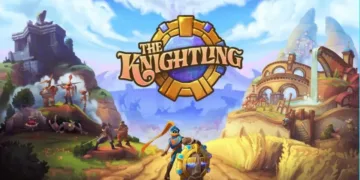
























The Knightling places players in the small boots of an apprentice to the world’s greatest hero, Sir Lionstone. The adventure begins on a routine patrol that quickly turns dire. After a confrontation with a powerful creature, Sir Lionstone disappears, leaving his young squire with nothing but his legendary shield, Magnustego. This single object becomes the Knightling’s inheritance and burden.
The game immediately sets a charming, family-friendly tone, casting the player as an underdog on a grand quest. This premise is the narrative’s strongest hook. You are not a destined champion but a trainee forced to grow into a role that feels several sizes too large. The colorful land of Clesseia awaits, promising a lighthearted journey to find a missing mentor and perhaps discover a hero within.
A Charming but Conventional Kingdom
The world of Clesseia is immediately striking for its aesthetic, which opts for a chunky, stylized presentation over photorealism. Character models have exaggerated proportions, and everyone in this knightly society remains perpetually helmeted, their personalities conveyed through a pair of expressive eyes and animated body language.
This design choice gives the world a tangible, toy-like quality. The environments are vast and colorful, though the palette can sometimes appear a bit flat, lacking the deep saturation that would make the landscapes truly pop. Still, the art direction succeeds in creating a grand sense of scale. Standing on a cliff edge to look out over a sprawling valley or approaching a massive palace for the first time are moments where the game’s visual ambitions are fully realized.
The world is a mixture of a cheerful, medieval-inspired kingdom and the mysterious, angular ruins of a far more technologically advanced civilization, creating an undercurrent of history and mystery beneath the otherwise sunny atmosphere.
This lighthearted feeling is cemented by the game’s approach to dialogue and storytelling. The cast of characters communicates almost entirely through emotive, comedic mumbling. This technique forces the narrative to rely on strong physical animation and clever visual gags to communicate intent and humor, a method that recalls the classic 3D platformers of the late 1990s. It is a decision that largely succeeds, creating an endearing and universally understandable comedic language that prevents the story from becoming bogged down in exposition.
The central narrative, which follows the Knightling’s efforts to find Sir Lionstone while helping citizens along the way, is straightforward but effective. It provides a constant forward momentum without ever feeling too dire, making it a suitable adventure for a wide audience. The story is less about a world in peril and more about a young person’s personal growth and the discovery of their own capability.
When it comes to structure, however, The Knightling is far less inventive. The game is built upon the familiar scaffolding of the modern open-world genre. The player’s experience is guided by a map populated with icons that mark points of interest, main quest objectives, and side activities.
This design provides constant direction, but it can also drain the world of some of its potential for organic discovery. Exploration sometimes feels less like a journey into the unknown and more like executing a checklist. The gameplay loop of traveling to a marker, completing a specified task, and receiving a reward is a well-worn path.
What saves this from becoming entirely rote is the quality of the content itself. The side quests often display a creative spark and sense of humor that the main structure lacks. One task might have you searching a sewer for rare flowers to help a hapless knight woo his beloved. Another might involve gathering ingredients for a famously terrible-smelling cheese to satisfy a local baron’s strange tastes.
These small, self-contained stories do an excellent job of building out the world and giving its inhabitants personality. The world is also dotted with dungeons that contain more focused challenges.
These areas often feature clever environmental puzzles reminiscent of a Zelda shrine, requiring the player to manipulate switches, find trigger plates, and think through clever spatial conundrums. The puzzles are generally not difficult enough to cause significant frustration, but they provide a welcome change of pace from the combat and exploration of the overworld.
An Unwieldy Inheritance
Magnustego is the mechanical heart of The Knightling, an all-in-one tool that dictates how the player moves and fights. The game’s most imaginative system is its shield-based traversal. By holding a button, the Knightling can hop onto the shield and surf down any sloped surface. When you find a long, uninterrupted hill, this mechanic truly sings.

You can build up impressive speed, careening through forests and fields in a thrilling display of momentum. In these moments, getting from one place to another becomes its own reward. The system, however, is brittle.
The physics that govern the shield sliding feel inconsistent and unforgiving. Hitting a small rock or attempting to slide up even a minor incline can kill your momentum instantly, resulting in a jarring stop that breaks the exhilarating flow. The experience often feels like a gamble, a binary state of either pure speed or frustrating inertia.
When not sliding, the Knightling relies on more standard platforming abilities, including a double-jump and a dash. These controls are functional, allowing you to clear gaps and navigate complex terrain, but they lack the personality of the shield mechanics. The jump, in particular, has a floaty quality that can make precision movements difficult.
There is a noticeable disconnect between the input and the character’s movement, which can lead to misjudged leaps. Later in the game, an unlockable gliding ability adds a much-needed layer to traversal, giving the player more control over their descent and opening up new paths for exploration. It feels like a necessary addition to compensate for the primary movement systems’ limitations.
The shield also serves as the Knightling’s sole weapon, and the combat system is built around this limitation. The design is ambitious, attempting to distill the complex inputs of a character action game into a more accessible format. A single attack button can be used to execute a basic three-hit combo, and upgrades unlock more advanced techniques like launchers for aerial combat and a powerful shield throw.
The defensive options are equally important. You can block most incoming attacks, but the most crucial skill is the parry. Executing a parry with precise timing will deflect an attack and briefly stun the aggressor, creating a vital opening for a counterattack. Mastering this defensive maneuver is essential for managing the large groups of enemies the game frequently throws at you.
For all its ambition, the combat system feels unrefined in practice. Its deeper mechanics are consistently undermined by a collection of foundational issues. The most glaring omission is a proper lock-on system. Without the ability to focus on a single target, combat in a crowd becomes a chaotic affair. It is difficult to direct your attacks precisely, and you will often find yourself swinging at the air while a different enemy attacks you from the side.
The camera struggles to keep up with the action, meaning attacks from off-screen are a constant threat. The controls themselves can feel sluggish. There seems to be a delay between a button press and the corresponding action, and animations for both attacking and defending have long recovery periods.
This creates a clunky feeling that discourages aggressive play and makes switching from offense to defense a fumbling process. The combat is competent enough to be passable, but its many small frustrations prevent it from ever feeling truly fluid or satisfying.
Cracks in a Colorful Veneer
From a presentation standpoint, The Knightling makes a strong first impression. The endearing, stylized art direction is a consistent visual treat, and the game’s world is brought to life by a truly wonderful orchestral score. The music is a major highlight, perfectly capturing the spirit of adventure.

It swells to epic, sweeping themes as you explore the open plains and shifts to more playful, lighthearted melodies during comical side quests. The sound design is mostly effective, with the charming character mumbling adding a great deal of personality. This makes the game’s most significant audio misstep all the more noticeable.
The shield, Magnustego, is fully voiced and speaks to the Knightling throughout the game. While this works as a narrative device, the shield’s lines are extremely repetitive. Hearing the same few phrases chastising you for dodging or reminding you of your objective becomes grating very quickly. It is an intrusive element that disrupts the otherwise pleasant soundscape.
This one questionable design choice is indicative of a broader problem: a pervasive lack of polish that affects nearly every aspect of the experience. The technical state of the game is precarious. The camera is a persistent source of frustration, often getting stuck on parts of the environment or swinging wildly during combat, obscuring the player’s view at critical moments.
Performance is also unstable, with noticeable frame rate drops occurring during intense sequences with many enemies or effects on screen. These dips make the already imprecise platforming and sluggish combat feel even worse. Visual glitches are common, from textures that are slow to load in, to environmental objects that pop into existence only a few feet away from the player.
The most egregious technical flaw, however, is a recurring, critical bug that can halt progress entirely. When entering or leaving certain dungeons and major areas, the game has a tendency to freeze on the loading screen. The loading bar will fill, the background animation will continue to play, but the game itself becomes unresponsive.
The only solution is to force-quit the application and restart it. Because the game autosaves frequently before these transitions, players can find themselves reloading into the same broken state, forced to replay sections of the game. This is not a minor inconvenience; it is a fundamental stability issue that shows a lack of proper testing. It is a deep crack in the game’s otherwise charming facade, one that can easily turn an enjoyable adventure into a deeply frustrating one.
The Review
The Knightling
The Knightling is a deeply endearing adventure with a charming world and an ambitious set of core ideas. Its wonderful art style and fantastic musical score create a compelling atmosphere for a lighthearted quest. This strong presentation is sadly undermined by a severe lack of polish. Unrefined combat, inconsistent traversal, and a host of technical issues, including a game-freezing bug, hold the experience back from its clear potential. It is a game with a great deal of heart but not enough finesse to fully recommend.
PROS
- Charming art style and endearing world.
- Excellent orchestral soundtrack.
- Fun and humorous side quests.
- Ambitious and unique shield-based mechanics.
CONS
- Combat and traversal feel unrefined and clunky.
- Significant technical issues and lack of polish.
- A major bug can freeze the game on load screens.
- Repetitive voice lines from the main companion.