




















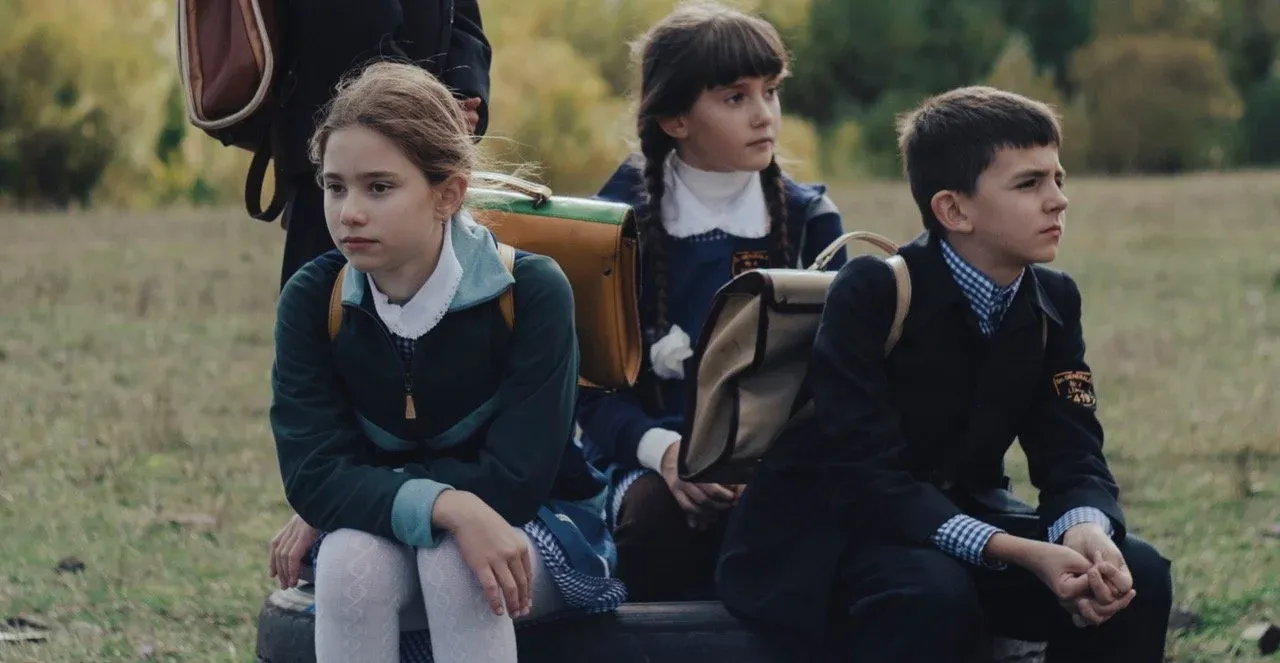

Romania, 1989. In the suffocating gray air of the Ceaușescu regime’s final months, life moves with a heavy, predictable rhythm. It is a world of concrete apartment blocks and the quiet dread of a state in decay. A mundane domestic chore initiates the film’s central fissure in reality.
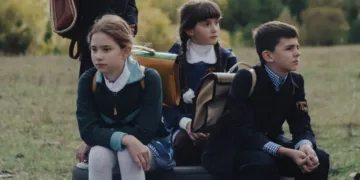
Young Alina is sent to dispose of a bucket of walnut shells. She walks out of the frame and never returns. This casual vanishing act is witnessed by her ten-year-old sister, Maria, who becomes the silent repository for the event. The narrative that follows is not one of investigation but of absorption, filtering a family’s agonizing collapse and a nation’s slow-motion implosion through a child’s unblinking eyes.
Through a Child’s Eyes
The film’s perspective is relentlessly anchored to Maria, locking the viewer inside her limited, bewildered consciousness. Her reaction to the traumatic void left by her sister is a difficult study in opacity. One could read her impassivity as a defense mechanism, the only rational response to an irrational event. She appears numb, a small stoic navigating a new and hostile landscape defined by absence.

This stillness, however, conceals a potent combination of guilt and solitude, as it was Maria’s chore that Alina performed. She attempts to impose order on this new chaos through childhood ritual. She and her friends play detective in vast, empty industrial hangars, a child’s attempt to force a genre narrative onto a terrifyingly formless reality.
She clutches a single walnut as a talisman, a hard, tangible link to the last moment of normalcy. The performance from Emma Ioana Mogoș is an exercise in sublime restraint. She avoids the typical beats of cinematic grief, instead using her steady gaze and quiet posture to convey a state of pure observation.
It is a work of profound authenticity, forcing us to question what we expect from a victim. We see her parents disintegrate through this same filter: her mother’s frantic, outward search for answers and her father’s mute, inward collapse. Their separate agonies create a pincer movement of grief that completely isolates her.
A Sensory Portrait of Fear
Director Mihai Mincan constructs a potent atmosphere of dread through meticulous, neo-noir cinematic technique. George Chiper-Lillemark’s cinematography gives the world a hazy, dreamlike patina, achieved with a soft focus that suggests the entire film is a half-recalled, traumatic memory.
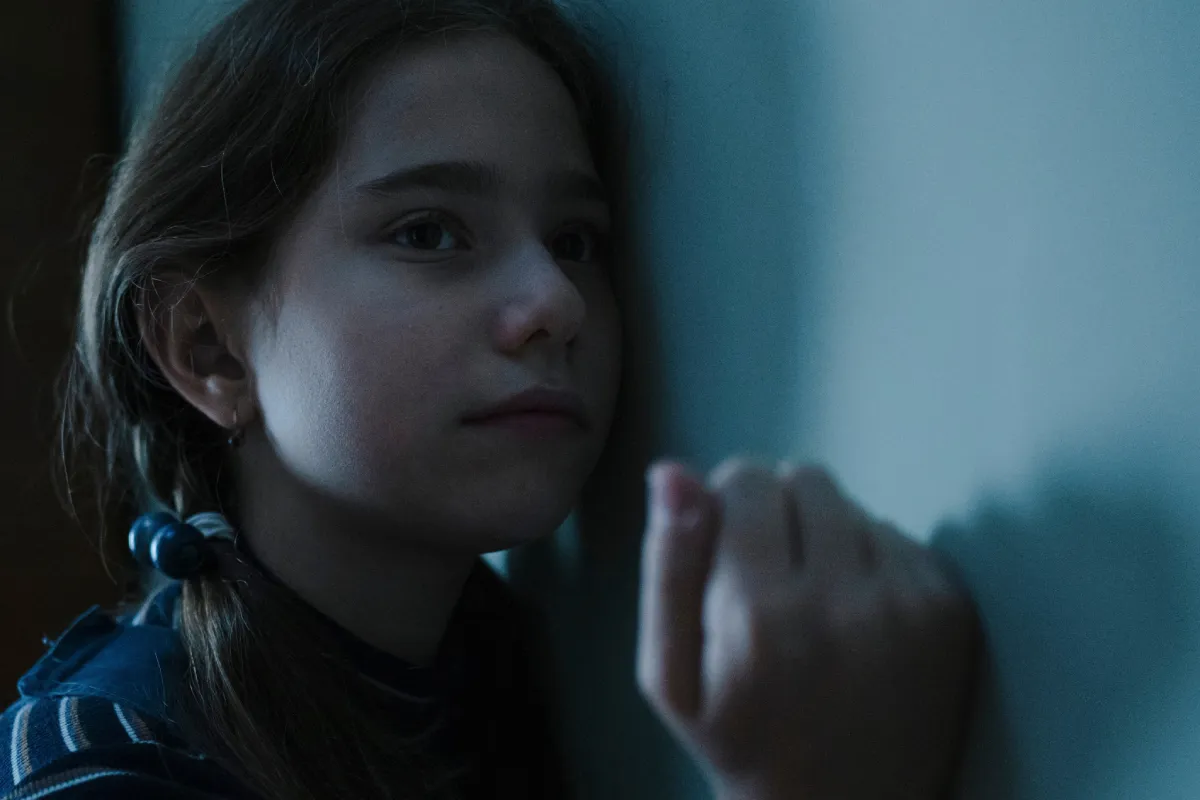
The camera stays intimately close to Maria, its hand-held movements forging a subjective bond, before pulling back to stark, alienating wide shots of the housing estate’s brutalist architecture. This visual rhythm creates a constant tension between personal claustrophobia and impersonal emptiness.
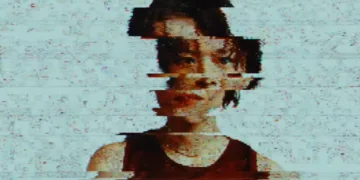
Certain sequences abandon realism entirely, descending into pure nightmare with a deep, bloody red chiaroscuro that externalizes Maria’s inner terror. Nicolas Becker’s sound design is the film’s secret weapon.
He crafts a muffled, psychological soundscape that erects an auditory wall between Maria and the world. Unexplained rustles and scratches bleed into the diegesis, suggesting a malevolence lurking just outside the frame. The distant, distorted echo of a Pet Shop Boys song provides a moment of wry, tragic irony: a ghost of Western optimism haunting a world without it.
The film’s deliberate, slow pacing is a thematic tool, forcing the audience to inhabit the stasis of unresolved grief. The elliptical editing mirrors the fragmented nature of traumatic memory, denying us the comfort of a linear plot.
A Nation’s Fracture
The film’s private tragedy operates as a potent political allegory. Alina’s disappearance becomes a metonym for an entire “lost generation,” casually erased by the apathy and paralysis of a crumbling state. The police investigator’s tired, bureaucratic indifference is a perfect microcosm of the regime’s relationship with its people. He is not a villain, just a functionary of a system that has ceased to care.
Mincan loads the film with quiet symbolism, most pointedly in a scene where Maria joins the Pioneers youth group. She stands in a clean uniform and pledges loyalty to a socialist republic that, unbeknownst to her, has mere weeks left to exist. The oath is a hollow echo in a historical vacuum, a performance of a social contract already broken.
By refusing to depict the 1989 revolution directly, the film makes its sharpest point. History is not the grand, televised event but the personal wreckage left in its wake. The real collapse happened long before the dictator fell, in the quiet decay of families and communities. The film suggests Maria’s painful maturation runs parallel to Romania’s own violent, uncertain passage from one kind of darkness into another.
Milk Teeth is a Romanian drama film that premiered in the Horizons competition at the 82nd Venice International Film Festival on August 29, 2025. The film was inspired by the non-fiction book Atomic Bazaar by journalist William Langewiesche. The film is set to be released in Romania on October 17, 2025. It is also scheduled to be screened at the Toronto International Film Festival.
Full Credits
Director: Mihai Mincan
Writers: Mihai Mincan
Producers and Executive Producers: Radu Stancu, Ioana Lascăr (Producers), Cyriac Auriol, Monica Hellström, Konstantinos Vassilaros, Poli Angelova, Nikolay Todorov (Co-producers)
Cast: Emma Ioana Mogos, Marina Palii, Igor Babiac, István Téglás, Ada Lupu, Cătălin Filip, Mihaela Rădescu, Liana Mărgineanu, Tudor Morar
Director of Photography (Cinematographer): George Chiper-Lillemark
Editors: Dragoș Apetri
Composer: Marius Leftărache
The Review
Milk Teeth
Mihai Mincan’s film is a demanding piece of cinema, one that trades narrative momentum for a deeply immersive and unsettling atmosphere. Anchored by a wonderfully restrained central performance, the film masterfully uses sound and image to portray a child’s perspective on collapse. While its deliberate slowness may frustrate some viewers, its psychological depth and potent political subtext make it a haunting and artistically confident work. It is a powerful meditation on the way historical trauma quietly poisons private lives.
PROS
- Exceptional, atmospheric cinematography that creates a hazy, memory-like quality.
- Masterful and immersive sound design that heightens psychological tension.
- A superb and naturalistic central performance from Emma Ioana Mogoș.
- Rich allegorical depth connecting personal trauma to national history.
- Unwavering commitment to its unsettling mood and singular perspective.
CONS
- The deliberately slow pacing will be a barrier for some audiences.
- An elliptical narrative that offers few conventional plot points or resolutions.
- The protagonist’s opacity can make the film feel emotionally distant at times.