


























A life is not a ledger of years but an accumulation of textures, a private cartography of the soul. For María Ángeles, an elderly Spanish woman rooted in the sun-bleached earth of Tangier, existence is measured in the smooth slip of market grains through her fingers, in the specific slant of light across a familiar wall at dusk.
Her apartment on Calle Malaga is less a dwelling and more a physical archive of her spirit, each object a repository of memory, each worn surface a testament to a life lived. Director Maryam Touzani immerses us in this sensory world from the first frame, a space where the self and its surroundings have fused over a lifetime of quiet rituals.
Into this fragile peace walks her daughter, Clara, a messenger from a different world, one of grim practicality and urgent needs. She brings news of a sale, an eviction notice not just from a property but from a life’s narrative, threatening to liquidate meaning and dismantle the very architecture of María’s being.
A Portrait of Defiant Existence
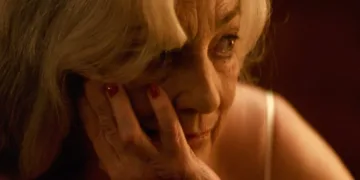
At the film’s center is Carmen Maura’s face, a landscape etched with the profound truths of a long life, a map of joy and sorrow. Her performance is the film’s powerful anchor, a study in the difficult art of remaining visible when the world wishes you to fade. As María, Maura presents a woman who refuses the quiet obsolescence society prescribes for her age.

She is a creature of immense, sometimes prickly, resilience. Her wit is not a charming quirk; it is a sharpened tool against the absurdity of her situation, a way to assert her mind’s sovereignty. When banished to a sterile nursing home, a place of managed decline, her feisty retorts are declarations of a selfhood that will not be institutionalized. She uses her vulgar humor as a shield and a statement, a refusal to be made placid or docile.
Maura charts the character’s inner world with startling precision. A gaze can hold the cold fury of displacement one moment, then melt into the radiant warmth of belonging the next. She shows a woman stripped of her context, fighting to prove she still exists. The performance is a masterclass in physical storytelling; the slight slump of her shoulders in defeat, the renewed strength in her spine when a plan begins to form. She is not a victim awaiting rescue.
María is an active agent of her own preservation, her schemes a form of guerilla warfare against erasure. Her humorous, one-sided confessions to her friend Josefa, a silent nun, become a brilliant narrative device. It is more than exposition; it is the act of speaking one’s truth into a receptive void, a way of affirming her existence without the complication or judgment of a reply. It is a portrait of a person demanding to be the author of her own final chapters.
The Grammar of Resistance
What is a home if not the place where the self is allowed to cohere? Calle Malaga explores this question with quiet, philosophical insistence. María’s rebellion is a deeply personal fight against a modern logic that renders all things, including people, fungible assets on a balance sheet. Her struggle against her daughter is a poignant clash of temporalities and perspectives.
Clara, caught in the urgent demands of her own fractured present, sees the apartment as a disposable solution, a means to an end. For María, it is the irreplaceable vessel of her past and the very stage for her present. The film wisely refrains from making Clara a simple villain; she is another soul trapped by circumstance, her pragmatism a survival mechanism. This complexity makes their conflict a genuine tragedy of competing, valid needs.
Into this drama of attachments, a late-life romance with the antiques dealer, Abslam, unfolds with startling sincerity. Their connection is not a sentimental afterthought. It represents the possibility of a new beginning when the old world has been emptied out. It asserts that desire and connection are not the exclusive province of the young, offering a tender counterpoint to María’s fierce public battles.
Their relationship is handled with an affection that avoids caricature, celebrating sexuality in later years as a natural and dignified expression of life. The film finds a strange, beautiful harmony between its comedic moments and its undercurrent of sorrow. The humor derived from María’s bluntness is not just for levity; it is the laughter of the absurd, a recognition of life’s inherent contradictions and a final, powerful tool of defiance.
Light as Memory, Sound as Ghost
Maryam Touzani’s direction is an act of intimate witnessing, a meditation on the objects and spaces that hold our stories. Her camera does not merely look; it seems to touch, lingering on the surfaces and textures that constitute María’s world with an almost haptic quality. The cinematography by Virginie Surdej bathes Tangier in a sun-drenched, painterly light.
This is not for simple beauty, but to create an elegiac mood, imbuing every frame with the heavy weight of what might be lost. The visual style is intensely personal, often holding close on Maura’s face, inviting us to read the complex, fleeting emotions written there. The apartment itself is filmed as a living character, its rooms breathing with history.
Sound becomes a crucial ghost in this house of memory. The recurring melody of “Toda Una Vida” (“A Whole Life”) is a narrative thread, its meaning transforming as María’s circumstances shift. It begins as a private hymn of grief and nostalgia, becomes an anthem of defiant reclamation, and finally settles into a quiet note of future hope.
This thoughtful use of music elevates it beyond simple score. While some supporting characters remain sketches, their faintness on the periphery only sharpens the focus on the figure at the story’s core. Their lack of depth may be a flaw, yet it reinforces the film’s central perspective. The film stands as a profound and moving portrait of one woman’s refusal to vanish, a testament to a life that insists on its own irreducible, unmarketable value.
Calle Malaga is a drama film that had its world premiere at the 82nd Venice International Film Festival on August 29, 2025. It will be released theatrically in France by Ad Vitam on March 16, 2026, and in Spain by Caramel Films in early 2026. The film is Maryam Touzani’s Spanish-language directorial debut. It is available to watch in select theaters as part of the Toronto International Film Festival (TIFF) as of September 9, 2025.
Full Credits
Director: Maryam Touzani
Writers: Maryam Touzani, Nabil Ayouch
Producers and Executive Producers: Nabil Ayouch, Amine Benjelloun, Sol Bondy, Fred Burle, Simón de Santiago, Olivier Père, Jean-Rémi Ducourtioux
Cast: Carmen Maura, Marta Etura, María Alfonsa Rosso, Ahmed Boulane, La Imèn, Miguel Garcés, Tarik Rmili, Mohamed Naimane
Director of Photography (Cinematographer): Virginie Surdej
Editors: Teresa Font
Composer: Freya Arde
The Review
Calle Malaga
A moving character study anchored by a magnificent lead performance. While its narrative structure holds few surprises and its secondary characters are thinly drawn, the film succeeds on the strength of its profound central theme. It is an intimate, beautifully rendered portrait of a woman’s fight for selfhood against the quiet erasure of old age, a sincere and affecting picture about the irreducible value of a life's accumulated meaning.
PROS
- Carmen Maura delivers a powerful, deeply nuanced performance that anchors the entire film.
- The direction is intimate and sensory, immersing the viewer in the protagonist's world.
- A thoughtful and dignified exploration of aging, independence, and the meaning of home.
- The sincere handling of late-life romance and desire.
CONS
- Supporting characters, particularly the daughter, lack sufficient development.
- The instrumental score can feel overly sentimental at certain moments.
- The plot follows a somewhat predictable path.