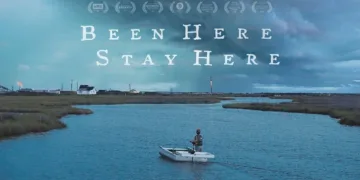



























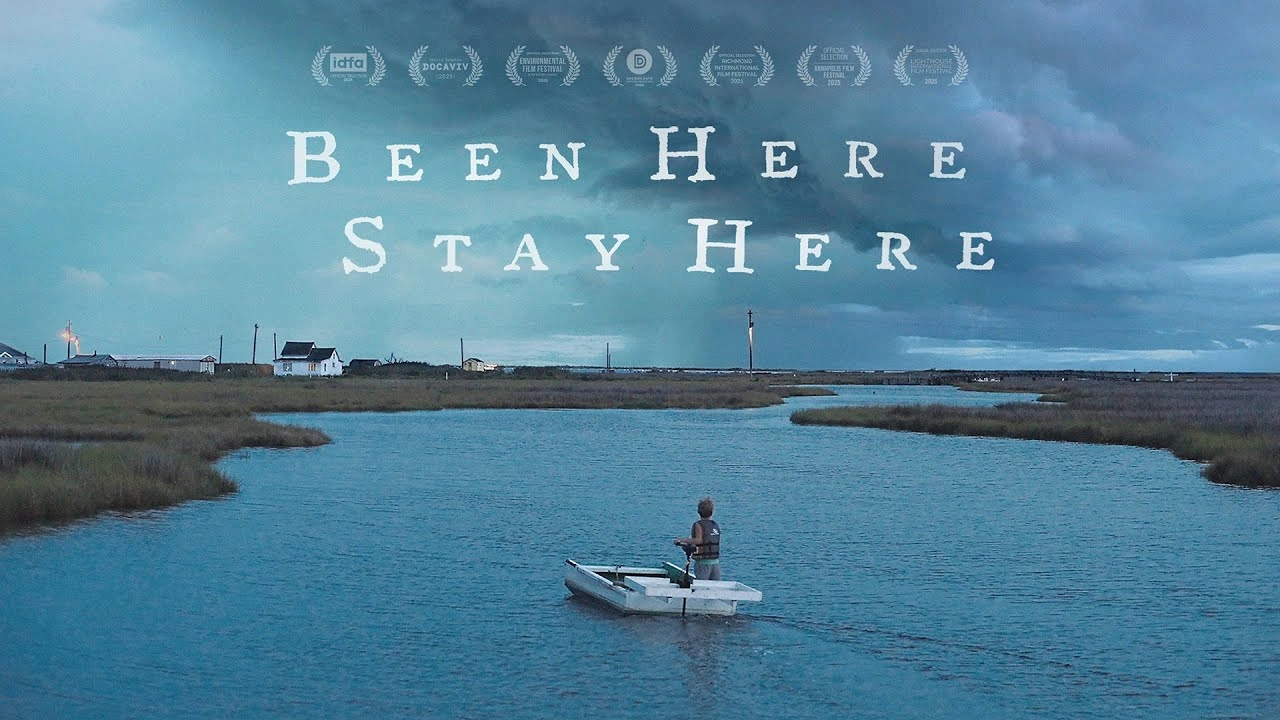

The tide keeps its own terms, and David Usui understands the narrative force of that fact. In his solo feature directorial debut, Been Here Stay Here, he places his camera on Tangier Island, a five-foot-high ridge of sand and shell set in the middle of the Chesapeake Bay. For over two centuries, this Virginia outpost has watched the Atlantic eat away at its borders, losing two-thirds of its total land mass to erosion and rising sea levels.
Experts project total submersion before the century ends, yet Usui keeps the standard environmental documentary toolkit offscreen: animated charts, stern academic authorities from the mainland, urgent warnings about carbon footprints.
The film takes the form of a quiet observational study of a few hundred soul-stubborn residents who look at a vanishing shoreline and recognize home. Its story belongs to a place where memory is pulled into the surf one tide at a time, and where identity is built through the refusal to leave.
A Generational Framework in Real Time
Usui works inside a strict cinema vérité frame, using a fly-on-the-wall perspective that lets the island set its own rhythm. With traditional voiceover narration and explanatory infographics removed, the film asks the viewer to read meaning through small, persistent habits.
Watermen haul crab pots from grey water. Congregations fan themselves in wooden pews. Tour guides repeat familiar local histories to day-trippers. Young children ride bicycles through narrow, flooded lanes. The structure is patient, sometimes stubbornly so, which suits a film about a community trained by repetition, weather, and waiting.
The story gains progression through a three-part generational design. Mayor James Eskridge functions as the town’s political and spiritual anchor, giving the film its clearest expression of survival as protection of Tangier’s sovereign identity. His presence steadies the documentary, providing a civic frame for a place that sees outside judgment as another incoming tide.
Cameron Evans, a college student who crosses the water to attend Virginia Wesleyan on the mainland, carries the pressure of transition. His strand gives the film a needed bridge between a modern education and an ancient, sinking heritage. Through him, the documentary asks what happens when a young islander must carry belonging, ambition, and inherited place at once.
Seven-year-old Jacob Parks gives the film its sharpest future tense. Usui films him learning the traditional waterman trade from elders who openly wonder if his generation will inherit an island at all. That uncertainty lands with the plainness of a practical lesson.
Usui adds narrative disruptions that keep the daily vignettes from flattening into atmosphere. A visiting German documentary crew interviews residents, a smart meta-textual choice that exposes the gap between international media expectations and local reality. A young visiting pastor creates further tension by trying to open dialogue between climate science and conservative Christian theology.
Fragments of archival film from fifty years ago deepen this structure, reminding the viewer that Tangier has been watching its own slow-motion disappearance across generations. The old footage gives the present-day scenes a quiet ache, since the film’s future is already visible in its past.
The Intersection of Belief and Sovereignty
Tangier Island’s cultural life is shaped by deep evangelical Christian faith, the main lens through which residents interpret their changing environment. For much of the population, rising water reads as an expression of divine sovereignty and natural cycles. Their interpretation rejects the idea that industrial civilization stands as the main accused. This worldview closely aligns with the community’s rigid political identity, reflected in the island’s 88 percent vote for Donald Trump in the 2024 national election.

Usui treats this ideological friction with careful empathy. He does not frame the residents’ skepticism toward mainstream climate science as intellectual failure. The film understands faith as a working system of endurance, showing prayer as the language these residents use to process physical instability. That choice gives the documentary its fairest register. It recognizes the limits of the residents’ position without turning them into specimens pinned under a glass slide.
Under the theological surface runs a sharper current of political frustration over infrastructure and state governance. The film records a shared grievance among the watermen: neighboring Maryland has built heavy stone sea walls to protect its own bay islands. Virginia has repeatedly declined to fund similar engineering projects for Tangier after mainland bureaucrats calculated the costs and benefits.
That perceived abandonment intensifies Tangier’s insular pride. Leaving the island is never treated by the residents as standard economic relocation or sensible adaptation to environmental risk. For the people living along these ridges, abandoning Tangier means the erasure of lineage, a surrender of the lifestyle that has sustained them since the eighteenth century. Usui’s narrative strength lies in letting that logic reveal itself from the inside, even as the water outside keeps making its own counterargument.
Tactile Realism and Meditative Rhythms
The visual grammar established by Usui and co-cinematographer Peter Steusloff avoids the glossy postcard polish common to modern nature documentaries. The imagery favors weathered, tactile realism, turning toward the island’s rough surfaces: rotting dock timbers, wet mud, rusted boat engines, wrinkled skin, and wind-battered marsh grasses. These lived-in textures stress the physical labor required to exist in this environment. James William Blades’ ambient, soothing musical score supplies a melancholic background that deepens the elegiac tone without smothering it.
The 85-minute runtime moves at a slow, meditative pace that mirrors the island’s geographic isolation. The unhurried accumulation of everyday scenes builds an immersive atmosphere, and it also creates structural friction likely to test general audiences. This is where Usui’s faith in observation begins to look a bit too devout.
Certain observational sequences, especially the extended passages inside the local Methodist and non-denominational churches, linger past their narrative use. These scenes repeat similar emotional notes, and the film’s momentum stalls as it circles familiar thematic ground without adding fresh analytical pressure. The patience that gives the documentary its texture also becomes its main structural risk.
Those pacing missteps do little to weaken the technical achievement. By fixing its gaze on the material reality of a community built on shifting sand, the cinematography captures the visual logic of a world nearing collapse. Been Here Stay Here records fragile lives before the geographic clock runs out, giving Tangier’s story the shape of a final account taken in real time.
Been Here Stay Here initially held its world premiere at the International Documentary Film Festival Amsterdam on November 19, 2024, before traveling across various local communities and film festivals throughout 2025. Following its specialized regional tours, the film launched its theatrical run at the Quad Cinema in New York on May 15, 2026, with subsequent engagements scheduled for Laemmle Theatres in Los Angeles on May 27, 2026. Audiences looking to watch this non-fiction study can currently catch it during its limited domestic theatrical release courtesy of Grasshopper Film.
Full Credits
Title: Been Here Stay Here
Distributor: Grasshopper Film
Release date: November 19, 2024
Running time: 86 minutes
Director: David Usui
Writers: David Usui
Producers and Executive Producers: Giorgio Angelini, David Usui, Nicole Shipley, Jaden Levitt
Cast: James Eskridge, Cameron Evans, Jacob Parks, Kyle Meyaard-Schaap, Yasmin Ismail, David Schulte
Director of Photography (Cinematographer): Peter Steusloff, David Usui
Editors: Liz Rao, David Usui
Composer: James William Blades
The Review
Been Here Stay Here
Been Here Stay Here rejects the aggressive rhetoric of traditional environmental filmmaking, opting instead for an intimate, observational approach. David Usui succeeds in presenting a community defined by endurance, allowing the geographic reality of Tangier Island to emerge organically through the lens. While the meditative rhythm occasionally stalls during repetitive church sequences, the documentary functions as a deeply empathetic and visually arresting portrait of structural loss. It demands that audiences look beyond political calculations to witness the human cost of a vanishing heritage.
PROS
- Rejects data-heavy lecturing in favor of an immersive, observational framework.
- Captures a poignant multi-generational perspective through three distinct local figures.
- Displays gorgeous, tactile cinematography that highlights the weathered beauty of the island.
- Approaches the residents' deeply conservative worldview and faith with genuine empathy.
CONS
- The unhurried pacing creates structural friction that may alienate mainstream audiences.
- Certain liturgical sequences linger too long, stalling the overall narrative momentum.
- Avoids deep exploration of policy, funding, and local infrastructure debates.