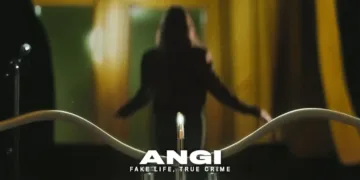
















Some true crime stories thunder in with the shock of a sudden storm. Others, like the one at the center of Angi: Fake Life, True Crime, are a slow, creeping rot. The subject is not a shadowy monster but a woman who could be your neighbor, María Ángeles Molina, known as Angi.
She perfected a particular brand of evil that operated in broad daylight, armed with forged paperwork and a disarming smile. This two-part Spanish docuseries unpacks the life of a woman who didn’t just bend the rules but rewrote them entirely to serve her own sinister ledger.
The story it tells is not simply about a murder. It is about the terrifyingly thin line between a person’s public face and their private machinations, exploring a life built on a mountain of calculated lies that eventually required a human sacrifice to maintain.
How to Steal a Life, Literally
The foundation of any great deception is a believable facade, and for Angi, that facade was her friendship with coworker Ana Páez. The series effectively portrays how their professional relationship was merely a laboratory for Angi’s scheme.

One gets the sense that Angi, with a predator’s instinct, identified Páez as the perfect mark: trusting, financially stable, and perhaps a bit naive to the depths of human treachery. The documentary details a relationship where one party offered genuine companionship while the other was taking notes, measuring her target for a metaphorical coffin lined with stolen credit and life insurance policies. The betrayal is profound not just for its deadly outcome, but for the years of methodical grooming that preceded it. Angi wasn’t just a murderer; she was a meticulous social engineer.
Her fraudulent enterprise was a masterwork of audacity. For years, she operated as Páez’s phantom twin, a shadow self that haunted banks and insurance agencies across Barcelona. The series explains how she would don wigs and alter her appearance, walking into sterile financial institutions to perform her role. This wasn’t a one-off crime; it was a long-running performance piece.
She forged signatures with an artist’s precision and navigated complex financial paperwork to open accounts, secure massive loans, and, most critically, become the beneficiary of insurance policies on Páez’s life. The sheer nerve required is difficult to comprehend. Each successful transaction must have been a private thrill, a confirmation of her superiority over the systems and people she so easily fooled. She was living a double life not in the shadows, but under the fluorescent lights of corporate Spain.
That performance reached its grisly finale in February 2008. Ana Páez was found drugged, bound, and suffocated in a rented apartment, her death carefully arranged to look like a sexual misadventure gone fatally wrong. This staging is the documentary’s most chilling passage.
It reveals a mind that is not just murderous but creative in its malice. To complete her fiction, Angi procured semen from male prostitutes, planting foreign DNA at the scene to send police down a rabbit hole of anonymous encounters. It was a cold, chess-like move intended to obscure her true motive: cashing in on the policies and silencing the only person who could unravel her empire of lies.
But such elaborate fictions often have plot holes. Investigators, initially baffled, began to notice inconsistencies. The scene was too neat, too theatrical. The true narrative began to emerge from the quiet hum of servers and the unblinking eye of security cameras.
CCTV footage of Angi in disguise, coupled with a mountain of incriminating financial documents, drew a straight line from Páez’s death to Angi’s doorstep. Her alibi, a conveniently sorrowful trip to another city, was systematically dismantled by investigators who found her deception was far more extensive than a simple lie about her whereabouts.
An Echo in the Evidence Locker
Just as the viewer settles into the grim certainty of the Páez case, the documentary executes a jarring pivot. The second episode rewinds the clock to 1996 and the death of Angi’s husband, Juan Antonio Álvarez Litben. His death, which occurred in the Canary Islands, had been swiftly closed, officially labeled an accident or perhaps a suicide.

With Angi’s later conviction, however, old questions gained new, horrifying weight. The series dives headfirst into this cold case, suggesting the murder of Ana Páez was not a shocking aberration but the grim evolution of a predator. Here, the documentary’s sure-footed, evidentiary approach begins to falter. It trades the hard facts of the Páez investigation for the shifting sands of speculation.
The narrative is built almost entirely on the testimony of Litben’s family and friends, individuals who, understandably, had their suspicions sharpened by future events. Their statements are heartfelt and compelling on a human level, but they are not evidence. The series presents these theories with significant weight, allowing suspicion to fill the vacuum left by a lack of forensic proof.
This section feels less like a criminal investigation and more like a séance, an attempt to conjure a ghost from old grievances and circumstantial clues. You can feel the filmmaking style shift; the tone becomes more questioning, the editing more reliant on suggestive juxtapositions. The series essentially asks the audience to connect the dots, even though the dots themselves are faint and far apart.
This structural choice is a gamble. While it deepens the psychological portrait of Angi, it does so by sacrificing the rigorous objectivity that made the first episode so powerful. The purpose is clear: to frame Angi not as a woman who committed a terrible crime, but as a lifelong monster whose true body count might never be known. It transforms her from a killer into a potential serial predator, a far more terrifying prospect.
A Documentary Divided
Angi: Fake Life, True Crime is a series cleaved in two. Its bifurcated structure is both its most interesting feature and its primary weakness. The first episode is a model of efficiency: a taut, suspenseful procedural that marches forward with the relentless logic of the police investigation it documents. It is satisfyingly concrete.

The second episode, by necessity, is a different beast entirely. It is speculative, slower, and ultimately inconclusive. This stark division makes for a somewhat unbalanced viewing experience. After the propulsive momentum of the first half, the second can feel like a frustrating detour into a fog of what-ifs. The decision to split the narrative this way is defensible—it cleanly separates the proven crime from the suspected one—but it risks losing the audience that was hooked by the initial, clear-cut story.
The direction under Carlos Agulló is defined by a clinical, almost sterile, tone. This is not a flashy, sensationalist production. It eschews dramatic music cues and overly stylized reenactments in favor of a stark presentation of facts, relying on court records, archival news clips, and police interviews. This “no-frills” approach is surprisingly effective, as the unadorned horror of the events needs no embellishment.
The extremely short runtime of each episode, however, is a double-edged sword. It ensures a brisk pace, free of the bloat that plagues many true crime series. Yet it also means that complexity is often sacrificed for clarity. One is left wondering about the details of Angi’s trial, the full scope of her financial web, or the psychological toll on Páez’s family, areas that a longer series would have surely explored.
The most significant element is the void at the story’s center. Angi herself is silent. With no interviews from her, her daughter, or her legal team, she remains a chilling enigma. Her absence forces the viewer to construct a version of her from the testimony of others, making her less a character and more a reflection of the chaos she created. Her silence is, in the end, more powerful than any self-serving explanation could ever be.
The Unsettling Silence
The series stumbles toward its finish line with a moment of bizarre self-sabotage. After two episodes of carefully constructed, if sometimes speculative, narrative, it concludes with an on-screen text card about Angi’s prison status that seems to directly contradict information presented moments earlier.
This baffling editorial choice throws the viewer into a state of confusion, muddying the waters just when clarity is needed most. It is an unsatisfying, almost amateurish, final note that leaves a lingering sense of unresolved ambiguity, a feeling that the filmmakers themselves were unsure how to end the story.
Yet the story, it turns out, was not over. In a shocking epilogue that takes place outside the documentary’s frame, the real world provided a coda. As recently as this year, 2025, Angi was re-arrested while on temporary leave from prison. The accusation: plotting a new murder from behind bars.
This stunning development acts as a real-time validation of the documentary’s darkest implications. It reinforces the portrait of Angi as a remorseless and incorrigible criminal, a woman for whom rehabilitation is a foreign concept.
Her case is a study in a uniquely modern form of sociopathy, one that thrives by exploiting the inherent trust in the systems that govern our lives—banking, insurance, and even friendship. She turned the mundane tools of civilization into weapons.
The series’ greatest impact is this quiet, chilling revelation of a monster hiding in plain sight, a person who sees societal rules not as guidelines for living, but as vulnerabilities to be exploited. What do you do with a person whose very nature is a corruption of the trust that holds a society together?
Full Credits
Director: Carlos Agulló
Producers and Executive Producers: Brutal Media
Director of Photography (Cinematographer): Alfonso Postigo
Editors: Alberto J. Baixauli, Sam Baixauli, David Gallego
Composer: Sergio Jiménez Lacima
The Review
Angi: Fake Life, True Crime
Angi: Fake Life, True Crime presents a disquieting portrait of a meticulous predator. The series shines in its first half, delivering a taut, evidence-based account of a shocking murder and a years-long deception. Its second part, however, drifts into unsatisfying speculation, creating a fractured viewing experience. While structurally uneven and marred by a confusing ending, the documentary is a stark and memorable study of a criminal mind. The shocking real-world updates about its subject make this a particularly unnerving watch.
PROS
- A genuinely chilling and fascinating true-crime subject.
- The direct, clinical tone is effective and avoids sensationalism.
- The first episode is a strong, fact-driven procedural.
- The brisk pacing keeps the narrative moving.
- The absence of the subject’s own testimony becomes a powerful narrative element.
CONS
- A structurally uneven and disjointed viewing experience due to the split focus.
- The second episode is significantly weaker and relies heavily on speculation.
- The short runtime leads to a sense that important details are glossed over.
- The ending is abrupt and confusing.
- The use of reenactments feels sparse and adds little value.