


















We first meet Avi Schwooper in 2004, a young man alive with the intellectual thrill of dissecting a Paul Simon lyric about the cruel velocity of time. Then, in a blink, it is 2022. The man is solitary in his car, the song a faint echo, his face a quiet map of the intervening years.
This sharp, disorienting cut is the central thesis of Raphael Bob-Waksberg’s animated series, Long Story Short. The show documents the Schwooper family—parents Naomi and Elliot, children Avi, Shira, and Yoshi—not as a linear progression but as a scattered collection of moments pulled from three decades. It is a family album whose pages are shuffled and read out of order.
The result is a profound meditation on the accumulation of a life, a story built from the small joys and profound sorrows that constitute an existence. The show is less a narrative and a deep exploration of how the past is never truly past; it lives inside us, a constant, complicated presence.
A Shattered Chronology
The series builds its world on a foundation of fractured time. Its defining characteristic is the deliberate abandonment of a straight line, choosing instead to leap between decades within a single episode, often without warning. A childhood argument from 1996 spills its emotional contents onto a marital dispute in 2021. This is more than a clever narrative device; it is a philosophical argument about the nature of consciousness itself. T
he show suggests that we do not experience our lives as a neat, orderly progression from A to B. Instead, we live in a perpetual present that is constantly haunted and informed by a chaotic collage of memories. The past is not a foreign country but an active, sometimes violent, citizen of the present moment. This structural choice dismantles the comforting illusion of a stable, coherent self.
Who is Avi Schwooper? He is the bright-eyed boy at a bar mitzvah, the cynical music critic, and the silent man in the car, all at once. The self is not a fixed point but a flickering image, reassembled moment by moment from these temporal fragments. This approach forces a quiet contemplation of fate. Are the Schwoopers free agents, or are they simply playing out scripts written in their childhood bedrooms?
The show offers no easy answers, leaving its characters suspended between the weight of their history and the terrifying openness of their future. Major life events—a death, a separation—are often learned through overheard whispers and passing remarks, denying us the catharsis of dramatic revelation. Life, the series understands, is mostly lived in the quiet aftermath of its biggest moments.
Ghosts in the Machine
Each member of the Schwooper clan is a case study in familial determinism, a soul shaped by the gravitational pull of its origins. The matriarch, Naomi Schwartz, first appears as a living cliché, a whirlwind of affection and criticism. She is the engine of the family, her anxieties setting the emotional weather for everyone.

The series, however, patiently chips away at this surface, revealing not a stereotype but a woman of formidable intelligence and deep, unarticulated sorrow. Her need for control is a desperate attempt to build a bulwark against the chaos of a world that took her own mother too soon. She is a tragic figure, her fierce love a weapon she wields against the terror of loss. Her husband, Elliot Cooper, provides the quiet counterbalance.
His gentleness and conciliatory nature could be mistaken for weakness, yet it feels more like a philosophical retreat. He has chosen a life of lesser resistance, a passive existence that shields him from the sharp edges of his wife’s intensity and the anxieties of decisive action.
The children are living texts written in their parents’ ink. Avi, the eldest, weaponizes his intellect, becoming a critic in a world that demands feeling. His analyses of music and culture are a sophisticated defense mechanism against the raw, unmanageable emotions of his upbringing. His journey is a slow, painful stripping away of this armor.
Shira, the middle child, is defined by her reaction to the family’s emotional temperature. Her adult life is a conscious project of reinvention, an attempt to build a new family with her wife, Kendra, that might operate on different principles. Her story is a poignant exploration of the question: can we ever truly escape the blueprints of our childhood?
Yoshi, the youngest, is perhaps the most existentially adrift. Marked by his status as the “extra” child, he moves through life with a frantic, unfocused energy. His various schemes and passions are the flailings of a man trying to invent a purpose for himself, to prove his own necessity in a world that has never quite made room for him.
The Question of a Meaningful Life
The series is saturated with a quiet, persistent melancholy, a deep awareness of finitude. It returns again and again to the idea that the fundamental tragedy of human existence is not its suffering but its brevity. The real pain, the show suggests, is that even a life rich with love will never feel like enough time.

Funerals and bar mitzvahs are recurring motifs, cyclical rituals that mark the passage of time and bind the generations together in a shared story of appearance and disappearance. Grief is not an event but a permanent feature of the landscape, a low hum beneath the noise of daily life. The show handles this with a stark honesty, recognizing that moments of profound loss are often punctuated by absurd, inappropriate laughter. It is in these moments that the Schwoopers feel most real.
This exploration is given a specific texture through the family’s Jewish identity. The series offers a remarkably nuanced look at what it means to be a modern, largely secular Jew. The religion is treated as a cultural inheritance and a philosophical toolkit, a 3,000-year-old tradition of wrestling with questions of meaning, obligation, and mortality.
The debates within the family—about keeping kosher, about the meaning of a bar mitzvah, about raising children within the faith—are not just about religious observance. They are about how to live a meaningful life in a seemingly indifferent universe. The show uses the specific language of this one tradition to ask universal questions.
What do we owe our ancestors? What do we owe our children? How do we find a sense of belonging in a world that is constantly changing? The series offers no single answer, instead presenting a spectrum of belief and practice, a quiet argument for the value of a life lived in conversation with these difficult questions.
Laughter in the Dark
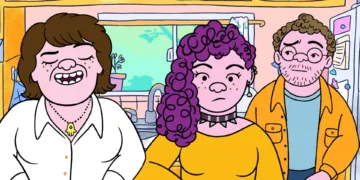
The visual world of Long Story Short is as crucial to its philosophical project as its script. The animation, under the guidance of Lisa Hanawalt, has a warm, hand-drawn quality that feels intimate and subjective. It is a world rendered from memory. The use of bold, flat colors and soft, scribbled lines evokes the feeling of a half-remembered children’s book.

The aesthetic is a deliberate choice to represent an internal reality. Backgrounds are often impressionistic or blurred, a visual metaphor for the way memory works, sharpening focus on an emotional detail while letting the periphery fade. This style allows the characters to move through time with a fluid grace; the child and the adult are visibly the same person, their essence captured in the simple lines of their design.
This visual warmth is the vessel for the show’s unique blend of humor and sorrow. The series is often wildly funny, capable of intricate wordplay and elaborate, cartoonish set pieces. This comedy is not a reprieve from the show’s existential concerns; it is an expression of them. The humor is born of an absurdist sensibility, a recognition of the fundamental strangeness of being alive.
The characters laugh in the face of their own anxieties and failures. It is the laughter of people who understand that life is a beautiful, ridiculous, and deeply sad affair. The wit and the melancholy are not opposing forces. They are two sides of the same coin, a deeply honest acknowledgment of the human condition.
Long Story Short is a Netflix adult animated comedy series created by Raphael Bob-Waksberg, the acclaimed creator of BoJack Horseman. The first season, consisting of 10 parts, was released on August 22, 2025, and is available to stream exclusively on Netflix.
Full Credits
Director: Dave Franco, Henry C. King
Producers: Noel Bright, Steven A. Cohen, Corey Campodonico, Alex Bulkley, Raphael Bob-Waksberg
Cast: Lisa Edelstein, Paul Reiser, Ben Feldman, Nicole Byer, Max Greenfield, Abbi Jacobson, Angelique Cabral, Michaela Dietz, Dave Franco
The Review
Long Story Short
Long Story Short is a masterful and melancholic piece of television. It uses its fractured timeline not as a gimmick, but as a profound tool to explore the nature of memory, identity, and the unbearable swiftness of a human life. The series is a rare work that is both intellectually rigorous and deeply moving, a philosophical inquiry disguised as a family comedy. It is a quiet, devastating, and essential viewing experience that lingers long after the credits roll.
PROS
- Philosophically rich non-linear narrative.
- Deep, emotionally resonant character studies.
- A successful and poignant balance of comedy and melancholy.
- Nuanced exploration of family dynamics and cultural identity.
- Distinctive, warm, and expressive animation style.
CONS
- The fragmented timeline may challenge viewers seeking a conventional plot.
- Some secondary characters feel underdeveloped compared to the core family.
- Its contemplative pace might not engage all audiences.