
























![Kingdom Hearts Collection [I-III] Review](https://gazettely.com/wp-content/uploads/2026/10/Kingdom-Hearts-Collection-I-III-1-360x180.webp "Kingdom Hearts Collection [I-III] Review: KHII Holds Steady as Newer Entries Fluctuate 37")




In the salt-sprayed air of a North Wales coastal town, life is a metronome set to the rhythm of the tides and generations of mussel farming. This is the world of Jack (Barry Ward), a man who appears fused to his environment.
He has the expected accoutrements of a stable life: a wife, a son, the family business. Yet, director Helen Walsh immediately instills a sense of profound dislocation. Jack moves through his days like a ghost haunting his own existence.
He is a man performing the role of himself, and the performance is beginning to fray at the edges. His discomfort is palpable, a quiet rebellion brewing beneath a surface of filial duty. The film positions itself not as a grand drama, but as a forensic study of a man whose foundations, built on the bedrock of expectation, are about to liquefy.
An Aberration in the Ecosystem
Jack’s community operates as a closed system, a self-policing organism where tradition, patriarchy, and religion are the dominant genes. This is not a caricature of rural life; it is a depiction of a specific cultural stasis found in places bypassed by modernity, where identity is a legacy, not a choice. Deviation is a mutation to be corrected or expelled.

Everyone has a place, and the knowledge of everyone else’s business serves as a societal panopticon, ensuring conformity through passive, ever-present surveillance. Within his own family, the pressure is immense, a generational weight passed down like a fisherman’s net. His son, Tom (Henry Lawfull), shows a heretical disinterest in the family trade, a small crack in the dynastic facade that Jack seems to secretly admire.
His brother, Dyfan (Celyn Jones), is a perfect specimen of local masculinity, a walking embodiment of the town’s unwritten code and a constant, if unintentional, judge of Jack’s perceived softness. Jack’s marriage to Maggie (Liz White) has the hollow echo of a long-fulfilled contract, a partnership based on shared history instead of present connection.
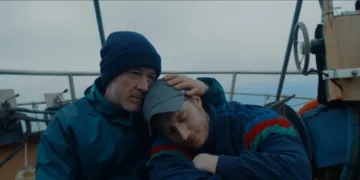
Into this hermetically sealed world walks Daniel (Lorne MacFadyen), a deckhand unburdened by the local pieties. He is an itinerant, a free radical in a stable compound. Daniel is not a predator or a savior; he is simply an anomaly whose very existence suggests other ways of being are possible.
His presence introduces a new variable into a fixed equation, and his quiet confidence awakens something in Jack. Their first meeting is less a spark and more a quiet shift in the local magnetic field, a subtle change that signals an impending storm.
The Aesthetics of Repression
The affair between Jack and Daniel unfolds with the patient, inexorable pull of a tide. It is a development that feels less like a choice and more like an inevitability, a physical manifestation of Jack’s long-suppressed identity. Walsh films their intimacy with a frankness that avoids sensationalism.

These encounters are sensitive and deeply felt, suggesting a hunger for connection that transcends mere carnality. The film’s aesthetic choices are welded to this internal drama. The very work of mussel farming becomes a potent symbol: the backbreaking labor required to pry open a hardened shell to find the vulnerable life within. Jack himself is such a shell.
Cinematographer Sam Goldie paints the landscape in a palette of washed-out blues and damp greys, a visual correlative for Jack’s own muted spirit. The world is beautiful but bleak, a cage wrought from stunning scenery.
The soundscape amplifies this feeling. The constant cry of gulls and the rush of wind against water are not background noise; they are active participants in Jack’s psyche. The sounds underscore the physical isolation of the characters while highlighting the suffocating closeness of a town where a single whisper can travel like the wind.
This unhurried, observational style is a deliberate choice. By refusing to rush the narrative, the film forces the viewer to experience Jack’s contemplative agony, making his gradual awakening feel earned and authentic. By allowing moments of silence and stillness, Walsh lets the emotional weight of Jack’s decisions accumulate slowly, turning small acts of rebellion into gestures of seismic personal importance.
Breaking the Male Chassis
Barry Ward’s portrayal of Jack is a masterclass in physicalized repression. His performance is located in his tight shoulders, his downcast eyes, his hands that seem unsure of their function outside of hard labor. He conveys the immense internal pressure of a man fighting against the very chassis of his identity, a framework built by generations of masculine expectation.
This is a study in what one might call compulsory stoicism, the societal demand that men of a certain class and place must cauterize their emotional lives, treating vulnerability as a terminal illness. Ward makes this internal war visible with heartbreaking clarity. The supporting performances provide the necessary atmospheric pressure.
Lorne MacFadyen’s Daniel is the perfect foil, his ease of being a constant, quiet indictment of Jack’s constriction. He isn’t aggressive; his freedom is simply a fact, making Jack’s lack of it all the more pronounced. Liz White gives the spurned wife, Maggie, a dignity and depth that defy stereotype, allowing her moments of humor and confusion that make her a person instead of a plot device.
The film’s primary project is to examine this rigid form of masculinity and the devastation it causes. It offers no simple liberation or triumphant escape. Jack’s awakening is painful, his path toward self-realization littered with the wreckage of a life he never truly wanted but was honor-bound to maintain.
There is a terrible beauty in this crack-up, a sad acknowledgment of the human cost of conformity. It suggests that for some, freedom is not a destination but a brief, shattering glimpse of a life that can never be lived.
“On the Sea” is a 2025 British drama and romance film directed by Helen Walsh. It premiered at the Edinburgh International Film Festival on August 16, 2025. The movie is a Red Union Films production and is a profound exploration of masculinity, desire and sexual identity within a remote Welsh fishing community. It was filmed on the island of Anglesey.
Full Credits
Director: Helen Walsh
Writers: Helen Walsh
Producers & Executive Producers: David Moores, David (Yoz) Hughes, Billie Hallows, Mariam Shatberashvili, Luise Hauschild, Alexandre Koberidze
Cast: Barry Ward, Lorne MacFadyen, Liz White, Henry Lawfull, Celyn Jones, Danny Webb
Director of Photography (Cinematographer): Sam Goldie
Composer: Felix Rösch
The Review
On The Sea
On The Sea is a beautifully bleak and patient character study. It excels in its atmospheric direction and a powerful lead performance from Barry Ward, who perfectly captures a man suffocating under the weight of tradition. While its deliberate pacing may test some viewers, the film offers a profound, unflinching look at the painful cost of self-discovery in a world that punishes deviation. It's a quiet film with a loud, melancholic heart.
PROS
- A masterful and physically expressive lead performance from Barry Ward.
- Evocative cinematography that perfectly captures the setting's bleak beauty.
- A thoughtful and sensitive exploration of traditional masculinity and repression.
- Strong, immersive atmosphere created through sound design and pacing.
CONS
- The deliberately slow, observational pacing may feel sluggish to some viewers.
- Its narrative of forbidden love in a rural setting treads familiar ground.
- The relentlessly somber tone can be emotionally taxing.







