































The film opens with an image both strange and poignant: three grown men in superhero costumes stand against the majestic backdrop of Norwegian mountains. This is not the beginning of a fantasy, but a desperate act of mythmaking in the real world.
Director Christian Einshøj places himself and his brothers inside this frame, attempting a heroic feat of emotional rescue for a family long ago shattered by silence. The Mountains is his intimate, self-aware examination of this fracture. He turns his camera inward, investigating the quiet aftermath of a family tragedy that occurred decades prior.
The death of his infant brother, Kristoffer, did not cause a dramatic explosion but a slow, creeping implosion, sealing each of the Einshøj men in their own private worlds. Einshøj’s film is not a simple documentary of events. It is an active investigation, a quest to understand how a family so full of love could forget how to speak to one another, and to map the lonely emotional orbits they have occupied ever since.
Excavating the Family Archive
The visual language of The Mountains is built from the artifacts of memory itself. Einshøj constructs his story by blending a vast family archive with crisp, contemporary footage. This collection began with his father, Søren, who obsessively filmed his terminally ill son, a quintessentially 20th-century response to impending loss—an attempt to render memory tangible on magnetic tape.
Decades later, Christian inherits this role of family chronicler, but his purpose shifts from preservation to dissection. He sifts through the grainy, 4:3 aspect ratio home videos of the past. This visual format feels both nostalgic and claustrophobic, a boxed-in representation of a history the family cannot escape. These scenes are set against modern widescreen shots of the present, a technical choice that visually represents the immense, empty chasm between a curated past and a disconnected reality.
Einshøj, as both director and protagonist, becomes a kind of unreliable narrator. We see the past through the filter of his own search for answers, a process of selection and assembly that questions whether he is discovering a single truth or creating a new narrative to survive the old one. His voiceover acts as the essential guide through this archaeology of grief, while the subtle electronic score, with its hints of 8-bit nostalgia, sonically mirrors the artificial yet deeply felt nature of these recorded memories.
The Geography of Male Grief
At its center, the film presents a tender and critical study of a specific type of masculine emotional restraint, one deeply rooted in Scandinavian culture. The tragedy of Kristoffer’s death sends the men of the family into separate, silent forms of retreat, a reaction informed by a cultural ethos where stoicism is often valued over open emotional expression.

The father, Søren, copes through perpetual motion, a life of business travel that serves as a literal and figurative flight from introspection. His final act in this flight is the decision to sell the family home, an attempt to erase the physical anchor of his grief. The older brother, Frederik, directly inherits this coping strategy, escaping into a demanding career in America that ultimately contributes to the collapse of his own marriage.
The youngest, Alex, born a year after the loss, embodies the lingering effects of the trauma. His feeling of being an outsider is so profound that he chooses geographical and linguistic distance, refusing to speak the family’s language at home.
Einshøj does not spare himself from this analysis, recognizing that his impulse to film is his own shield. The film’s tight focus on this dynamic means the mother’s perspective remains on the periphery. This is a deliberate choice that sharpens the film’s thesis, offering a potent look at a closed system of male sorrow while implicitly acknowledging the story’s own incompleteness.
The Clumsy Climb Toward Connection
The film’s emotional current shifts when the father decides to sell the home, an act that threatens to sever the last physical link to their shared history and forces the issue into the open. This prompts Christian to initiate a series of reunions, framing the film’s latter half as a subversion of the American road movie.
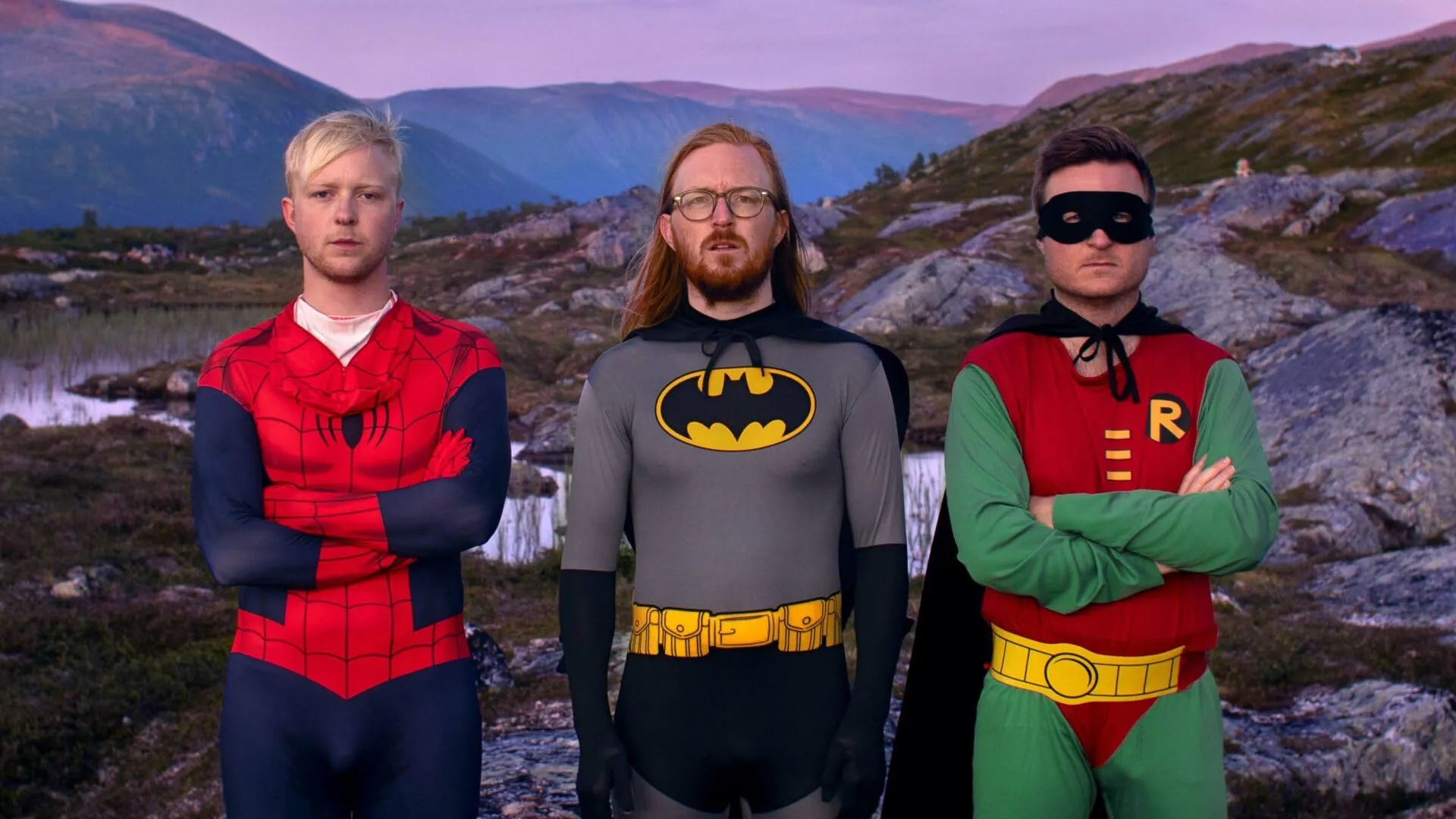
Instead of a journey toward freedom and escape, this is a journey back into the heart of the problem. The superhero scene, seen again here, is a brilliantly self-aware performance. The men are playing at connection, acting out a fantasy of unity with the hope it might spark something real, the absurdity of their costumes mirroring the absurdity of their decades-long silence. The filmmaking process itself becomes the primary therapeutic tool.
The camera is not a passive observer; it is an active agent, a formal pretext for the intimacy the family cannot otherwise manage. This is powerfully revealed in a moment where the director’s mother sadly observes that he seems to only be able to talk with her when the camera is rolling.
The Mountains does not build toward a simple resolution. Its potent message is that healing is not found at the summit but in the clumsy, difficult, and ultimately liberating act of the climb itself. The true victory is in turning to face the pain and beginning the faltering conversation.
“The Mountains” is a Danish documentary film about director Christian Einshøj’s family and their journey to cope with the tragic death of his brother decades earlier. The film premiered at the CPH:DOX festival and won the Best International Feature Documentary and Emerging International Filmmaker Awards at Hot Docs. It had its US premiere at the Tribeca Film Festival on June 9, 2023, followed by releases at other festivals like the BlackStar Film Festival and the Toronto International Film Festival.
Full Credits
Directors: Christian Einshøj
Writers: Christian Einshøj
Producers: Mathilde Hvid Lippmann
Executive Producers: Helle Faber
Cast: Christian Einshøj, Søren Einshøj, Frederik Einshøj, Alexander Einshøj, Eva Einshøj
Director of Photography (Cinematographer): Christian Einshøj, Søren Einshøj
Editors: Christian Einshøj
Composer: Toke Brorson Odin
The Review
The Mountains
The Mountains is a profoundly moving and intelligent documentary that uses the raw material of a family's past to dissect the silent geography of masculine grief. Director Christian Einshøj crafts a story that is both deeply personal and culturally resonant, showing that the most heroic act can be the clumsy, painful, and necessary attempt to finally speak. It’s a beautifully constructed piece of cinematic therapy that finds immense power not in a tidy resolution, but in the brave, awkward first steps toward connection.
PROS
- An emotionally honest and intimate portrait of a family.
- A unique and effective blend of archival home videos with modern cinematography.
- An insightful and nuanced exploration of masculine grief within a Scandinavian cultural context.
- Delivers a powerful message about the difficulty and importance of communication.
CONS
- The tight focus on the male experience leaves the mother's perspective largely unexplored.
- The narrative is highly subjective, filtered entirely through the director's personal lens.
- Its slow, introspective pace and deeply personal subject matter may not connect with all audiences.







