


























Sometimes a piece of media asks you to unlearn everything you think you know about its form. Certain games discard traditional mechanics; certain films abandon familiar story structures. Toshiaki Toyoda’s Transcending Dimensions is one such film.
Toyoda, a director whose work consistently challenges Japan’s conservative norms, presents something that starts like a stone-cold thriller before it melts into a pool of psychedelic wonder. The premise is your first clue that things are slightly off-kilter: a stoic hitman is dispatched to a remote mountain retreat to investigate a cult leader.
From its opening minutes, which unfold almost without dialogue, the film establishes a mood of deep unease and strange beauty. It is a work that does not hold your hand. Instead, it invites you to let go and fall into its hallucinatory, disorienting world, promising a sensory immersion that defies easy categorization. It is less a movie to be watched and more a frequency to be tuned into.
The Rules of the Game
The film’s first act establishes its world with the cold precision of a noir thriller, setting up the initial rules of engagement for the viewer. We are introduced to our protagonist, the hitman Shinno, played with a perfect, world-weary stillness by Ryuhei Matsuda. He is a skeptic, a professional unfazed by superstition, which makes him the perfect audience surrogate for the bizarre spiritualism he is hired to confront.
His client, Nonoka (Haruka Imou), gives him a clear objective: find her missing boyfriend, Rosuke (Yosuke Kubozuka), who has fallen under the influence of a dangerous guru. This antagonist, Master Hanzo (Chihara Jr.), is a fantastic creation, a smirking, dyed-blond spiritual guide who projects an aura of playful menace. He holds court in a mountain temple, offering enlightenment for a steep, physical price: a severed finger.
This is not just for shock value; it’s a brutal gameplay mechanic designed to test commitment and establish his control. The tranquil mountain setting, filled with the sounds of nature, only amplifies the tension, creating a sense of isolation where Hanzo’s psychological power feels absolute.
Then, in a moment that shatters any sense of predictability, Nonoka gives Shinno his final order to kill Hanzo before calmly taking her own life on a train platform. This act serves as a violent break, the first true glitch in the system, signaling that the established rules are about to be completely rewritten.
Breaking the System
Just when you have a handle on the film’s rhythm, Toyoda hits the reset button. Roughly forty minutes in, the familiar crime plot dissolves entirely. The movie shifts gears so hard it feels like the system itself has crashed, an effect punctuated by the sudden, stylish appearance of the opening title sequence.

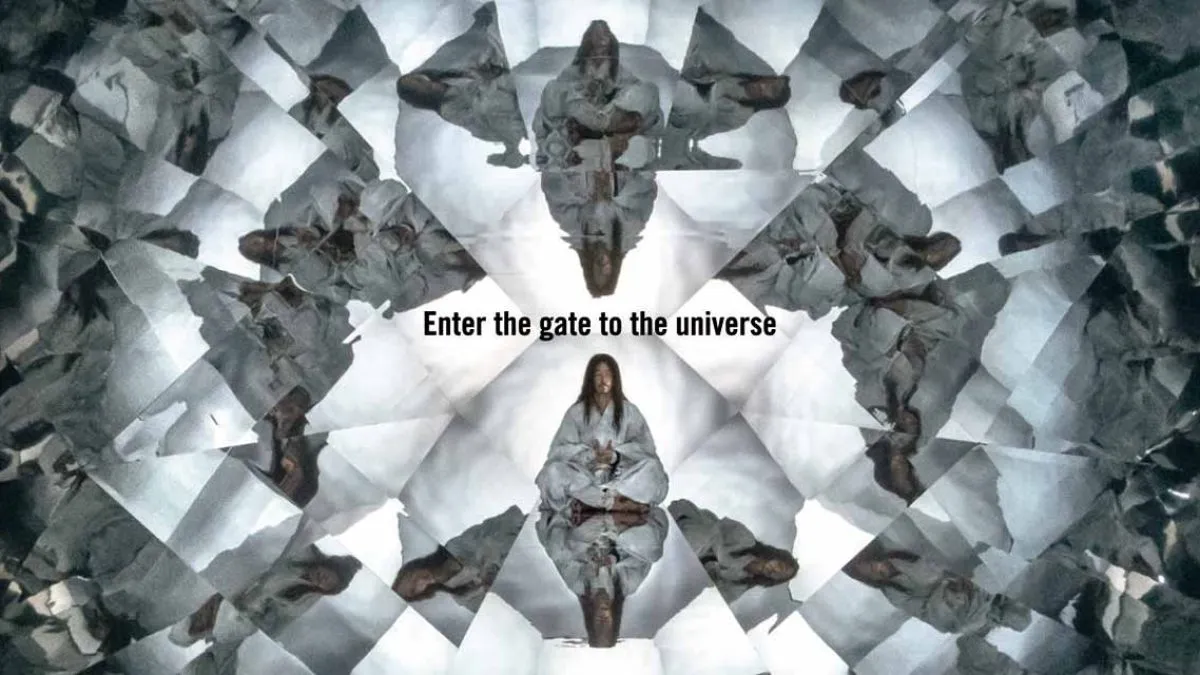
The film’s language changes completely, moving from plot progression to pure sensory input in a way that recalls how a game like Nier: Automata will suddenly switch genres. What follows is a pivot into a non-linear, meditative state. We are pulled through breathtaking, abstract sequences: a chamber of mirrors faceted like a diamond, a spaceship shaped like a human finger, and glitchy shifts in perspective that suggest reality itself is fraying at the seams.
The driving force behind this shift is the incredible soundtrack. The propulsive, chaotic jazz of Sons of Kemet and the thunderous beat of taiko drums are not just background music; they become the main engine. The music creates a sense of manic energy even when the visuals are slow and contemplative, a brilliant and intentional contrast.
Long, slow-motion shots of a character walking become hypnotic statements. The recurring motif of a mysterious conch shell being blown seems to act as a key, unlocking these shifts between dimensions and grounding the esoteric events in a kind of ritualistic logic.
The Philosophy of Vision
What is the point of a film that discards its own story? Transcending Dimensions seems to argue that the point is the act of looking itself, of searching for meaning beyond conventional storytelling. The film’s thematic core—the potential of the human mind to move past physical reality—is mirrored perfectly in its structure.
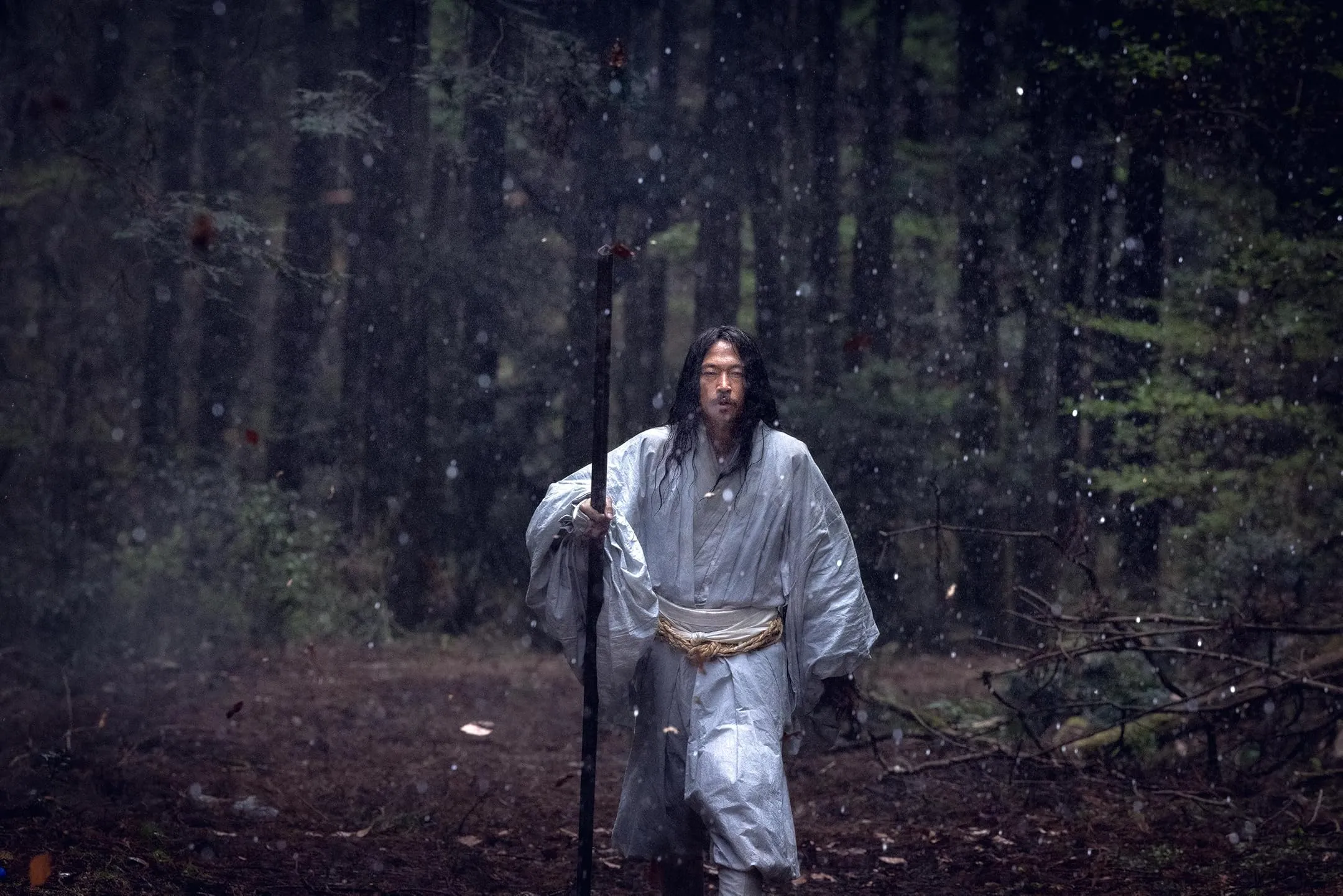
Toyoda asks the viewer to transcend their own need for a linear plot to appreciate the work. This approach is reminiscent of the films of David Lynch or experimental games like Kentucky Route Zero, where atmosphere and symbolism are the primary methods of communication. The technical elements all serve this purpose. The cinematography by Kenji Maki uses deep shadows and brilliant torchlight to create a persistent dreamlike state.
The performances are crucial in grounding the absurdity; Ryuhei Matsuda’s calm, observant hitman acts as our anchor, while Chihara Jr.’s Master Hanzo is a magnetic mix of genuine menace and winking self-awareness.
Ultimately, the film rewards a specific kind of engagement. It is for the viewer who enjoys dissecting a system, who likes to find the ghost in the machine, and who appreciates when a creator is brave enough to build something so beautifully and intentionally broken. It demands your participation, not just your attention.
“Transcending Dimensions” is a Japanese sci-fi thriller that delves into themes of existence and higher dimensions. The film premiered at the International Film Festival Rotterdam (IFFR) on February 1, 2025.
Full Credits
Directors: Toshiaki Toyoda
Writers: Toshiaki Toyoda
Producers: Shinichiro Muraoka, Ryo Yukizane, Mariko Kurose
Executive Producers: Toshiaki Toyoda
Cast: Yosuke Kubozuka, Ryuhei Matsuda, Chihara Jr., Haruka Imou, Kiyohiko Shibukawa, Masahiro Higashide, Itsuji Itao, Kirara Inori, Danko Iida, Mame Yamada
Director of Photography (Cinematographer): Kenji Maki
Editors: Masaki Murakami
Composer: Sons of Kemet, Mars89, Kodo, Kazuhide Yamaji, The Birthday
The Review
Transcending Dimensions
Transcending Dimensions is a bold, uncompromising piece of filmmaking that trades narrative coherence for a profound sensory journey. It demands patience and an open mind, but rewards the viewer with a stunning audiovisual experience driven by a phenomenal soundtrack and a fearless artistic vision. This is not a film for everyone, but for those willing to take the plunge, it is a strange, beautiful, and unforgettable trip into the abstract.
PROS
- A stunning and immersive audiovisual experience.
- Bold, unconventional structure that defies cinematic norms.
- An incredible punk-jazz and taiko-infused soundtrack that drives the film.
- Strong, committed performances perfectly suited to the film's deadpan, philosophical tone.
- Provokes thought on themes of reality, perception, and consciousness.
CONS
- The deliberately confusing narrative will alienate many viewers.
- Pacing is meditative and can feel languid or boring to some.
- The plot is secondary to mood, offering little traditional character development.
- Some visual effects are hampered by a low budget.