



























Scandinavian thrillers often excel at dissecting the pristine surfaces of progressive societies to reveal the disquiet underneath. Director Caroline Ingvarsson’s Unmoored follows this tradition, presenting a psychological drama centered on a stark public and private divide. The film introduces Maria, a Swedish television host celebrated for her uncompromising feminist interviews.
Her professional life is a performance of moral clarity, one that stands in sharp contrast to her personal reality. She is married to Magnus, an older academic whose reputation is crumbling under a serious accusation of sexual assault.
Maria’s quiet complicity in his defense creates a tense, fragile dynamic. This hypocrisy reaches a breaking point when the couple embarks on a trip, leading to a fateful confrontation that sends Maria fleeing alone into a new life of suspense and fear.
The Weight of a Lie
At the center of Unmoored is a difficult, compelling anti-heroine, a figure drawn from a rich Nordic literary tradition of morally complex characters. Maria is not designed for easy sympathy; her choices are born from a complicated mixture of desperation, long-suppressed resentment, and a flickering desire for liberation.
Her flight is not just an escape from the law but from a life she co-authored. After she arrives in the isolation of the English coast, the narrative becomes a deep exploration of her psyche. Her guilt manifests as a palpable paranoia, a constant fear of discovery that colors her every interaction. This internal journey is the film’s anchor.
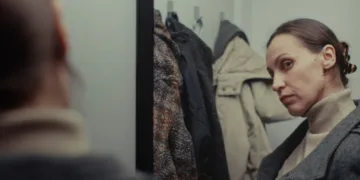
The story’s success rests almost entirely on the shoulders of Mirja Turestedt, who gives a masterful performance. She portrays Maria’s deteriorating mental state with remarkable subtlety, conveying a storm of anxiety and resolve through a downcast gaze, a nervous tightening of her hands, or a sudden flinch at the sound of an approaching car.
Turestedt uses silence and restrained physicality to make Maria’s inner world visible. Her portrayal elevates the character beyond a simple victim or villain, positioning her as a complex individual whose path toward a twisted form of agency is paved with morally compromising acts.
Crafting a Mood of Quiet Dread
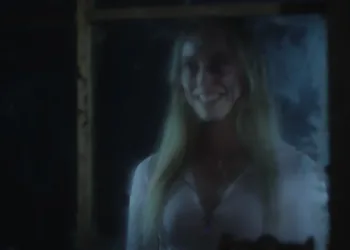
The film’s technical execution is finely tuned to amplify its protagonist’s psychological state, reflecting an aesthetic common to the Scandi-noir genre. Ingvarsson cultivates a pervasive atmosphere of subdued, chilling dread that settles over the story from its opening scenes. The cinematography plays a crucial part in this effect, creating a powerful visual language for Maria’s journey.

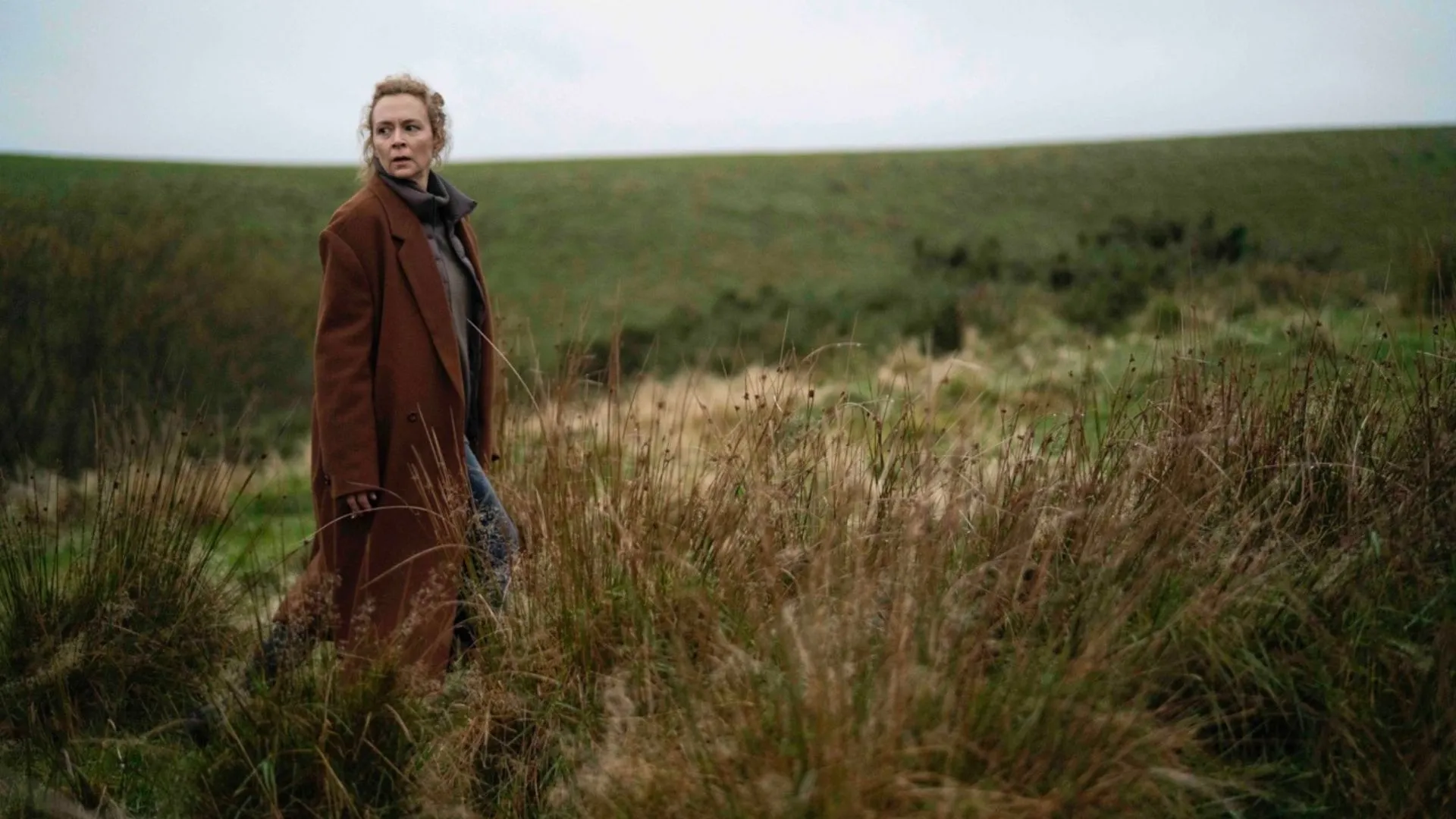
Her cold, stylish home in Sweden, with its clean lines and minimalist decor, functions as a gilded cage, a visual representation of her emotionally sterile and trapped existence. This is sharply contrasted with the desolate, windswept landscapes of Exmoor, England, an external manifestation of her foggy, uncertain moral state.
The narrative structure reinforces this disorientation through the deliberate use of fragmented flashbacks. The truth of what happened with Magnus is revealed piece by piece, a mechanism that mirrors the fractured nature of memory under trauma.
This choice puts the audience in a detective’s role, forcing them to question every detail and making them complicit in judging Maria. The sound design amplifies the tension, using ambient noises like howling wind and creaking floorboards to transform the remote cottage from a refuge into a prison of paranoia.
A Leaky Vessel
For all its atmospheric strength and a commanding lead performance, the film’s narrative structure begins to falter after its potent setup. The tightly coiled tension of the first act slackens as the film shifts from a taut character study into a more conventional “woman on the run” thriller, losing some of its unique analytical edge.

The pacing becomes uneven, with certain subplots feeling rushed. Maria’s brief affair with a gentle local man, for example, develops too quickly to feel organic, serving more as a convenient narrative device to offer her a moment of warmth than a meaningful exploration of her capacity for connection.
The characterization of Magnus as a relentlessly boorish and one-dimensional antagonist also simplifies the central conflict. A more complex villain would have made Maria’s years of complicity more tragically understandable. Instead, her decision to flee feels merely overdue.
The film’s suspense is also undermined by glaring logical inconsistencies, especially its handling of modern technology. The story’s internal logic seems better suited to a pre-internet era, and Maria’s casual use of phones and email without any attempt to hide her digital trail strains credulity, momentarily breaking the immersive world the film works so hard to build.
Unmoored is a psychological thriller adapted from the novel The Living and Dead in Winsford by Håkan Nesser. The film premiered at the BFI London Film Festival on October 5, 2023. It was later released in Sweden on January 28, 2024, and in Poland on May 1, 2025. The film was released in select cinemas in the United Kingdom on August 15, 2025, distributed by Bulldog Film Distribution.
Full Credits
Director: Caroline Ingvarsson
Writers: Michèle Marshall, Håkan Nesser
Producers and Executive Producers: Naomi Despres, Michèle Marshall, Mariusz Wlodarski, Martin Persson, Agnieszka Calik, Luiza Skrzek, Ayanna Hart, Greg McManus
Cast: Anna Próchniak, Thomas W. Gabrielsson, Ia Langhammer, Kris Hitchen, Mirja Turestedt, Andrzej Konopka, Marta Zmuda Trzebiatowska, Sven Ahlström
Director of Photography (Cinematographer): Caroline Ingvarsson
Editors: Laurence Buchmann, Tristan L’Hermite
The Review
Unmoored
Unmoored is a compelling psychological study anchored by a superb lead performance from Mirja Turestedt. Its chilling atmosphere and sharp cinematography effectively build a world of paranoia and guilt. While the film excels as a character portrait, it is hampered by an uneven narrative, underdeveloped supporting characters, and logical flaws that weaken its thriller elements. The result is a film with a potent, unsettling mood that never quite fulfills the promise of its strong beginning.
PROS
- A powerful and nuanced lead performance by Mirja Turestedt.
- A consistently chilling and effective atmosphere of dread.
- Strong cinematography that contrasts different settings to mirror the protagonist's state of mind.
- An engaging and tense first act that establishes the core conflict well.
CONS
- Uneven pacing, especially after the inciting incident.
- Underdeveloped supporting characters, particularly the one-dimensional antagonist.
- Logical inconsistencies that strain credulity, pulling the viewer from the story.
- A loss of narrative tension in the film's second half.