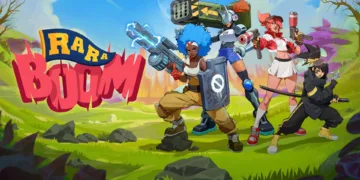
























Ra Ra BOOM enters a revitalized beat ‘em up scene with a jolt of high-fructose energy. It presents itself as a modern arcade brawler, complete with four-player co-op, wrapped in the bright packaging of a Saturday morning cartoon.
The aesthetic is pure comic book, a feeling that defines the entire experience. Players take control of a team of ninja-like cheerleaders from outer space, tasked with saving the world. The team consists of Aris, the leader; Ren, a swift katana wielder; Vee, who carries a massive shield and gun; and Saida, a powerful cyborg.
Their mission is straightforward: a rogue AI named Zoi has unleashed her robot army on Earth, and this quartet is our last line of defense. The game even incorporates a clever team-based life system. When your first hero falls, you jump back into the action as another teammate, continuing the fight until the entire squad is defeated.
Mechanics in Conflict
At its foundation, Ra Ra BOOM equips its heroines with a familiar arsenal. A light attack forms the basis of simple combos, while a heavy attack is meant to provide a weightier, more damaging alternative. Each character also has a ranged weapon for distant threats, a special move for clearing crowds, and a dodge for defense.
These elements are functional on their own, yet the game’s problems begin where these systems intersect, or rather, where they fail to. The combat attempts to emulate the depth of fighting games but misses the connective tissue that makes such systems satisfying. For example, the light and heavy attacks exist as two separate entities. There is no intuitive way to cancel a quick string of light jabs into a heavy launcher.
The aerial combo system, which should be the rewarding follow-up to a successful launch, is equally shallow, often amounting to little more than a couple of unsatisfying mid-air hits. In a genre where titles like Marvel vs. Capcom built legacies on freeform aerial expression, Ra Ra BOOM’s version feels like a pale imitation that misunderstands its inspiration.
The defensive options are just as problematic. The dodge mechanic, a staple for survivability in modern action games, is implemented here with a critical flaw: it cannot be used to cancel an attack animation. In a fast-paced brawler where enemy hordes can fill the screen, being locked into an attack sequence without a defensive out feels needlessly punishing.
This issue is magnified by what appears to be a severe input buffering problem. A player might see a telegraphed attack and press the dodge button, only for the character to complete their current attack animation and then perform the dodge a full second or two after the command was given. This lag between intent and action is immensely frustrating and makes encounters feel less about skillful reaction and more about wrestling with unresponsive controls.
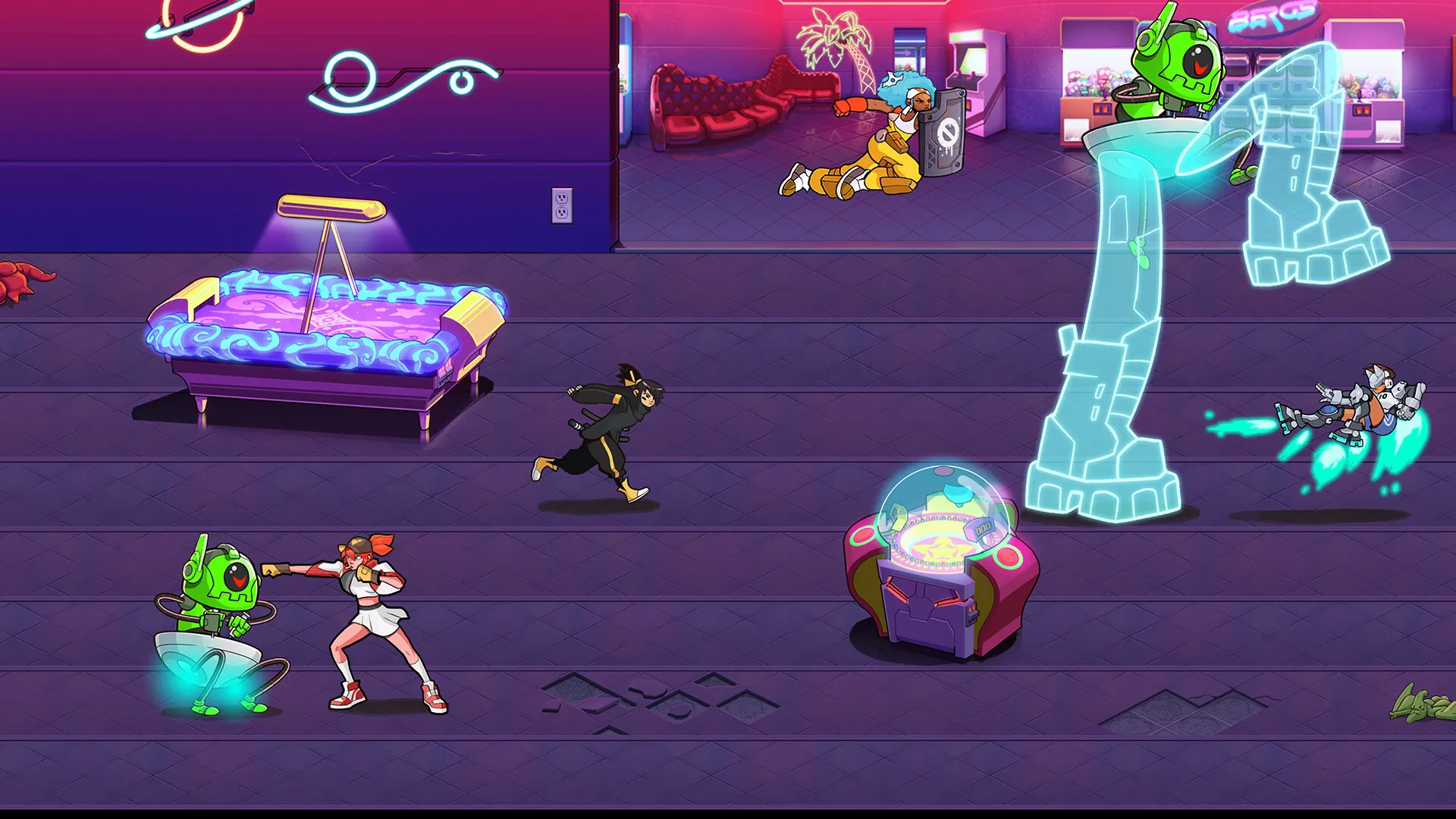
This mechanical awkwardness extends to the game’s structural ideas. The action is set on a plane with clearly defined horizontal lanes, a system intended to add tactical depth to positioning. During certain boss fights, this works as intended; a boss might unleash an attack that travels down a single lane, forcing players to reposition. In the moment-to-moment brawling against standard enemies, however, the system breaks down.
Player attacks are often locked to a specific lane, but enemies move between them with a freedom the player does not have, leading to many attacks whiffing for reasons that feel entirely disconnected from player input or skill. The lanes become little more than lines on the floor. Ranged combat, while a welcome alternative, does not fix these core issues.
It serves a purpose for handling specific enemy types from afar, but its low damage output makes it a situational utility rather than a viable primary strategy. The game is fundamentally confused about its own identity. It presents the frantic, enemy-filled screens of a classic brawler like Teenage Mutant Ninja Turtles: Shredder’s Revenge but couples this with a rigid, commitment-heavy control scheme more akin to a Souls-like, all without the precision and responsiveness that make those games fair.
Pitch-Perfect Presentation
While the game’s hands-on feel is a source of frustration, its audio-visual presentation is an unqualified success. The art direction is exceptional, perfectly capturing the intended “comic book come to life” aesthetic. Narrative sequences are not traditionally animated. They are presented as a series of gorgeous, high-detail splash panels that slide into frame, with characters frozen in expressive poses.

The effect is like reading a digital comic, a style reinforced by mission briefings that appear as pencil sketches on coiled notebook paper. This artistic vision carries over into the gameplay itself. The four heroines are designed with distinct, colorful outfits that pop against the varied backdrops, which range from toxic swamps and neon-drenched arcades to dilapidated amusement parks. The enemy robots provide a great visual contrast, appearing as a cold, metallic force against the heroines’ lively energy.
The sound design is equally impressive and works hard to sell the game’s energetic personality. The experience opens with a fantastic femme-pop anthem that could easily find a home on a Charli XCX playlist, immediately establishing a tone of fun and confidence. This energy is maintained by an upbeat electronic soundtrack that drives the action forward.
The voice acting is another high point. Each of the four protagonists is brought to life with a performance that perfectly matches her archetype, making them easy to distinguish during chaotic fights. The audio feedback from combat is also well-executed. The crackle of energy weapons and the satisfying clang of melee attacks connecting with robot chassis provide a sense of impact that the game’s unresponsive controls often fail to deliver.
This excellent presentation is tasked with carrying a narrative that is ultimately quite thin. The story is a simple vehicle to move players from one stage to the next. The plot about the rogue AI Zoi is a familiar trope that is never explored with any real depth. The four heroines are visually distinct and have strong voice performances, but they are given almost no character development. Their personalities are established at the start and remain static throughout the short campaign.
The game misses opportunities to build relationships between them or explore their motivations beyond the basic goal of saving the world. Even Zoi, the main antagonist, is a generic villain who is defeated without offering any memorable monologue or interesting perspective. The story is serviceable, but it lacks the heart and narrative payoff that would elevate it beyond a simple excuse for the action.
Unfulfilled Potential
Character improvement in Ra Ra BOOM is handled through a straightforward upgrade system. Defeated robots drop scrap, a currency that can be spent at any time in the Scrap Shop, which is accessible from the pause menu. This creates an immediate and simple feedback loop: fight, earn scrap, get stronger.
The shop offers a wide array of stat increases, allowing players to boost their health, attack power, speed, and other attributes. It also offers entirely new moves to unlock, such as an air dash for improved mobility or special ammo types like poison and ice for the ranged weapons. While these upgrades add a sense of progression, they also expose a significant imbalance in the game’s design.
The “Luck” stat, which increases the drop rate of items from enemies, can completely trivialize the game’s difficulty. A player who focuses on upgrading Luck will find the screen littered with health-restoring items after every major fight, effectively removing any sense of danger or tension. This turns encounters that should be challenging into simple exercises in attrition.
Other upgrades are questionable in their utility; one review noted that an “upgrade” to reduce weapon recoil might actually be a downgrade, as the natural pushback from firing a weapon is a useful defensive maneuver. The new moves one can unlock do little to fix the core disconnectedness of the combat system. An uppercut or a spike attack are welcome additions, but they are still governed by the same rigid rules that prevent them from flowing together with the rest of your moveset.
The game is a short experience, and its difficulty curve is shallow. Checkpoints are generous, appearing frequently throughout levels and even during multi-stage boss fights, which removes much of the penalty for failure. For replayability, the game offers a scoring system, an end-of-level Report Card that gives a team grade, and optional “homework assignments” for each stage.
These challenges, such as completing a level without using ranged attacks, offer a mild incentive to revisit areas, but they are not compelling enough to support long-term play. The experience of playing Ra Ra BOOM is one of friction between what the game shows you and what it lets you feel. The eyes are treated to a spectacle of color, style, and personality.
The hands, however, are left to grapple with a control scheme that feels incomplete. It is a game with a tremendous amount of surface-level charm that is unfortunately undermined by a foundation of flawed and unsatisfying mechanics. It stands as a powerful example of how crucial a game’s core feel is, and how even the most brilliant presentation cannot fully redeem a system that feels unresponsive to play.
The Review
Ra Ra BOOM
Ra Ra BOOM is a dazzling spectacle of art and sound that is tragically let down by its core gameplay. While its comic-book energy is infectious, the experience is soured by unresponsive controls and a combat system that feels fundamentally broken. It is a game with immense style but a frustrating lack of substance, full of unfulfilled potential.
PROS
- Stunning comic book art style and fluid animation.
- Exceptional, high-energy soundtrack and voice acting.
- Strong, charming personality and character designs.
CONS
- Unresponsive controls and noticeable input lag.
- Clunky and disconnected combat mechanics.
- Shallow story and minimal character development.
- Difficulty is easily trivialized by the upgrade system.