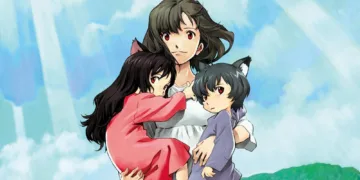






















A young woman named Hana watches a man in her university lecture hall. He is a solitary figure, keeping to himself, yet she is drawn to his quiet presence. Their courtship is gentle, a series of shared moments that deepen into love. Then, he reveals his secret: he is a descendant of the Japanese wolf, the last of his kind, able to shift between human and animal form.
This revelation does not break their bond; it solidifies it. From this fairytale union come two children, a spirited daughter, Yuki, and a timid son, Ame, who both inherit their father’s strange gift. Their precarious happiness is shattered when their father dies in an accident while hunting for food.
Suddenly, Hana is a single mother, the sole guardian of a secret that the modern world would never understand. What follows is a thirteen-year chronicle of her resilience and the profound question her children must face: where, in a world of rigid definitions, does a creature of two natures belong?
A Mother’s Singular Burden
Hana’s new reality in the city is a prison of constant vigilance. Her maternal instincts are warped by an impossible calculus of risk. When her children cry, their bodies threaten to betray them with sprouting ears and tails. When they fall ill, she is caught in a paralyzing limbo between a pediatrician who cannot treat a wolf and a veterinarian who cannot treat a human.
The thin walls of her apartment amplify every howl, every crash, transforming the normal chaos of childhood into a source of unending paranoia. Her flight to the countryside is therefore not an escape but a deliberate act of reclamation. She finds a dilapidated, forgotten house at the foot of a mountain, a structure whose decay mirrors her own fractured family.
This home becomes her singular project. With no experience, she confronts the land, learning to till unforgiving soil under the gruff tutelage of a neighboring elder. He scolds her clumsy efforts before slowly offering his wisdom, representing a community that values persistence over polish.
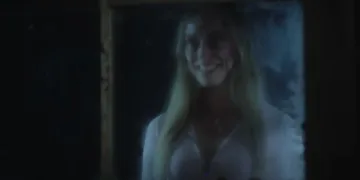
She learns to repair the house, her physical labor a direct investment in her children’s freedom. Her smile, which she deploys in the face of every setback, is her armor. It is the outward expression of a deep, unyielding fortitude, a portrait of a mother whose love is powerful enough to rebuild a world from its foundations.
Between Two Natures
The sanctuary Hana builds gives her children the space to discover who they are, and their explorations lead them down opposite paths. Initially, Yuki is the quintessential wolf-child, a whirlwind of energy who digs for prey and runs wild through the fields. Ame is her timid shadow, a frail boy who shrinks from his lupine side and clings to his mother.

As years pass, the pressures of the outside world trigger a profound reversal. Yuki’s desire to join the human world, to have friends and attend school, forces her into a state of careful self-regulation. She learns to suppress her wildness, to sit still, to hide her otherness behind a mask of normalcy. Her humanity becomes a conscious, daily performance.
Ame, finding no place for himself in the rigid structure of school, is pulled in the other direction. The mountain becomes his true classroom. He follows an old fox, his silent mentor, learning the laws of the forest, the scent of prey on the wind, and the feeling of the earth beneath his paws. His connection to the wild evolves from a fearful uncertainty into a powerful sense of belonging.
Their divergence presents the film’s central philosophical conflict as a tangible choice. It is a potent allegory for identity, where the path one chooses fundamentally alters one’s being. Hana’s greatest trial is to witness this separation, to understand that her role is not to dictate their nature but to love them enough to let them go, even into a world she can never enter.
The Soul in the Scenery
The film’s emotional force is intrinsically tied to its visual artistry. Director Mamoru Hosoda renders his characters with a soft, expressive simplicity that allows their emotions to be universally understood. These figures are placed within natural landscapes of staggering, photorealistic detail.

The contrast is deliberate and effective; the tangible reality of the lush forests, sun-drenched fields, and snow-covered mountains grounds the fantastical story. This world feels alive and consequential. The narrative pacing is patient and observational, eschewing conventional antagonists for a more natural emotional arc.
Years pass in lyrical, wordless montages, showing the children growing and the seasons turning, with time itself being the primary force of change. The camera frequently adopts a dynamic, first-person perspective, especially during the children’s runs through the forest. We experience their exhilarating freedom as they leap over logs and race down hillsides, a pure cinematic expression of their animal joy.
The artistry reinforces the story’s core ideas. Nature is not a passive backdrop; it is an active, formative character in the lives of the family. The meticulous animation and unhurried storytelling work in concert to create an authentic and deeply affecting meditation on the bonds of family, the pain of loss, and the difficult beauty of growth.
Wolf Children is a Japanese animated fantasy drama film directed and co-written by Mamoru Hosoda. It was co-produced by Studio Chizu and Madhouse. The movie explores themes of parenthood and self-discovery. The film premiered on June 25, 2012, in Paris, France, and on July 21, 2012, in Japan. A 4K restoration was re-released in North American theaters by GKIDS on May 11, 2025. The movie is available on Apple TV+ and Prime Video. It is also available to purchase or rent on platforms like Amazon Video, Apple TV, and Fandango At Home. GKIDS has also released a 4K Blu-ray edition on August 5, 2025.
Full Credits
Director: Mamoru Hosoda
Writers: Mamoru Hosoda, Satoko Okudera
Producers and Executive Producers: Yuichiro Saito, Takuya Itō, Takashi Watanabe, Justin Cook, Izumi Murakami, Nozomu Takahashi, Genki Kawamura, Hiroyasu Asami, Z. Charles Bolton, Suzuko Fujimoto, Seiji Okuda, Fumihiro Hirai, Yuka Saito, Hiroyuki Okada, Hiroyasu Asami, Gen Fukunaga, Yoshio Takada, Hidenori Ueki, Minami Ichikawa, Ken Hironaka, Shinichirou Inoue
Cast: Aoi Miyazaki, Takao Osawa, Haru Kuroki, Yukito Nishii, Momoka Ohno, Amon Kabe, Takuma Hiraoka, Megumi Hayashibara, Kumiko Aso, Tadashi Nakamura
Director of Photography (Cinematographer): Ryo Horibe
Editors: Shigeru Nishiyama
Composer: Masakatsu Takagi
The Review
Wolf Children
Wolf Children is a masterful work of animation, a deeply affecting and mature story that uses its fantastical premise to explore the universal truths of parenthood, sacrifice, and the difficult search for identity. It is a patient, poignant, and visually stunning film that stands as a quiet triumph of storytelling.
PROS
- Stunning hand-drawn animation combined with beautiful, detailed backgrounds.
- A profound and emotionally resonant portrayal of single motherhood.
- A thoughtful allegorical story about identity and choosing one's path.
- Excellent character development, especially for the mother, Hana.
- Patient pacing that allows emotional moments to land with significant weight.
CONS
- The leisurely narrative pace may not engage all viewers.
- The central romance at the beginning feels slightly rushed.
- Its deeply melancholic ending can be emotionally challenging.