































Whimside positions itself as a persistent digital terrarium, a small world that lives at the bottom of your computer screen. It is designed to be a quiet companion while you work or browse. This habitat is populated by “Whimlings,” peculiar creatures assembled from the parts of different animals. One might have the ears of a donkey, the head of a rabbit, and the tail of a deer.
The game’s fundamental premise is to discover these creatures, collect their varied traits, and breed them to produce new combinations. This activity slowly expands your colorful pixel-art domain. The initial presentation suggests a relaxing, cozy experience focused on casual collection, drawing you in with its soft aesthetic and simple promise of growth.
A Beautiful Window That Demands Your Gaze
The game’s aesthetic is its most polished and immediately successful feature. The pixel art evokes a sense of cozy nostalgia, rendering its world with a softness that feels both gentle and inviting. This visual style is perfectly complemented by the creativity of the Whimlings themselves. They are not predefined creatures but modular creations, assembled from a vast library of parts.
One of the earliest pleasures is simply seeing what the random generator produces, like a creature with the horned head of a goat, the prickly body of a hedgehog, and the majestic antlers of a deer. This modular system creates a persistent sense of small-scale discovery, as the sudden appearance of a previously unseen tail or ear type can be a minor event in itself.
The game ties these discoveries to its environments, with the initial Meadow biome yielding familiar woodland creature parts and later areas introducing more esoteric elements like mushroom-based appendages. The visual appeal is undeniable and serves as the primary hook.
In stark contrast, the audio design is almost entirely forgettable. The background music is generic, ambient fare that quickly fades from consciousness. The sounds the Whimlings make are non-distinct and do little to give them personality. The audio landscape is so sparse that one could play the game on mute for hours and miss nothing of consequence, with one critical exception.
A specific, sharp audio cue plays whenever a Whimling with a new, uncollected trait appears on screen. This single sound transforms the player’s relationship with the audio. It is no longer background noise but a signal that demands immediate attention. You learn to listen for it not for enjoyment, but for progress.
This alert is the first sign of the game’s fundamental misunderstanding of the idle genre. True idle, or incremental, games like AdVenture Capitalist or AFK Arena are built on the principle of meaningful offline progress. Their appeal lies in returning after a break to see substantial growth. Whimside rejects this entirely. It presents itself as a background companion but requires the foreground of your attention.
You cannot walk away for long because new traits are tied to randomly spawning creatures that will disappear if not clicked. Breeding is not automated; you must manually select the parents, place them in an enclosure, and later click the resulting egg to hatch it. Even resource collection from the garden is a manual task. This is not a passive process; it is a low-intensity active game that merely confines itself to a small window.
The Intricate Puzzle of Creation
At its heart, Whimside is less a creature collector and more a complex puzzle of genetic data management. The central gameplay loop is a multi-step process that requires patience and precision. It begins with passively watching the band of land at the bottom of your screen, waiting for a Whimling with a new trait to appear. Upon its arrival, you must quickly click to adopt it into your collection.
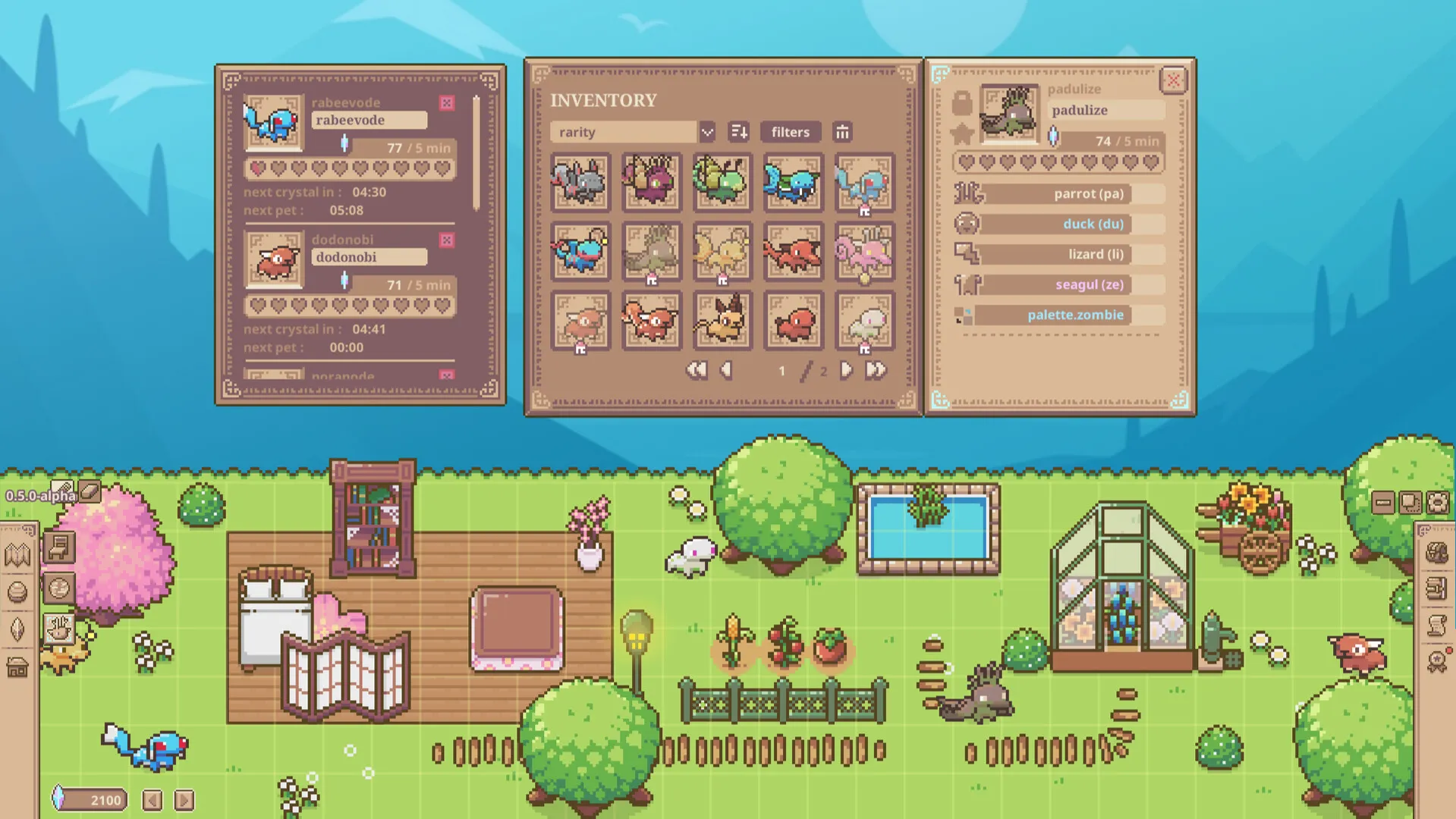
From there, you enter the menus, a surprisingly dense part of the game. Here, you will find two primary drivers for your breeding efforts. The Altar for each biome functions as the main quest, demanding very specific Whimling combinations to unlock the next region and its associated traits. Separately, a Quest Board offers a rotating list of breeding assignments that serve as side quests, rewarding you with crystals.
This currency is essential for purchasing cosmetic decorations and, more importantly, for functional upgrades like expanding your nests to hold more eggs. This system forces you to divide your limited breeding enclosures and creature stock between long-term progression and short-term resource grinding.
This entire process is made more difficult by a set of deliberately obtuse systems. The Whimling naming convention is the most significant hurdle. Instead of memorable names, creatures are identified by a confusing shorthand of their component parts. A Donkey-Rabbit-Rabbit-Deer hybrid becomes ‘Donrarade,’ while a Mushroom-Boar-Cheetah-Hedgehog is a ‘Mubogehe.’ The rules for these abbreviations are inconsistent; ‘Cheetah’ becomes ‘GE,’ presumably because other letters were taken. This naming scheme is nearly impossible to internalize.
The frustration is magnified by a restrictive user interface that prevents you from viewing your breeding pen and the Altar’s requirements at the same time. You are forced to either commit the bizarre names to memory or resort to writing them down on a piece of paper, a solution that pulls you completely out of the game. One can only imagine a more streamlined system, perhaps like the clear breeding menus in Slime Rancher, and lament its absence here.
Navigating this confusion feels like the intended challenge. The game’s tutorial does little to help, presenting new players with an overwhelming infodump that fails to explain the most useful tools. The key to managing the breeding puzzle is the “target” system, a feature that many players will only discover after hours of frustration. By clicking a small button above a quest’s required creature, you can tag it.
This action then allows you to filter your entire collection, instantly highlighting the Whimlings that possess the traits you need. Discovering this function is a moment of pure relief, turning a chaotic guessing game into a manageable, almost enjoyable, process of elimination. The satisfaction of this discovery, however, is soured by the knowledge that it was earned through poor tutorial design, not genuine player skill.
The Slow March of Repetition
After you have deciphered the cryptic systems and mastered the user interface, the game reveals its true, unvarying form. It settles into a rigid and deeply repetitive cycle. The gameplay operates on a model of horizontal, not vertical, progression. You are not building towards bigger or better things; you are simply getting more of the same.

Unlocking a new biome feels momentous for a few seconds, but the feeling quickly fades when you realize it only offers a new background image and a fresh checklist of traits to collect. No new mechanics are introduced. No new challenges alter the formula. The core activity, a loop of watching, clicking, and breeding, remains static from the first hour to the last. While games in the roguelike genre use repetition as a foundation for varied runs and meta-progression, Whimside’s repetition is stark and mechanical. The task is always identical; only the ingredients change.
The rewards for your efforts are similarly hollow. The payoff for breeding a difficult Whimling is simply the ability to begin the next, equally difficult breeding task. The satisfaction is purely intrinsic and procedural, derived from the successful completion of a task for its own sake.
This stands in sharp contrast to collection-heavy games like Stardew Valley or Animal Crossing, where completing tasks and collections leads to tangible rewards: new tools that open up new gameplay, new areas with new functions, and new interactions that deepen your connection to the world. Whimside’s progression feels disconnected from any meaningful outcome. You are solving puzzles to unlock more puzzles.
This philosophy extends to its secondary systems. The garden is positioned as the game’s passive income source, a place to put a creature who will drop crystals over time. Yet, even this is not truly passive. You must manually mouse over and click the crystals to collect them. The game even offers an upgrade for 1000 crystals that purports to “auto-collect” from the garden.
This upgrade, however, does not automate the process. It simply provides a single button that collects all visible crystals at once. You are still required to be present and active. It is perhaps the most emblematic feature of the game: a system that promises automation but ultimately still demands your direct and constant involvement.
A Niche Collector for the Meticulous Player
Whimside is a game with an identity crisis. It presents itself with the cozy, welcoming aesthetic of a casual pet simulator but plays like a demanding, detail-oriented management sim. It is like purchasing what appears to be a simple coloring book, only to discover its pages are filled with complex paint-by-number logic puzzles.

The experience is not about nurturing creatures; it is about managing an information database. The gameplay is not about relaxing; it is about methodically executing a series of logistical tasks. This fundamental disconnect between presentation and mechanics defines the entire experience. It is a puzzle box disguised as a toy.
The game is best characterized as a hands-on micromanagement challenge. The core skills it tests are not strategy or reflexes, but information management, pattern recognition, and process optimization. The player’s main objective is to create an efficient workflow to tame the game’s intentionally confusing systems. The enjoyment, for those who find it, comes from bringing order to this chaos. It is the satisfaction of organizing a messy spreadsheet or perfectly sorting a catalog of items.
This makes Whimside a product for an extremely specific audience. If you are the kind of person who enjoys methodical, repetitive, and detail-oriented work, you may find a strange meditative quality in its loops. It is a game for the patient organizer, the meticulous list-completer, and the player who finds a unique joy in untangling knotted systems for its own sake.
If, however, you are looking for a relaxing virtual pet, an emergent story, or a game that respects your time by making progress while you are away, you will find little here to enjoy. It fails as an idle game and is too abstract to succeed as a virtual pet. It is better understood as an entry in a different, barely explored genre: the desktop puzzle box. Its value is entirely dependent on a player’s personal tolerance for its brand of focused, mechanical work. It is a well-executed version of something very few people may have been looking for.
The Review
Whimside
Whimside is a beautiful puzzle box that sells itself as a relaxing virtual pet. Its charming pixel art and creative creature designs are a thin veil over a demanding and repetitive micromanagement game. It completely fails to be an "idle" experience, requiring constant attention to navigate its confusing systems. While meticulous players who enjoy logistical challenges may find a strange satisfaction in its loops, most will be frustrated by its misleading premise and tedious gameplay. It is a well-made game for an extremely niche audience, but a disappointment for everyone else.
PROS
- Visually appealing pixel art and creative creature designs.
- Satisfying core puzzle for players who enjoy methodical tasks.
- Runs in a small desktop window, suitable for some multitasking.
CONS
- Fundamentally misrepresented as a passive or idle game.
- Requires constant active attention and micromanagement.
- Systems are confusing and poorly explained by the tutorial.
- The gameplay loop is highly repetitive with little evolution.