















Every supergroup has an origin story, usually polished for a documentary years after the fact. Disney’s Electric Bloom cuts straight to the chase, building its entire premise around the flashback. The series opens with the titular girl group, Electric Bloom, already a global sensation. From the stage of a sold-out stadium tour, the members—Posey, Jade, and Tulip—answer a fan’s question: “How did it all start?”
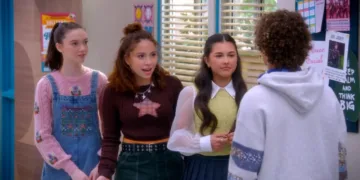
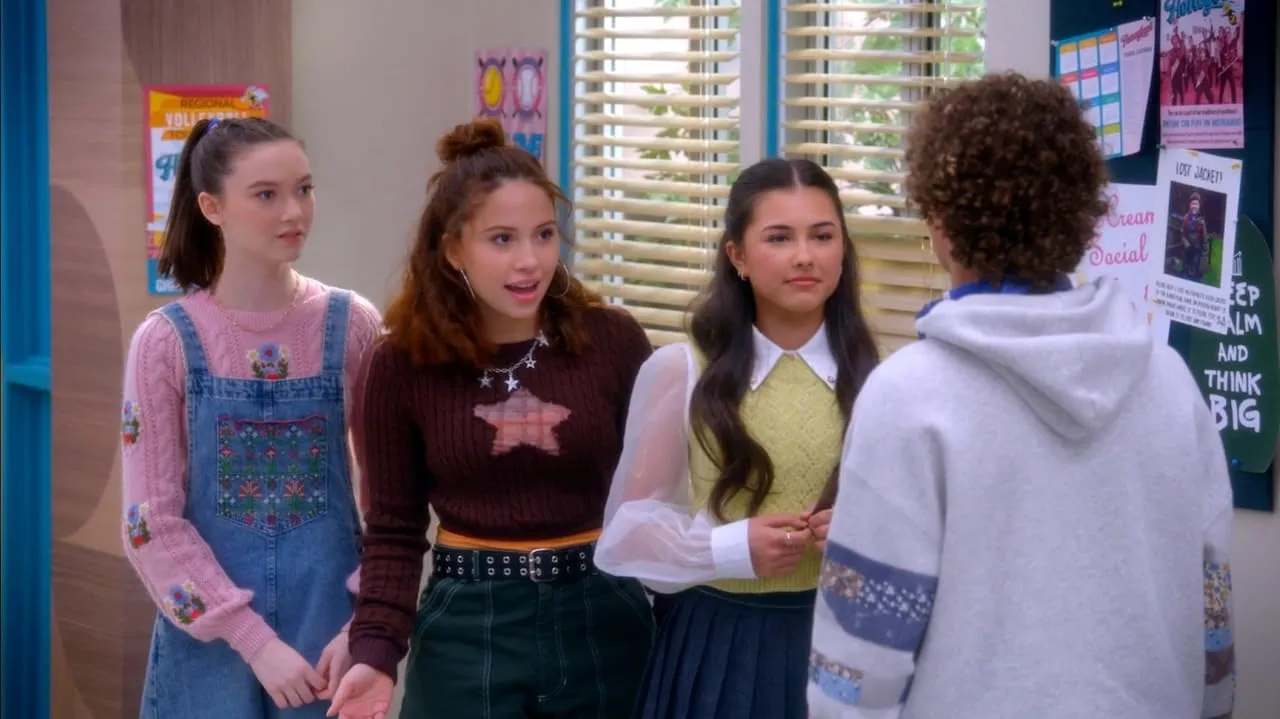
The show then throws us back to the fluorescent-lit hallways of ninth grade, a world away from the screaming crowds. Here, the future pop stars are just an unlikely trio navigating the treacherous waters of high school cliques, science projects, and the desperate need to find their place.
The narrative device is simple, creating an immediate and effective hook. We know where they end up; the fun is in discovering the chaotic path they took to get there, a journey that apparently began with an F on a science project.
The Perfectionist, the Rebel, and the Homeschooler
The show’s engine runs on the classic sitcom formula of mismatched personalities, but it invests commendable effort in exploring the anxieties beneath the archetypes. Posey Parker is the group’s aspiring leader, a meticulous perfectionist whose life plan is detailed with unnerving precision. Her introduction, a conversation with her own reflection, initially reads as pure vanity.
Yet, it is quickly revealed to be a ritual of self-motivation, a desperate attempt to manifest a perfect life into existence. Lumi Pollack’s performance captures this duality well; her posture is ramrod straight and her smile is camera-ready, but a flicker of panic lives in her eyes. Posey’s ambition is a shield, a carefully constructed defense against the messiness of life.
Her friendship with Shelley Sharp feels less like a partnership and more like a project she is managing. When Shelley defects to form a rival duo, Posey’s reaction is not just disappointment; it is a full system crash. The betrayal dismantles her sense of control and forces her to confront a future she did not schedule, a prospect that is, for her, a fate worse than social oblivion.
Her polar opposite is Jade, the school’s defiant rebel. Carmen Sanchez portrays her with a well-practiced slouch and a sarcastic wit that serves as a force field. Her rebellion is not aimless; it is a direct response to an environment that has already labeled her. The principal, Mr. Jeffries, speaks to her with a tone of weary resignation, seeing her not as a student but as a problem to be managed.
This dynamic creates a self-fulfilling prophecy, where Jade’s defiance is both a cause and an effect of her reputation. Underneath the armor, however, is a sensitive artist who channels her frustrations into poetry, a secret she guards ferociously. The notebook she clutches is the story’s most potent symbol: a locked diary of her authentic self.
Her fear of being misunderstood is palpable. When Posey eventually reads her work, Jade’s immediate assumption is that she will be ridiculed, revealing a deep-seated vulnerability that her tough exterior is designed to protect. Her arc is about learning to trust that her creativity will be accepted, not mocked.
Rounding out the trio is Tulip, the relentlessly optimistic new girl whose enthusiasm borders on the chaotic. Her profound social awkwardness is given a clear and clever backstory: she was homeschooled her entire life, with her hamster acting as her therapist.
Ruby Marino’s performance is a masterclass in committed strangeness, a blend of wide-eyed earnestness and gangly physical comedy. She has no concept of personal space or social cues, making her both a source of humor and a catalyst for plot. The later reveal that she comes from a wealthy family with a state-of-the-art music room adds another dimension to her character.
Her naivete is not a result of simplicity but of a sheltered, privileged existence. Tulip has all the best equipment but none of the necessary life experience. She represents raw, uninhibited talent, a creative force that needs the structure of her more worldly friends to be properly channeled.
A Band Forged in Detention
The episode’s narrative is a finely tuned chain reaction of small disasters, with each failure pushing the girls closer to their shared destiny. The pacing is brisk, moving efficiently from one comedic set piece to the next while ensuring each moment serves the character-building process. The inciting incident, being forced into a science partnership, establishes their immediate lack of chemistry.

Posey attempts to impose order, Jade actively resists it, and Tulip tries to befriend them both with overwhelming sincerity. Their subsequent failure is inevitable and necessary, a low-stakes disaster that equalizes them. This failure directly fuels their individual motivations for entering the school’s Battle of the Bands.
For Posey, it is a desperate attempt to reclaim her narrative after being publicly abandoned by her best friend. For Jade, it is a pragmatic move to avoid failing music class and being held back. For Tulip, it is simply a chance to be part of something.
The first true moment of creative synthesis happens in the school auditorium. The scene is staged to reflect their dynamic: Jade bangs on the piano aimlessly, Posey tries to direct, and Tulip observes. The turning point occurs when Tulip joins in on her portable keyboard, her playful riff cutting through the tension and finding a melody that catches everyone by surprise.
This is followed by the episode’s most critical discovery: Posey’s invasion of Jade’s privacy. By reading the secret poetry notebook, Posey crosses a boundary, yet she is the only one who could recognize the lyrical potential in Jade’s words. It is a complicated but crucial moment where Posey’s drive and Jade’s soulfulness first connect.
The bond is truly solidified through shared misadventure. The sequence where Posey confronts a life-sized cardboard cutout of her ex-friend is a brilliant stroke of comedic staging. It allows her to unleash a torrent of righteous anger at a safe, inanimate target. The act escalates into the accidental destruction of the school’s trophy case, a symbolic shattering of the very idea of institutional perfection that Posey once cherished.
This act lands them in detention, the place where their band is unofficially born. They lose the competition, as they should. They are a chaotic mess of raw talent and conflicting personalities. The episode smartly subverts the instant-success trope. Their victory is not the trophy; it is the fact that they found a common purpose in the wreckage of their individual plans.
The Sound of Teenage Chaos
The show’s identity is defined by the interplay between its musical aspirations and its sharp, character-driven humor. The involvement of songwriter Diane Warren is a significant statement. It signals a commitment to genuine pop craftsmanship, lending the series a musical credibility that sets it apart from its peers.

The first song the girls write, “I’m Going To Be Me,” is lyrically straightforward, a direct expression of the show’s theme of self-acceptance. Its power comes from its context. It is constructed from Jade’s private, heartfelt poetry, given structure by Posey’s ambition, and colored by Tulip’s melodic intuition.
When they perform it at the Battle of the Bands, we are told they sound terrible. This is a crucial choice. The show prioritizes emotional authenticity over technical perfection, reinforcing that their music is, at this stage, an expression of their messy, evolving friendship.
The direction and editing are key to the show’s tone. Jody Hahn, who directed the pilot, expertly balances the high-energy performance scenes with quieter, more intimate character moments. The comedic timing is precise. The humor derives from exposing the characters’ core anxieties: Posey’s frantic attempts to maintain composure while internally combusting, Tulip’s blunt, filterless observations that cut through social pretense, and Jade’s deadpan reactions to the absurdity around her.
The camera often lingers on a character’s face just long enough to catch the crack in their mask. Supporting characters like Luca, the kind-hearted but dim-witted class crush, function as excellent comic foils. His simple-mindedness provides a grounding contrast to the girls’ complex emotional lives.
His delivery of lines about “day-old tacos” is a moment of pure, low-stakes silliness that offers a reprieve from the central drama. This blend of sincerity and comedy situates Electric Bloom within the legacy of classic Disney Channel properties while updating the formula for a contemporary audience that appreciates a bit more psychological depth with its pop anthems.
“Electric Bloom” is an American musical comedy television series created by Alex Fox, Eric Friedman, and Rachel Lewis. It premiered on Disney Channel on July 10, 2025, and is set to premiere on Disney+ on September 17, 2025.
Full Credits
Director: Jody Margolin Hahn, Danielle Fishel, Robbie Countryman, Morenike Joela Evans
Writers: Alex Fox, Eric Friedman, Rachel Lewis, Lacey Dyer, Erica Eastrich, Julia Layton, Ron Rappaport, Jess Pineda, Anna Suzuki, Jonathan De Weerd, Paul David Smith
Producers and Executive Producers: Eric Friedman, Alex Fox, Rachel Lewis, Diane Warren, Bahareh Batmang, Jody Margolin Hahn, Ron Rappaport, Natalie Duvoisin, Lacey Dyer, Julia Layton, Zack Lowenstein, Carla Myres, Jess Pineda
Cast: Lumi Pollack, Carmen Sanchez, Ruby Marino, Nathaniel Buescher, J’Adore Elizabeth, Trisha Macaden, Luke Busey, Van Brunelle, Audrey Grace Marshall, Leah Mei Gold, DaJuan Johnson, Clayton Thomas, Santina Muha, Irene White, Lennon Parham
Director of Photography (Cinematographer): Chuck Ozeas, Hisham Abed
Editors: Ryan Levi, Brady Heck
Composer: Diane Warren, Mitch Allan, Kotomi, Chad Fischer
The Review
Electric Bloom
Electric Bloom successfully recharges a familiar formula with sharp writing, genuinely funny character-driven humor, and a refreshing dose of self-awareness. While built on the bedrock of teen sitcom archetypes, the show gives its characters enough psychological depth to feel authentic. The series smartly prioritizes the messy process of friendship over instant fame, creating a charming and energetic origin story. Its musical credibility, thanks to Diane Warren, gives its pop anthems a genuine sparkle. It is a well-crafted and promising start that understands its audience and its place in television history.
PROS
- Well-defined characters that grow beyond their initial archetypes.
- Sharp, witty dialogue and strong comedic timing.
- Original music with professional songwriting credibility.
- Effectively subverts the "instant success" trope, focusing on the process.
- Strong performances from the lead trio.
CONS
- The overall plot structure follows a predictable teen show formula.
- Some story beats, like the forced partnership, are conventional.
- Supporting characters can feel one-dimensional at times.