






























Developer Alcot is known for its light-hearted romantic comedies, and Yomegami: My Sweet Goddess fits squarely within that tradition. The story introduces Narukawa Hayato, a high school student with a complicated past. He is the reincarnation of Angolmois, a powerful devil who once caused chaos in Heaven. His mother, the Goddess of Rebirth Iris, managed to seal the devil’s soul and give birth to him as her human son.
Now exiled from Heaven, Hayato’s only path back is to accumulate enough good deeds to offset his past self’s sins. His mission begins in the new town of New Masado, a seemingly ordinary place where his quest for virtue is immediately complicated by a cast of divine and mortal girls.
The game quickly establishes a tone that is equal parts sweet romance, chaotic comedy, and supernatural fantasy, setting the stage for a story about a boy trying to be good while his devilish nature lingers just beneath the surface.
Divine Romances and Tangled Fates
At the center of Yomegami is Hayato’s struggle with his own identity. He is a genuinely kind person dedicated to his mission, yet he possesses the immense magical energy and soul of a destructive devil. This duality is not merely a background detail; it actively shapes his moment-to-moment existence.
His worthiness is tracked by a system of “good deed points,” a tangible measure of his progress that can fluctuate wildly based on his actions, even those with good intentions. This creates a constant internal and external pressure.
His serious dedication to this heavenly accounting makes him the perfect anchor for the story’s comedy, as his single-minded focus on virtue is perpetually tested by the chaotic and amorous situations he finds himself in. The narrative uses this internal conflict to explore themes of nature versus nurture, questioning whether a person can truly escape their origins.
The story unfolds through its four distinct heroine routes, each exploring Hayato’s conflict from a different angle. Iris, his mother and a goddess, presents a complex and unconventional dynamic. Her affection is a focal point, moving beyond simple parental care into something much more intense. This character choice delves into the nature of divine beings, whose concepts of family and love may not align with mortal standards.
Her route forces the player to consider the implications of a bond that transcends typical human relationships, a theme that requires a delicate narrative touch. Her deep connection to Hayato’s very existence as both his mother and the one who sealed his demonic soul makes her story fundamental to the game’s lore.
Ichijiku Mikoto’s route uses the classic trope of amnesia to build its narrative. As the adopted daughter of a Yakuza leader, she projects an intimidating aura, yet she feels an inexplicable and immediate pull toward Hayato. This fated connection, which she cannot remember, creates a story built on rediscovery and the idea that some bonds persist beyond memory.
Her background provides a source of earthly conflict that contrasts sharply with the story’s celestial stakes. Hayato’s attempts to perform good deeds are complicated by his association with someone from the criminal underworld, forcing him to navigate a different kind of moral gray area. Her journey to reclaim her past runs parallel to Hayato’s journey to atone for his own.
The other two heroines provide different flavors of interaction. Rico, a goddess candidate, is a primary driver of the game’s outrageous humor. Her character is defined by a strange fetish for Hayato’s magical energy, which manifests as a compulsion to sniff him.
This extreme quirk is characteristic of Alcot’s style, creating a character who is impossible to predict and consistently pushes the boundaries of absurd comedy. Her route challenges Hayato’s patience and composure, testing his ability to remain virtuous when faced with constant, lewd provocations.
Beneath her comical exterior, her story explores her own struggles to achieve godhood. In contrast, Hakari Mari is the grounded, good-hearted class president. Her story takes a turn when she spontaneously develops the power to see auras and the weight of people’s sins. This development pulls her directly into Hayato’s world, transforming her from a normal human friend into an active participant in the supernatural conflict. Her desire to use her newfound abilities to protect her town gives the narrative a local, heroic focus.
Navigating Virtue and Vice
Yomegami is structured as a traditional visual novel, with a long common route that establishes the characters and setting before branching off into one of four heroine-specific paths. Player interaction is minimal, a design choice that firmly places the game on the more linear end of the genre spectrum, closer to a kinetic novel than a complex, branching narrative.

The few choices that appear do little to signal which path they lead to, making a player’s first playthrough a journey of discovery. For those wishing to see a specific heroine’s story, this structure can become a point of friction, as it necessitates skipping through hours of previously read text. This design prioritizes the unfolding of a set story over player agency, a common approach in many rom-com visual novels where the destination is more important than the path taken to get there.
To mitigate the repetition inherent in this structure, the game includes essential quality-of-life features. A standard text-skip function allows players to fast-forward through scenes they have already seen. More importantly, completing the game once unlocks a “Scenario Select” screen.
This feature is a crucial concession to the player, allowing them to jump directly to the start of any of the four heroine routes on subsequent playthroughs. It shows an awareness from the developer that the common route, while important for the initial experience, becomes an obstacle for players aiming for full completion. This small feature dramatically improves the game’s replayability.
The game’s most defining characteristic is its unapologetic comedic style, a hallmark of developer Alcot. The humor is relentless, leaning heavily on sexual innuendo, dirty jokes, and absurd situations. The heroines are often the instigators, openly discussing their perverted fantasies with a mix of sincerity and embarrassment.
This creates a lively and chaotic atmosphere where Hayato must constantly play the “straight man.” His serious mission to get into Heaven serves as the perfect foil for the cast’s antics, and his exasperated reactions are the punchline to many jokes. This comedic dynamic is effective because it is rooted in his core character conflict. The constant barrage of temptation is a direct test of his resolve, making the humor feel integrated with the narrative.
This comedic approach is also deeply connected to the game’s adult content. The story frequently links Hayato’s demonic power to his level of arousal, suggesting that his devilish nature surfaces during moments of passion.
This connection makes the H-scenes more than simple titillation; they become moments of character exploration. In these scenes, his demeanor can shift, revealing a different side of his personality that is influenced by the soul of Angolmois. A player who opts for the all-ages version would miss this subtle but important aspect of his character arc. The humor and the intimacy are two sides of the same coin, both serving to explore Hayato’s struggle to reconcile the human and demonic parts of himself.
Heavenly Sights and Sounds
The visual presentation of Yomegami is one of its strongest assets. The project involved five different artists, yet the final product maintains a remarkably consistent aesthetic. The character designs adhere to the conventions of the genre, with large, colorful eyes and vibrant hair that make each heroine instantly recognizable and appealing.
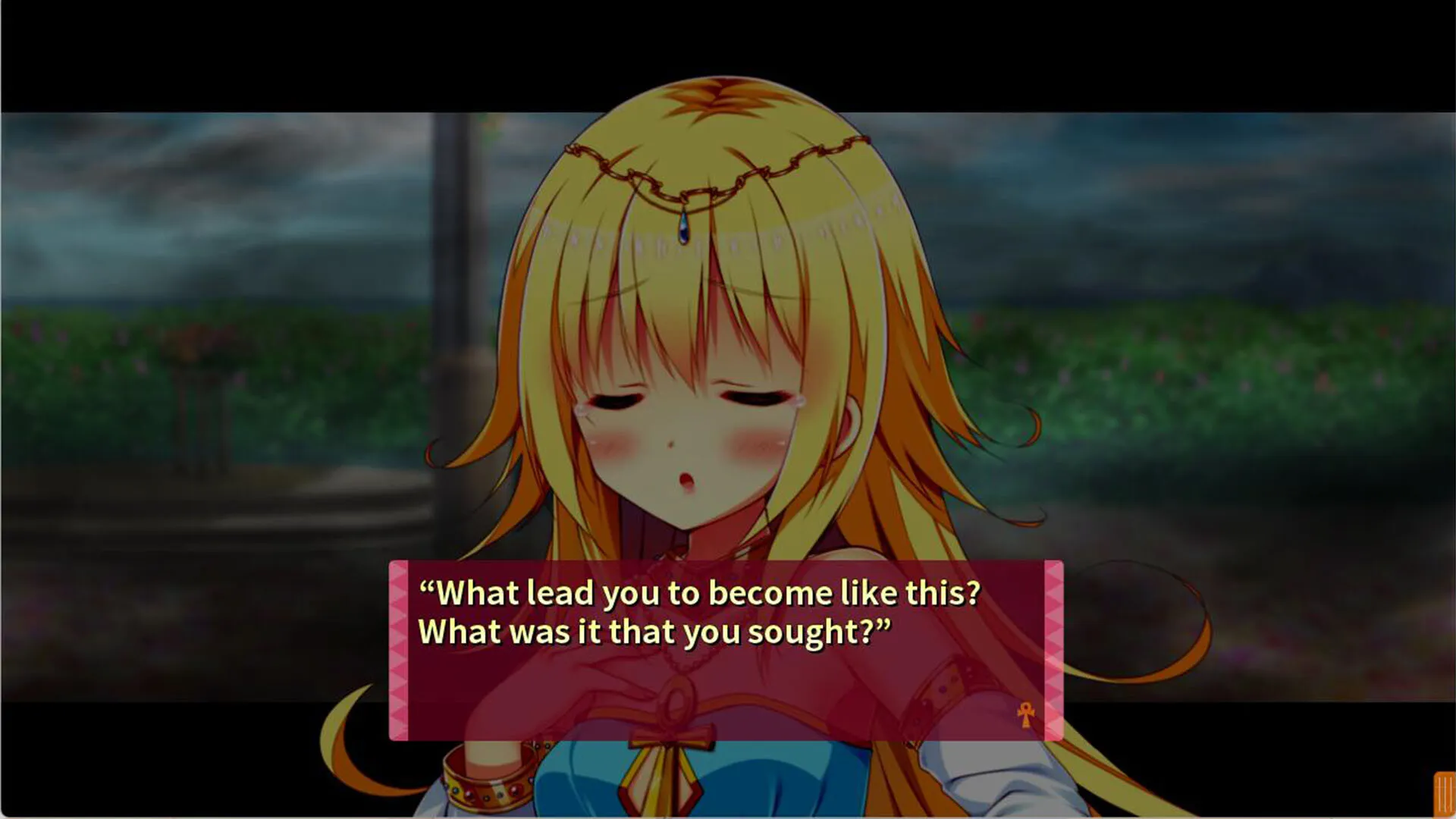
The art style feels polished and professional, easily meeting the standards set by other modern visual novels. The quality is consistent across all assets, from the character sprites used in daily conversations to the detailed backgrounds that give the town of New Masado a welcoming, lived-in feel.
Special attention was clearly paid to the CGs, the full-screen illustrations that appear during key narrative moments. These images serve as visual rewards for the player, and their quality is consistently high. They effectively capture the emotional tone of each scene, whether it is a tender romantic confession or a high-energy comedic gag.
The game also makes excellent use of chibi, or super-deformed, art during cut-ins to punctuate jokes and visually represent the characters’ exaggerated reactions. This technique adds another layer to the comedic presentation. The visual direction uses simple but effective tricks to create a sense of dynamism. Floating dialogue boxes, shifting camera angles, and slanted character sprites prevent scenes from feeling static, giving conversations a more engaging and lively flow.
The audio experience is just as well-crafted. With the common exception of the protagonist, the game is fully voiced in Japanese by a talented cast. The voice actors deliver strong performances that bring the quirky characters to life. Their delivery is critical for the game’s comedy, and they expertly handle the rapid-fire banter and absurd dialogue. Each performance feels perfectly matched to the character’s personality, enhancing the player’s connection to the cast.
The soundtrack, primarily handled by the prolific music production group Angel Note, provides a versatile and fitting audio backdrop. The collection of thirty-six tracks covers a wide range of moods. Upbeat, cheerful tunes accompany the daily slice-of-life scenes, while more intense, rock-inspired tracks like “Because I Love You” underscore the story’s pivotal action sequences.
Softer, more emotional melodies effectively heighten the impact of romantic moments. One review noted an interesting choice, with a cafe-like track titled “Bite My Lips” playing during some H-scenes, creating a slightly unusual atmosphere. This kind of distinct musical direction, combined with memorable opening and ending themes, results in a polished soundscape that significantly enriches the overall experience.
The Review
Yomegami: My Sweet Goddess
Yomegami: My Sweet Goddess is a strong entry from Alcot, delivering what fans of the developer expect: outrageous comedy, a charming cast, and a polished presentation. While its gameplay is mechanically simple with a linear structure that limits player choice, the story's earnest exploration of its quirky premise is entertaining. The high-quality art and full voice acting create an engaging experience. It succeeds as a light-hearted romantic comedy for those who appreciate its specific, shameless brand of humor.
PROS
- Polished visual presentation and cohesive art style.
- Excellent Japanese voice acting that brings the cast to life.
- A funny, well-defined group of heroines.
- Effective and self-aware comedic writing.
CONS
- Extremely linear structure with very few meaningful choices.
- The common route can be repetitive on subsequent playthroughs.
- Its specific style of sexual humor may not appeal to all players.