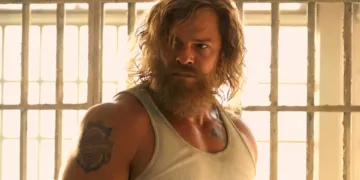


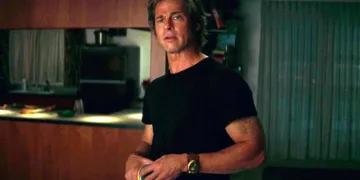

















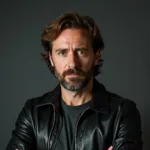
The year is 1977, and Detroit is a landscape of rain-slicked asphalt and decay. Within this setting, John Miller, a man fresh from prison portrayed by Alan Ritchson, attempts to build a new life. His plans center on his girlfriend, Sophia.
This fragile hope is quickly demolished by Reynolds, a local gangster played with menacing glee by Ben Foster, who wants Sophia for himself. Reynolds orchestrates a drug frame-up, sending Miller back to a world of concrete and steel. This setup is a familiar backbone for a revenge story. The film’s narrative experiment, however, is to tell this tale almost entirely without dialogue.
Motor City strips its story to the bone, relying on a cinematic language of action, expression, and sound to communicate its brutal intentions. The structure challenges the audience to follow a plot conveyed through pure visual and auditory cues, a formalistic exercise built upon a foundation of pulp fiction.
An Assault of Sight and Sound
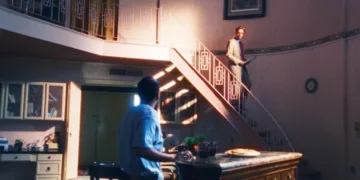
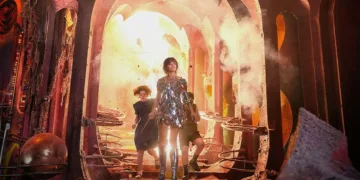
With spoken words largely removed, director Potsy Ponciroli fills the void with a thick, stylized atmosphere. The film’s visual palette is a lurid mix of neon signs bleeding onto wet pavement and deep, oppressive shadows. The production design commits fully to its period, filling the screen with gas-guzzling sedans and grimy interiors that reinforce the story’s simple, archetypal nature.

This is not a realistic depiction of a city; it is a comic book panel come to life, a heightened reality where every texture feels exaggerated. The narrative weight shifts to the soundtrack, which becomes the story’s primary voice, acting as exposition and internal monologue. The 70s rock and pop selections are deployed with precision. Bill Withers’ ‘Lovely Day’ scores a moment of fleeting happiness, an obvious but effective choice.
More interesting is the use of Starbuck’s ‘Moonlight Feels Right’ as the backdrop for a grim torture scene, creating a disturbing disconnect between the breezy tune and the on-screen cruelty. The prison break, a chaotic symphony of violence and fire, is set to the orchestral swells of The Moody Blues’ ‘Nights in White Satin’.
This heavy reliance on music gives the film the propulsive, highly choreographed feel of an extended music video. This aesthetic choice prioritizes rhythm over logical progression, creating a certain detachment where the audience observes stylized violence instead of feeling its raw impact.
The Silent Hero and the Scenery-Chewing Villain
Stripped of dialogue, the actors must communicate through different means. Alan Ritchson’s John Miller is a monolith of physicality, a performance of contained force. He builds the character through deliberate action: the way he handles a shotgun, the grim set of his jaw, the heavy weight of his footsteps.
His silence turns him into a blank slate for a revenge hero, a vessel for the audience’s assumptions about a man with nothing left to lose. In direct contrast, Ben Foster’s Reynolds is a creation of pure, unrestrained energy. Clad in flammable nylon shirts and armed with a nervous smirk, Foster delivers a villain who is both pathetic and terrifying.
His explosive bursts of rage and preening self-admiration provide the film with an unpredictable spark that its stoic protagonist cannot. He is the engine of the film’s chaos. The narrative structure, however, falters with its treatment of Sophia. Shailene Woodley is given a thankless role as the story’s catalyst. Her swift, unexplained return to Reynolds after Miller’s imprisonment is a major plot contrivance.
This decision is never justified, making her less of a tragic figure and more of a simple plot device, a narrative pawn whose sole purpose is to motivate the men. This structural weakness is a significant flaw, undermining the very foundation of Miller’s violent quest.
The High-Octane Payoff
As a narrative experiment, the film is a mixed success, but as a delivery system for action, it is remarkably efficient. The pacing is relentless, moving from one violent set-piece to the next with little room for breath. The stunt work is impressive and visceral, grounded in a tangible sense of impact.
A brutal fight inside an out-of-control convertible is a highlight of chaotic choreography, while the opening shootout establishes the film’s brutal tone from the first frame. Motor City fully embraces the clichés of its genre as a form of communication. The hero shaves his head to signal his transformation; he punches a mirror in a moment of anguish.
These are not moments of lazy writing but conscious nods to the B-movie tradition it emulates. Kicking a garbage can or staring grimly into the rain are signals to the audience, shortcuts that work in a film that has dispensed with verbal exposition. The movie’s self-awareness is key to its appeal. It succeeds on the terms it sets for itself: to be a visceral, stylish, and uncomplicated action piece. It is a loud, bloody, and unapologetically simple machine built for thrills.
Motor City is an American action thriller that premiered at the 82nd Venice International Film Festival on August 30, 2025. International rights are handled by Black Bear, while WME Independent and Range Select are handling US rights.
Full Credits
Director: Potsy Ponciroli
Writers: Chad St. John
Producers and Executive Producers: Greg Silverman, Jon Berg, Cliff Roberts, Chad St. John (Producers); Gideon Yu, Chris Bosco, John Friedberg, Harry Ahluwalia, Elizabeth A. Bell, Alastair Burlingham, Ford Corbett, Jatin Desai, Mark Fasano, Greg Friedman, Joshua Harris, Eric Hedayat, Charles Herzfeld, Nijat Heydarov, Tale Heydarov, Shannon Houchins, Bjorn Hovland, Nathan Klingher, Travis Mann, Ian Montone, Matt Pollack, Essad Puskar, Alan Ritchson, Dave Roberts, Dan Spilo, Michael Tadross Jr., Michael Tadross, Jack White (Executive Producers)
Cast: Alan Ritchson, Shailene Woodley, Ben Foster, Pablo Schreiber, Ben McKenzie, Lionel Boyce, Amar Chadha-Patel, Rafael Cebrián
Director of Photography (Cinematographer): John Matysiak
Editors: Joe Galdo
Composer: Steve Jablonsky
The Review
Motor City
Motor City is a successful exercise in pulp filmmaking, a visceral and highly stylized revenge thriller that commits fully to its dialogue-free premise. While the narrative is thin and a poorly developed female character weakens the story’s core, the film compensates with relentless pacing, brutal action, and a phenomenal, unhinged performance from Ben Foster. It is a triumph of mood and momentum over narrative depth, a loud, bloody cinematic experiment that works far better than it should. It offers a thrilling ride for those seeking pure B-movie aesthetics.
PROS
- A bold, nearly wordless storytelling concept.
- Intense, well-choreographed action sequences and relentless pacing.
- Ben Foster delivers a memorable and energetic villainous performance.
- A strong, stylized visual identity supported by an effective 70s soundtrack.
CONS
- The plot is generic and relies heavily on familiar genre tropes.
- The central female character is underdeveloped, serving only as a weak plot device.
- Its overwhelming style can make the film feel like a violent music video.