




























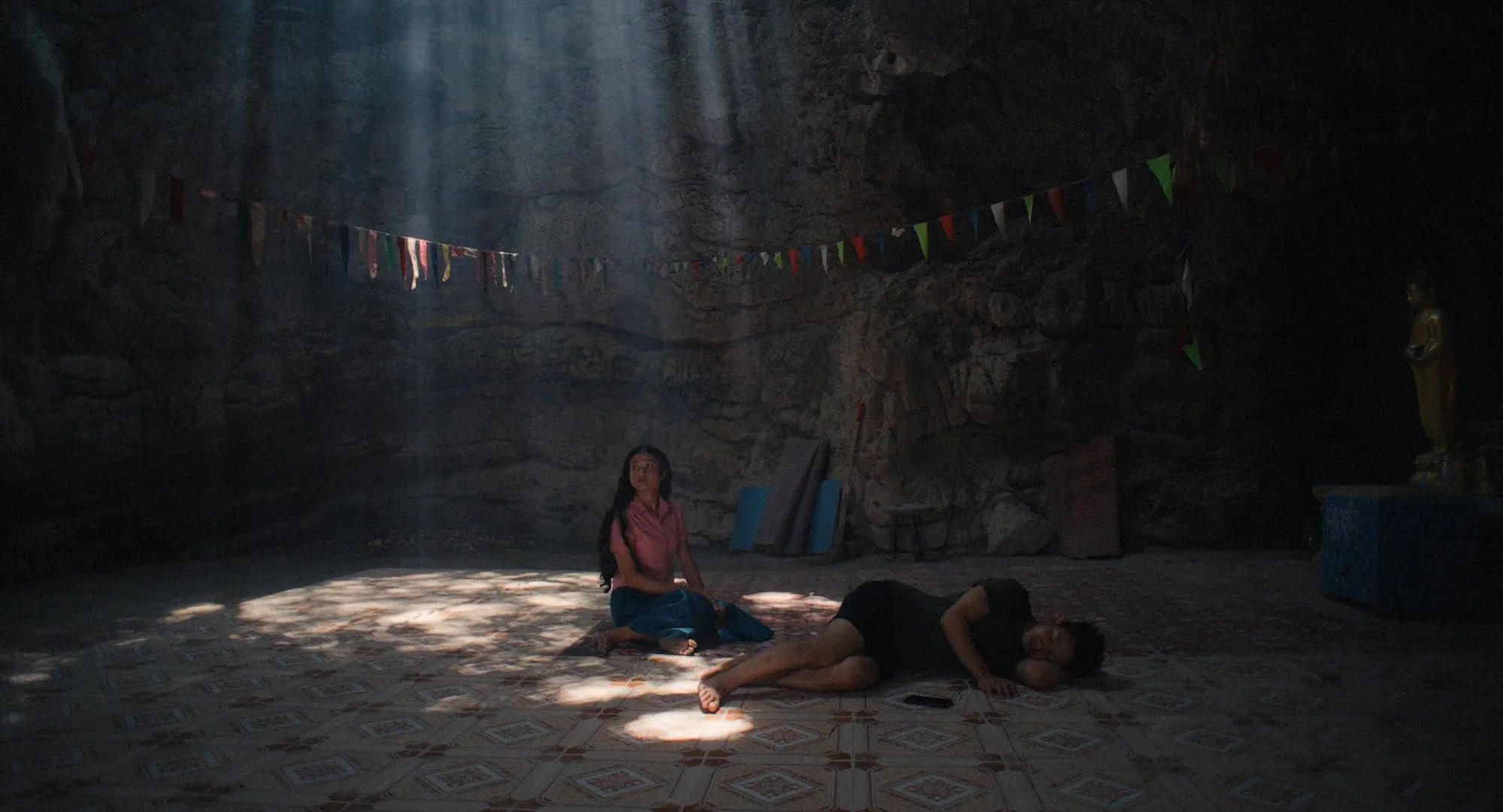

Ghost stories in a land scarred by historical trauma are rarely about simple fear. They are about the persistence of memory. Polen Ly’s debut feature, Becoming Human, understands this completely, presenting a phantom who is not a terrifying specter but a quiet anchor to a vanishing past. The film’s spirit, Thida (Savorn Serak), has been the silent guardian of a decaying cinema in Battambang for half a century. Her spectral existence is less a haunting and more a custodianship of what has been.
When a young journalist named Hai (Piseth Chhun) steps into the ruin, a space filled with the scent of rain and dust, he comes to photograph its final days. The cinema is scheduled for demolition, an act that will not only erase a building but will also unmoor its resident spirit, casting her into a cycle of rebirth she actively resists. Their encounter is a delicate negotiation between the living and the lingering, a conversation held on the precipice of oblivion.
The Ghosts of Progress
The film deftly uses its supernatural premise to diagnose a very real, earthly affliction: the erasure of cultural identity in the name of progress. The impending destruction of the cinema is mirrored by the threat to Hai’s own home, a pagoda endangered by new development. This establishes a pattern of displacement that defines the film’s vision of modern Cambodia, where sacred spaces and repositories of collective memory are systematically cleared for gleaming, anonymous towers for the wealthy.
The emotional core of this conflict recalls the cinematic language of India’s Parallel Cinema movement. Much like Shyam Benegal’s Ankur (1974) chronicled the decay of a feudal system, Becoming Human maps the spiritual dispossession that accompanies aggressive urbanization. Thida’s personal history is inextricably linked to Cambodia’s national trauma; she is a victim of the Khmer Rouge, a soul created by the genocide fifty years prior.
Her guardianship of the cinema becomes a powerful metaphor for a country’s relationship with its own painful history, a past that is ever-present yet continuously threatened with being buried under new concrete. The film’s sharpest critique is reserved for its vision of spirituality within this new world.
Thida’s forced rebirth into a “millionaire family” is not a salvation but a condemnation, a transfer into a life of sterile materialism devoid of meaning. This critique extends even to the act of movie-watching itself, as the characters view old films on Hai’s phone, a poignant image of grand cinematic traditions being miniaturized and consumed in private, within the hollowed-out shell of a public temple to film.
Also Read






A Meditative, Sensory Experience
Polen Ly’s direction favors immersion over exposition, creating a work that functions as a sensory poem. The film’s visual rhythm is patient and observant, built upon long, deliberate takes. This technique does more than slow the pace; it invites the audience into a state of active contemplation, encouraging us to notice the subtle play of light across peeling paint or the slow accumulation of dust on abandoned seats.
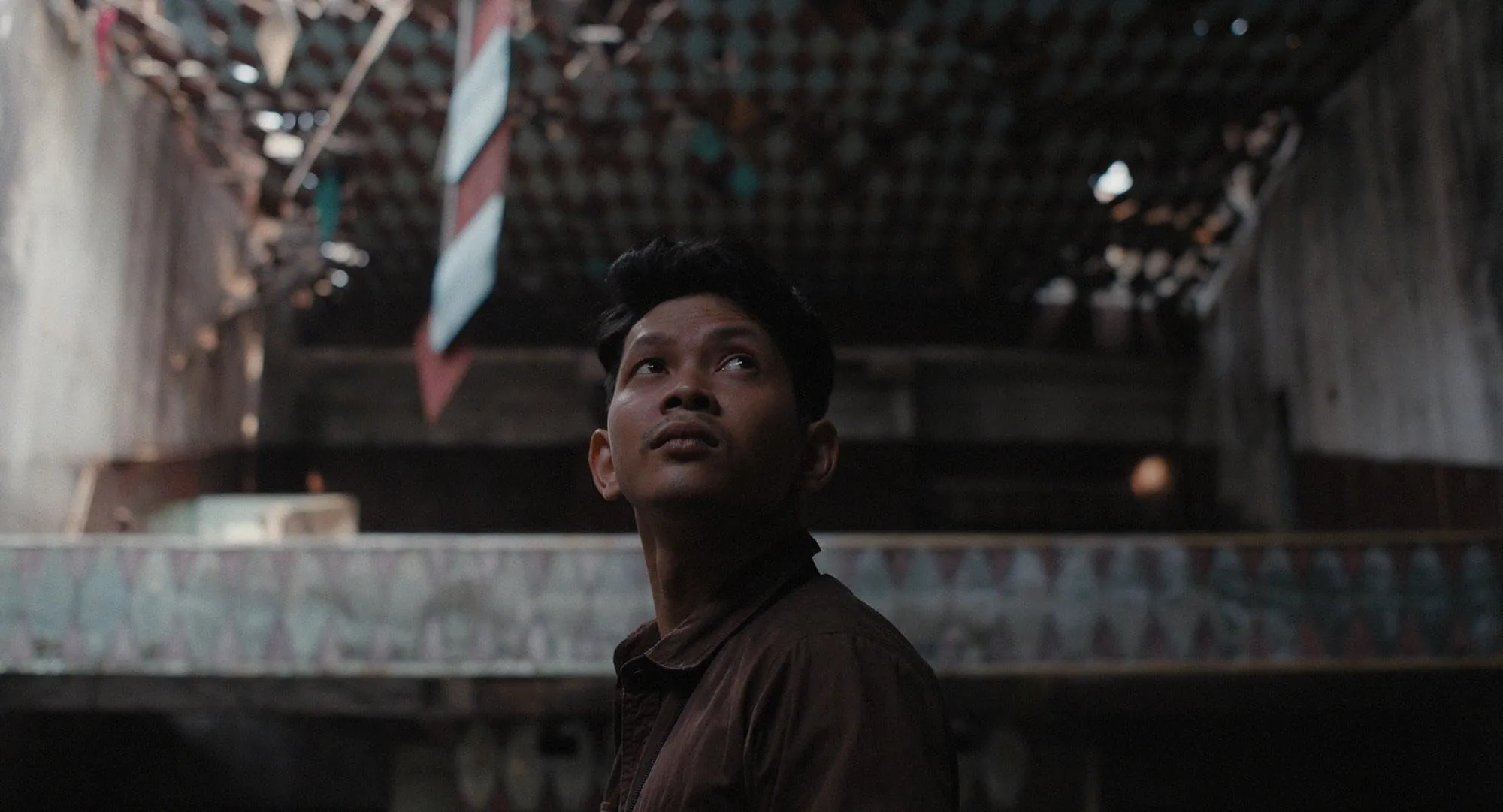
The camera rarely imposes, choosing instead to witness. This transforms the cinema from a mere location into a central character, its decay chronicled with the same sensitivity afforded its human and spiritual occupants. This aesthetic of duration and atmosphere finds a kinship with the work of Indian formalist filmmakers like Mani Kaul, whose films similarly prioritized the sensory experience of a space over a purely narrative progression.
The sound design is a critical component of this effect. Ly constructs a complex soundscape from the gentle, persistent dripping of water, the distant drone of city life, and the profound weight of silence. The ambient sounds are never just background noise; they are the voice of the world outside infringing upon this sacred, forgotten space.
The overall mood is one of a melancholic, dreamlike trance. The film’s power lies in its ability to lull the viewer into its specific emotional and temporal state, a hypnotic experience that demands patience but offers a deep, resonant feeling in return.
Anchoring Performances and Narrative Drift
The film’s quiet, contemplative world is held together by the strong, understated performances of its leads. Savorn Serak imbues Thida with a compelling stillness; her portrayal of the spirit is not ethereal or spooky but grounded in a profound sense of weariness and warmth. Piseth Chhun provides a necessary earthly contrast as Hai, his presence giving the audience a tangible link to the unfolding spiritual drama. Their chemistry is subtle and believable, forming the emotional bedrock of the film.
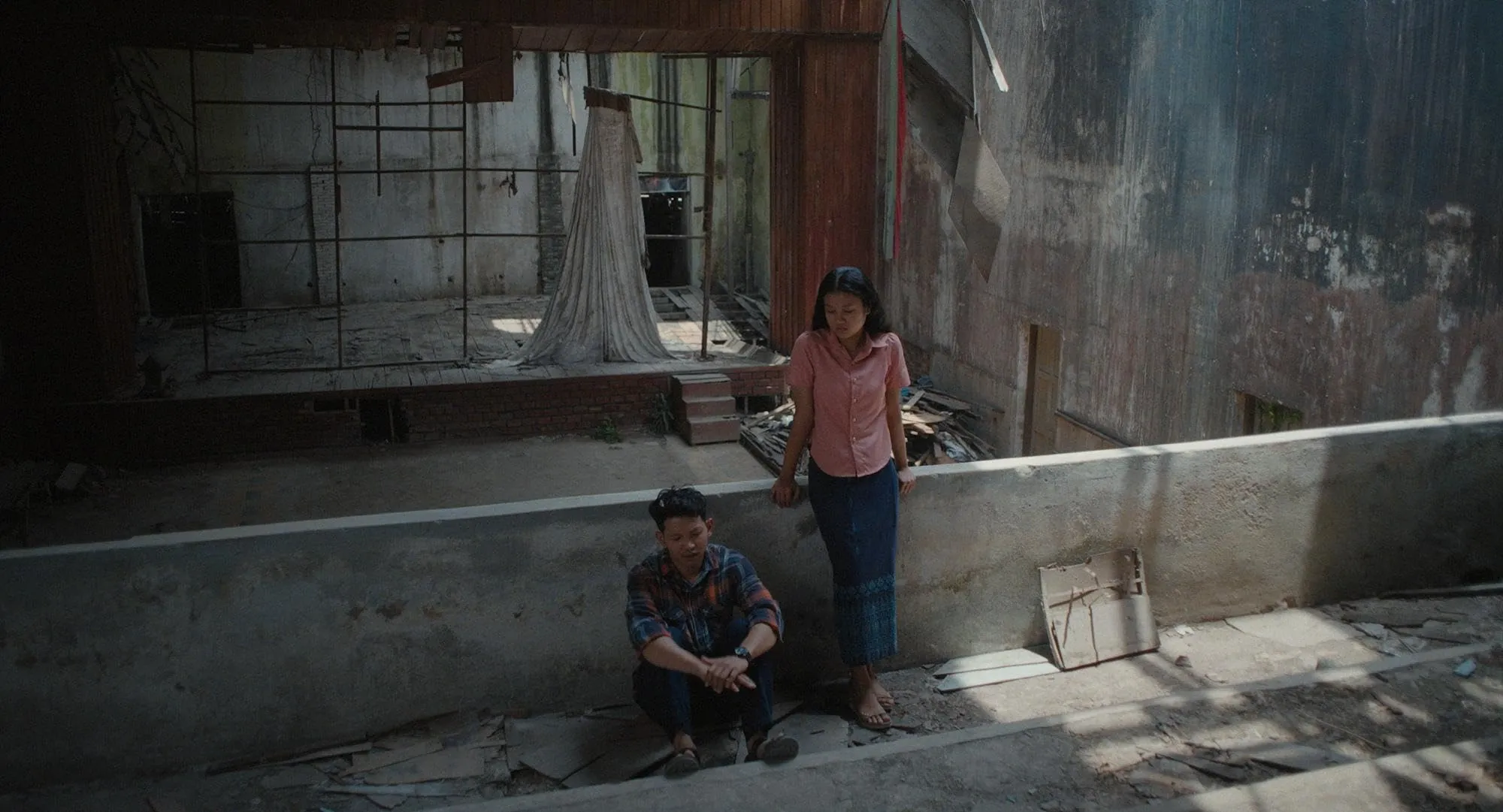
However, this delicate connection is occasionally weakened by dialogue that feels overtly constructed, its scripted nature creating a formal barrier that prevents full emotional immersion. A more significant structural weakness appears in the film’s second half. The initial act, contained entirely within the potent, metaphorical space of the cinema, is masterful in its focus and execution. Once the narrative leaves this location, it begins to lose its bearings, meandering through the countryside in a way that dilutes its central themes and tension.
The story’s power was intrinsically linked to its confined setting, and its expansion feels like a dissipation of that strength. This lack of focus is most evident in the character arcs. While Thida’s dilemma is clear, Hai’s journey becomes murky. He shifts from a proactive documentarian to a passive figure whose motivations and ultimate fate are left underdeveloped. This imbalance makes him less of a counterpart and more of a witness, leaving the film feeling slightly hollowed out by its end.
“Becoming Human,” also known by its original title “Chiet Chea Manusa,” is a 2025 Cambodian fiction film. The movie had its world premiere at the 82nd Venice International Film Festival on August 29, 2025. The story follows the ghost of an old cinema’s guardian, who must decide whether to embrace rebirth or remain a spirit. This choice is challenged when she forms a bond with a living human, forcing her to confront not only her spiritual destiny but also the rapid social and economic changes in Cambodia. The film is currently in post-production and its general release platform is not yet available.
Full Credits
Director: Polen Ly
Writers: Polen Ly
Producers: Daniel Mattes
Cast: Serak Savorn, Piseth Chhun
Director of Photography: Son Doan
Editors: Kavich Neang
Composers: Jean-Charles Bastion, Pierre Édouard Dumora
The Review
Becoming Human
Becoming Human is a visually beautiful and thematically rich meditation on memory, displacement, and the spiritual cost of progress. Polen Ly’s debut is a masterclass in atmosphere, using its patient cinematography and immersive sound to create a hypnotic, dreamlike state. While Savorn Serak’s lead performance is quietly captivating, the film is hampered by a narrative that loses focus after a powerful first act, leaving its potent ideas to drift. It is a work of immense artistry and feeling, whose structural flaws prevent it from achieving greatness.
PROS
- Atmospheric and beautifully composed cinematography.
- A poignant and potent central theme exploring memory and displacement.
- A captivating and warm lead performance from Savorn Serak.
- Immersive sound design that enhances the meditative mood.
CONS
- The narrative meanders and loses focus after the first act.
- The slow, deliberate pacing may not be suitable for all viewers.
- The character arc for the co-protagonist, Hai, is underdeveloped.