





























A nurse’s mother confides that the Prime Minister has made her feel more secure, a simple statement that reveals a deep national fracture. This intimate moment of familial division is the terrain of Connie Field’s “Democracy Noir,” a documentary that maps the quiet, methodical dismantling of a modern European state. The film is an unflinching examination of Hungary’s slide into illiberalism under Viktor Orbán, framed not as a distant political anomaly but as an urgent, transferable blueprint for subverting democracy from within.
Field constructs her narrative through the experiences of three women—a politician, a journalist, and a nurse—who occupy different posts on the front lines of an ideological war. Their distinct but interwoven stories form the film’s core, illustrating a chilling thesis on how a nation’s freedoms can be systematically unwritten using the very language and mechanisms of the state.
The Architect and the Blueprint for Autocracy
The film portrays Viktor Orbán as a patient and deliberate architect of autocracy. His ascent began not with a coup, but with a legitimate electoral victory that gave his Fidesz party a two-thirds parliamentary majority. This mandate became the key to unlock and rewrite the rules of the state itself. “Democracy Noir” meticulously details the subsequent steps.
The national constitution was remade to consolidate power. The Constitutional Court was systematically filled with loyalists, transforming a check on power into an instrument of it. Voting districts were gerrymandered to create a permanent electoral advantage, insulating the party from popular will. Simultaneously, the state’s grip tightened around the nation’s consciousness. In a stunning consolidation, Orbán’s allies acquired nearly 400 media outlets, effectively seizing control of the public narrative and shuttering critical voices like the country’s largest newspaper, Népszabadság.
This structural takeover was reinforced by a cultural campaign to redefine the nation. Hungary was declared a “Christian nation,” a new identity used to justify a propaganda war against migrants and the LGBTQ+ community, who were painted as existential threats. European Union funds were weaponized, strategically funneled into rural infrastructure projects and even distributed as sacks of potatoes to solidify Orbán’s political base far from the capital.
Portraits of Resistance
Against this machinery of state control, the film presents the human faces of the opposition. The emotional weight of the narrative rests on its three protagonists. Tímea Szabó, a Member of Parliament, represents the fight from within the system. The camera captures her delivering impassioned, razor-sharp speeches against government policies, her voice filling a parliamentary chamber that is often pointedly vacant. Her struggle is a portrait of principled resistance in a system designed to ignore it.

Babett Oroszi, a journalist, confronts a different kind of void: a media landscape scrubbed of objective truth. Her work is a relentless effort to uncover the regime’s corruption while searching for any platform willing to publish her findings. For her, the fight is profoundly personal. As a lesbian woman in a country where the government openly vilifies her community, she is forced to ask, “If the government hates me so openly, then what am I doing here?”
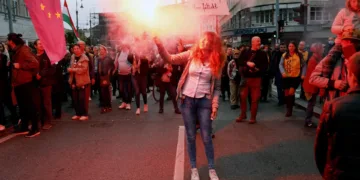
Her quiet home, shared with her wife, is shown as a fragile sanctuary from the mounting pressure. Finally, Niko Antal, a nurse and activist, embodies the exhaustion and resilience of the ordinary citizen. She works 18-hour shifts in a crumbling healthcare system, sometimes paying for her patients’ medicine out of pocket, before taking to the streets to protest.
Her conflict is made sharper by her mother’s support for Orbán, a painful symbol of the divisions cleaving Hungarian society. “I was raised to always fight for my dreams,” she says, her voice heavy with fatigue. “I don’t have them anymore. Now I’m really just caught on a hamster wheel that I can’t get out of.”
The Mirror Effect and a Call for Vigilance
“Democracy Noir” casts its longest shadow by holding Hungary up as a mirror to other Western nations. The film makes an explicit and compelling connection between Orbán’s playbook and the rising tide of illiberalism elsewhere, particularly in the United States.

It includes unnerving footage from a Conservative summit in Budapest, where American political figures praise Orbán’s Hungary as an aspirational model. Field’s documentary argues that the modern descent into authoritarianism is often a quiet affair, arriving not with tanks in the streets but through bureaucratic maneuvering, relentless propaganda, and the legal dismantling of institutional checks and balances.
The film’s power lies in its sober depiction of how a government can turn its people against one another by manufacturing internal enemies—the refugee, the sexual minority, the liberal intellectual. It offers no easy resolutions or triumphant victories.
Instead, the viewer is left with the quiet determination of its three subjects. Their exhaustion is a tangible presence, their hope a stubborn, flickering flame. Their stories stand as a potent message about the constant, difficult work required to protect democratic norms and the profound courage of those who refuse to be silenced when the lights begin to dim.
“Democracy Noir” is a 2024 documentary film that follows three Hungarian women—a politician, a journalist, and a nurse—as they work to expose the corruption and erosion of democratic institutions by Prime Minister Viktor Orbán’s government. The film has been shown at various festivals, including CPH:DOX and the Mill Valley Film Festival. It has a runtime of around 90-113 minutes depending on the source, and has been screened in countries like the United States, Germany, and Denmark. It has also been available on platforms such as Plex and NRK TV.
Full Credits
Director: Connie Field
Producers: Connie Field, Sigrid Jonsson Dyekjær, Heino Deckert, Harry Vaugh
Cast: Niko Antal, Babett Oroszi, Timea Szábo, Viktor Orbán, Katya Andrusz, Jordan Bardella, Malin Björk
Director of Photography: Connie Field
Editors: Gregory Scharpen
Composer: Jonas Struck
The Review
Democracy Noir
“Democracy Noir” is an essential and sobering piece of filmmaking. It operates as both a meticulous political analysis and a deeply human story of resilience. By detailing the systematic erosion of Hungarian democracy, the film provides a chillingly relevant warning for any nation where civil liberties are taken for granted. Its focus on the three women at the heart of the resistance gives the documentary a profound emotional anchor, transforming abstract political concepts into a tangible, high-stakes struggle. This is vital, urgent viewing.
PROS
- Presents a clear and detailed account of how a democracy can be methodically dismantled.
- The narrative is powerfully grounded in the personal stories of its three courageous protagonists.
- The subject matter is exceptionally timely and holds significant relevance for global audiences.
- Effectively builds a case for Hungary as a cautionary tale for other Western nations.
CONS
- The film’s unwavering focus on the opposition presents a singular perspective on a complex national situation.
- The bleakness of the subject matter can be emotionally taxing for viewers.