

























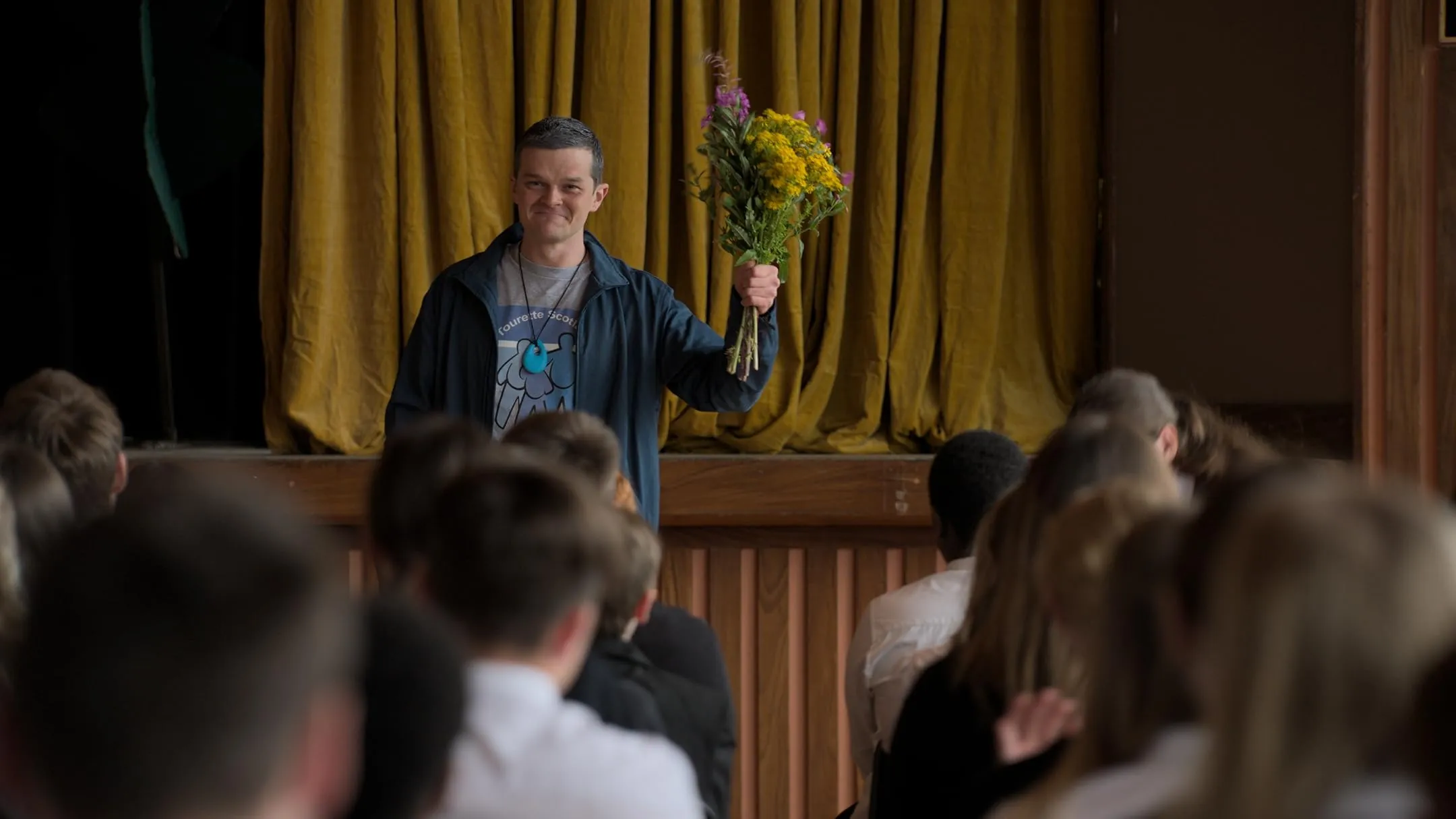

The film I Swear opens with a man about to receive an MBE from the Queen. In the tense silence, he blurts out a shocking expletive. This single moment perfectly captures the essence of the movie: a biographical picture about John Davidson, a Scottish man whose life was defined by the sudden onset of Tourette Syndrome in his youth.
The film places us in a time when the condition was barely recognized, leaving John to face a world of confusion and scorn. We see his difficult beginnings, where rejection from his own family and community becomes a constant presence. The movie presents his life with a raw honesty that refuses to look away from the pain, yet it finds a surprising warmth and humor in the most unexpected situations.
A Performance of Raw Honesty
Robert Aramayo’s portrayal of the adult John Davidson is the film’s foundation and its most profound achievement. His performance is a technical marvel, integrating the physical and vocal tics of Tourette’s so completely that they feel like a part of his being instead of a studied affectation.

He shows the physical strain before an outburst, the way John’s body seems to betray him at the worst possible moments. When he shouts “I have a bomb” on a quiet train or claims to be a pedophile during a job interview, Aramayo conveys the authentic horror of a man trapped inside his own neurology. The performance creates a constant tension between the gentle, kind person John is and the offensive persona his condition projects.
We see this in the small details: the flicker of apology in his eyes after an insult, the quiet way he holds himself when trying to remain calm. He also nails the story’s tricky humor, finding the absurdity in his condition without ever inviting the audience to laugh at him.
His work builds on the excellent foundation laid by Scott Ellis Watson, who plays the younger John. Watson perfectly captures the initial terror and confusion of a promising young football player whose body suddenly begins to fail him on the pitch, his dreams dissolving in a series of uncontrollable jerks and sounds.
A World of Cruelty and Kindness
The film carefully builds the world around John, showing how his environment shapes his life. He endures a particularly harsh reality at home, where his mother, Heather (Shirley Henderson), is a primary source of his suffering.

Her character is a complex study in frustration and ignorance. In one telling scene, she makes him eat his meals on the floor by the fireplace so that any food he spits out can be easily cleaned. This single action reveals a person so consumed by her own exhaustion that she has lost her maternal compassion. This cold domestic life makes the appearance of genuine support incredibly impactful.
Dottie (Maxine Peake), a mental-health nurse, offers John the patience he was denied. Her home is a sanctuary, a warm and welcoming space that stands in stark contrast to the sterile environment he grew up in. Later, he finds a quiet father figure in Tommy (Peter Mullan), a gruff caretaker who sees past the tics to the capable man within.
The narrative does not shy away from the brutality John faces outside these safe spaces. A scene where he is beaten with a crowbar for an inadvertent insult is difficult to watch, as are his humiliating encounters with the police, who see him as a public menace instead of a person with a disability.
The Biopic Blueprint
Writer-director Kirk Jones approaches the material with the familiar touch of a classic British crowd-pleaser, recalling films like The Full Monty or Billy Elliot, which also feature underdog protagonists grappling with social issues. It is an effective, if conventional, filmmaking style. The narrative structure, however, sometimes falls into a formulaic rhythm.

The screenplay creates a repetitive cycle where every moment of progress is immediately followed by a devastating setback. John secures a job and his first flat, only to learn that Dottie’s cancer has worsened. This pattern, while perhaps reflecting the harshness of life, can feel emotionally manipulative and predictable. The film also simplifies John’s story by omitting his real-life documentary career, a choice that streamlines the plot but removes a key part of his public activism.
Jones is most successful in balancing the film’s tone, skillfully handling the painful elements with respectful humor. The final act, which pivots to his advocacy, feels somewhat rushed, but it contains one of the film’s most moving scenes.
John shares a car ride with a young girl who also has Tourette’s. After they both have a series of vocal tics, they share a quiet smile of mutual understanding, a perfect moment that shows him turning his pain into a source of connection.
This British film premiered at the Toronto International Film Festival (TIFF) in September 2025. It is distributed by StudioCanal.
Full Credits
Director: Kirk Jones
Writers: Kirk Jones
Producers and Executive Producers: Georgia Bayliff, Kirk Jones, Piers Tempest
Cast: Robert Aramayo, Maxine Peake, Shirley Henderson, Peter Mullan, Scott Ellis Watson, Steven Cree
Composer: Stephen Rennicks
The Review
I Swear
I Swear is a heartfelt and moving biopic anchored by a truly exceptional lead performance from Robert Aramayo. While its narrative sometimes relies on familiar biopic conventions and a repetitive emotional structure, the film's unflinching honesty and respectful humor make it a powerful and worthwhile watch. It successfully illuminates a difficult subject with immense humanity.
PROS
- An outstanding and authentic lead performance from Robert Aramayo.
- A strong supporting cast that provides emotional depth.
- A skillful balance of heavy drama with respectful, effective humor.
- A humane and insightful exploration of living with Tourette Syndrome.
CONS
- Follows a conventional and sometimes predictable biopic formula.
- A repetitive narrative cycle of progress followed by setbacks.
- Simplifies the real story by omitting key life events.
- The final act about the subject's activism feels somewhat rushed.