

















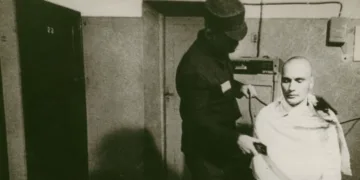











A jarring visual from the past opens the film: black and white photographs of Deaf children, their small bodies restrained in medical chairs, their expressions bearing a quiet, unsettling resignation. This deliberate historical trauma immediately frames the world of Ted Evans’ debut feature, Retreat, a movie billed as the world’s first Deaf thriller.
The scene shifts abruptly to the present, introducing Eva (Anne Zander) as she seeks refuge at Chilmark, an imposing country manor in rural England. The manor functions as a self-proclaimed safe haven for the Deaf community, promising protection and renewal away from the judgment of the “hearing world.” Led by the enigmatic Mia (Sophie Stone), the community aims to discard imposed labels and forge a new, autonomous identity.
However, this meticulously crafted utopia soon exhibits an unnerving, cult-like undercurrent. The film’s narrative is conveyed almost entirely through British Sign Language (BSL) by a Deaf principal cast, underscoring its significant role in representation. Retreat successfully integrates profound psychological tension with a deep, insightful exploration of Deaf identity and the search for authentic belonging.
The Architecture of Belonging and the Burden of History
Retreat functions as a thoughtful cultural critique wrapped within a genre narrative. The painful historical context established by the opening montage—documenting the abuse and institutionalization Deaf children once faced—is the trauma from which the Chilmark residents are perpetually attempting to escape. They strive for self-definition, explicitly rejecting the externally imposed term “Deaf,” which they view as a divisive label used to diminish them. They aim to build a world with its own rules, its own vocabulary, and a unique path toward healing.

Yet, this intense pursuit of self-sovereignty soon deteriorates into a chilling cult dynamic. Mia’s structured program, referred to as “The Way,” transforms the sanctuary into an insidious, oppressive structure. The signs of control are subtle at first but relentlessly build: mandatory group therapy sessions often require participants to wear identical, utilitarian clothing, hinting at psychological conformity.
Residents are discouraged from maintaining outside family contact, forced onto specific regimens, and expected to abandon outside technologies. The community’s profound isolation acts simultaneously as a necessary shield against past wounds and as a highly effective mechanism for indoctrination.
The film meticulously dissects the hypocrisy inherent in utopian aspirations. By attempting to purify themselves of all external bias and societal prejudice, the closed-off system inadvertently breeds its own internal form of “othering” and injustice. Mia dictates who is “healed” and who needs the most guidance, establishing an internal hierarchy that contradicts the promised equality.
The retreat promised to be an antidote to societal judgment, but it replaces one form of oppression with another, more personalized form of control. This internal tension is central to the narrative, positioning the supposed safe haven as the ultimate source of conflict and setting the stage for its inevitable implosion. The journey to shed external trauma tragically exposes the internal fragility of a system built on exclusion.
The Exchange of Scars: Eva, Matt, and Narrative Drift
The emotional core of the film rests on the powerful, often heartbreakingly opposed, arcs of its two central figures: Eva and Matt (James Boyle). Eva arrives deeply scarred and seeking a definitive refuge, hoping to rebuild her identity within this secluded community. Her journey begins as a trajectory of assimilation and renewal, finding solace and a sense of collective purpose within the confines of Chilmark. She starts to flourish, gaining confidence and certainty in her new identity, embracing the rigorous program of “The Way.”

In stark contrast, Matt, who has known no existence beyond the manor’s walls—having arrived as an orphan at the age of four—represents the community’s idealized success. He is the symbol of Chilmark’s potential to produce pure, untainted individuals. However, as Eva commits more fully to the community, Matt begins a painful process of unraveling.
He questions the rigid walls that define his entire existence and starts to yearn for the unknown freedoms of the outside world. He feels “othered” precisely because his lack of external trauma means he cannot fully participate in the community’s healing process. Their conversations, conducted in BSL, carry an immense emotional weight, as one moves toward the collective embrace while the other is forcefully pushed toward solitude.
The narrative structure capitalizes on this exchange. The film initially focuses on Eva’s perspective, placing the audience within the role of the newcomer trying to understand Chilmark’s peculiar rhythms. However, midway through, the focus subtly but firmly shifts to Matt’s growing disillusionment and his frantic need for escape.
This structural maneuver, while handled abruptly, proves effective, as it uses Matt’s forced displacement to reveal the oppressive nature beneath the communal façade. As Eva integrates, Matt’s forced separation allows the audience to view the sanctuary through a critical lens, recognizing that this haven has devolved into a bunker driven by fear.
Retreat is often more invested in maintaining a mood of psychological intrigue than providing clear-cut answers to its many mysteries. Questions surrounding the manor’s dubious financing, the true nature of Mia’s long-term plan, and the hinted-at history of stolen children remain frustratingly underdeveloped. This intentional ambiguity forces the audience to confront the moral dimensions of the cult structure itself. Evans chooses to challenge viewers to reckon with the systemic issues underpinning the narrative rather than relying on a conventional third-act reveal. The tension lies not in who survives, but in who is truly free.
Silence as a Weapon and the Purpose of the Gaze
Ted Evans exhibits a remarkable command of cinematic language, especially regarding sound design, which elevates the film beyond a standard thriller. Silence is not treated as an absence of noise; instead, it becomes a forceful, disorienting element of subjective dread. During key moments of heightened panic, such as an emergency drill, the house is plunged into near-total silence, broken only by the ominous, rhythmic flashing of red lights.
This technique weaponizes the visual, immersing the viewer in a Deaf reality where warning signs manifest as confusing shadows and sudden visual assaults. The film effectively asks hearing audiences to rewire their genre expectations, proving that fear can be communicated through a powerful, unsettling absence. Adam Janota Bzowski’s unnerving, jangling score, utilizing cello and sounds that mimic repetitive stomping, strategically augments the atmosphere only when necessary, amplifying the tension before receding once more.
Visually, Evans transforms the idyllic manor setting into a palpable source of claustrophobia. The contrasting colors—the vibrant communal scenes set against the sudden, shocking shifts to dark interiors or red-flashing alarms—underscore the instability of the environment. The masterful use of shadow, particularly during the early alarm sequences where characters are reduced to deep silhouettes against the wall, is a perfect visual encapsulation of the isolation they experience even within their community.
While Retreat occasionally suffers from conventional thriller threads that feel slightly underdeveloped, particularly during its tense but ambiguous finale, its overall achievement is significant. It is a bold, intellectually rigorous genre film that places authentic Deaf subjectivity at its center.
The film ultimately leaves the viewer with a profound, haunting question about the true cost of belonging and self-preservation. It does not provide easy answers, but demands that the audience ask more challenging questions about language, control, and the conditions under which a community can become a cage. This work is a crucial victory for identity-driven genre filmmaking.
Retreat is a psychological thriller and the feature film debut of writer-director Ted Evans, known as the “world’s first deaf thriller.” The film had its world premiere at the 2025 Toronto International Film Festival (TIFF). As of now, the film is being handled for worldwide sales by XYZ Films, and specific general release dates for theaters or streaming platforms have not yet been widely announced.
Full Credits
Director: Ted Evans
Writers: Ted Evans
Producers and Executive Producers: Michelle Stein, Jennifer Monks, Alex Usborne, Louise Ortega, Claudia Yusef, Paul Ashton
Cast: Anne Zander, James Joseph Boyle, Sophie Stone, Ace Mahbaz, Anna Seymore, Adam Bassett, Jude Mahon, David Hay
Director of Photography (Cinematographer): Luciana Riso
Editors: Adelina Bichis
Composer: Adam Janota Bzowski
The Review
Retreat
Retreat is a bold and essential piece of cinema that brilliantly weaponizes sound and silence to deliver a truly unique thriller experience. Director Ted Evans successfully weaves a chilling cult narrative around a deeply resonant exploration of Deaf identity, historical trauma, and the complex allure of community. While the film occasionally allows its larger plot mechanics to remain frustratingly ambiguous, the masterful control over mood, the compelling dual character studies of Eva and Matt, and the profound cultural significance elevate it far beyond its minor structural imperfections. It is an unmissable and thought-provoking meditation on the price of belonging.
PROS
- Features a Deaf principal cast and uses BSL throughout.
- Effectively uses silence and subjective sound to build visceral dread.
- Deeply explores identity, historical trauma, and the allure of controlled community.
- The opposing arcs of Eva and Matt provide powerful emotional resonance.
- Evans displays clear, intelligent control over visual and sonic language.
CONS
- Leaves certain thriller threads (financing, external threats) frustratingly underdeveloped.
- The shift in focus from Eva to Matt is handled with some abruptness.
- Some later sequences lean toward conventional genre tropes.