
























![Kingdom Hearts Collection [I-III] Review](https://gazettely.com/wp-content/uploads/2026/10/Kingdom-Hearts-Collection-I-III-1-360x180.webp "Kingdom Hearts Collection [I-III] Review: KHII Holds Steady as Newer Entries Fluctuate 37")





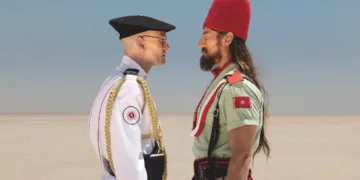
A line drawn in sand is an act of human arrogance, a frail attempt to impose order on an indifferent earth. In Oscar Hudson’s Straight Circle, this line stretches across a vast, bleached desert, a stage for an absurdist ballet of duty. Here, two soldiers, Pte Warne and Pte Arthur, are posted as solitary guards of a fragile peace between their rival nations.
They are ghosts haunting a forgotten conflict. Warne, bald and starched in his white uniform, is a figure of rigid discipline. Arthur, with his unkempt hair, projects a looser spirit. Their days are a metronome of hollow ritual, performing patriotic ceremonies for an audience of heat shimmer and stone.
They release pigeons into an empty sky, frail symbols of a peace no one is present to witness. The sun beats down, the silence presses in, and in this hermetic world, the architecture of the mind begins to show its cracks. The monotony is not a backdrop; it is an active, corrosive force, slowly sanding away the men’s sense of duty and self.
The Empty Theater of the Self
What is a nation but a story we agree to tell ourselves, a shared dream that requires an antagonist to feel real? Straight Circle holds this story up to the merciless sun until its fictions turn to dust. The soldiers’ loyalties are expressed through private languages spoken into the void.
One man’s four-hour process for boiling an egg is not merely a quirk; it is a desperate incantation against a universe that offers no inherent meaning, a small system of control in the face of cosmic indifference. Their patriotism is a performance in a vacant theater, their salutes offered to a god of geography who has long since departed. Soon, the performance sours.
Petty grievances over shared duties, the placement of a pot or the timing of a release, fester into a quiet hostility. This is a microcosm of the larger, equally senseless war that preceded their watch, a conflict born from manufactured difference. Here, in the crucible of isolation, the concept of the enemy is revealed as a necessary but fragile construct.
The line between Warne and Arthur, once a clear demarcation of uniform and haircut, wavers and blurs. The desert, a canvas of bleached bone, actively starves their convictions, erasing the ink of their identities until only their shared, terrified humanity remains.
A Geometry of Madness
The film’s direction is a cage built of camera angles and a relentless, cyclical rhythm. Hudson traps his subjects, and us, in a loop of mundane tasks that grow heavier and more freighted with dread upon each iteration. His static camera often frames the men as specimens in a sterile terrarium, their predictable movements a study in psychological decay.
The daily routine is not a measure of time but a tightening spiral toward a null point. The cinematography uses the split screen as a fractured mirror, a visual cleaving of the world that does more than represent duality. It suggests a consciousness at war with itself, the border line drawn directly across the celluloid to show one mind in two bodies.
This formal rigidity creates the film’s unique tone, a comedy of the abyss where laughter is a reflex against encroaching horror. It is a Beckettian humor, where the cosmic joke is existence itself. The outpost is a character in this tragedy, a symmetrical scar on the landscape.
Its clinical lines and sterile functionality stand in stark, mocking opposition to the chaotic unraveling it houses, a perfectly rational structure built for an irrational purpose, a monument to the cold, illogical nature of human division.
The Body as a Collapsing State
Casting twin brothers Elliott and Luke Tittensor is a stroke of genetic fatalism, making the film’s philosophical inquiry terrifyingly literal. Their performances are a slow, agonizing dance of convergence into a single entity. We watch them first as individuals, defined by opposing postures, speech patterns, and attitudes.
As their isolation deepens and their identities fray, their bodies become the texts of their inner collapse. Their movements shed military precision for something more primal, a physical language of confusion, despair, and eventually, a shared psychosis. They are no longer two soldiers guarding a border; they are one consciousness tearing itself apart.
The eventual need for post-it notes on their foreheads to tell themselves apart is the final, pathetic anchor to a dissolving reality. The sudden appearance of a goatherd, a specter from a world they have forgotten, does not offer salvation. He is an agent of the real, an incomprehensible truth intruding upon their hermetic illusion. His presence serves as a silent judgment, a force that proves their shared madness is not just an affliction but a destination.
The dark comedy film Straight Circle premiered at the Venice International Film Festival on September 1, 2025. The film is the feature debut for director Oscar Hudson and was produced by companies including 2AM, Magna Studios, and BBC Film.
Full Credits
Director: Oscar Hudson
Writers: Oscar Hudson
Producers and Executive Producers: Kevin Rowe, Thomas Benski, Riaz Rizvi, Rik Green, Greig Buckle, Oscar Hudson, Charlie Alderman, Ava Aashna Chopra, Christopher Dodds, Greg Field, Robert Kapp, Davud Karbassioun, William Rosenfeld, Eva Yates
Cast: Neil Maskell, Elliott Tittensor, Luke Tittensor, Fiona Ramsay, Matthew Dylan Roberts, Camilla Waldman, Michael Richard
Director of Photography (Cinematographer): Christopher Ripley
Editors: Fouad Gaber
Composer: Maxwell Sterling
The Review
Straight Circle
Oscar Hudson's film is a stark and formally precise descent into the absurdity of manufactured conflict. It functions as a bleakly funny piece of existential theater, using repetition and a rigid visual style to chart the psychological erosion of its two leads. The result is a disquieting and intelligent work that questions the very foundations of identity and nationalism, leaving the viewer in a state of profound unease.
PROS
- An intelligent and sharply focused central concept.
- Strong, committed performances from the twin leads that are both physical and psychological.
- Confident directorial style with purposeful cinematography and production design.
- A unique and effective tone that blends deadpan, absurdist humor with existential dread.
CONS
- The methodical, repetitive pacing could feel slow or indulgent to some viewers.
- Its bleak tone and abstract ideas may be emotionally distancing.
- The narrative is more of a philosophical exercise than a conventional plot.







