
























![Kingdom Hearts Collection [I-III] Review](https://gazettely.com/wp-content/uploads/2026/10/Kingdom-Hearts-Collection-I-III-1-360x180.webp "Kingdom Hearts Collection [I-III] Review: KHII Holds Steady as Newer Entries Fluctuate 37")





There’s a strange corner of the internet where deep human tragedy is repackaged as casual content. It’s the space where a person can learn how to apply the perfect winged eyeliner while listening to a detailed breakdown of a cold case. This digital ghost, the ghost of real suffering turned into a story, haunts our modern lives. It’s the perfect starting point for Haifaa Al-Mansour’s Unidentified, a film that understands this phenomenon intimately.
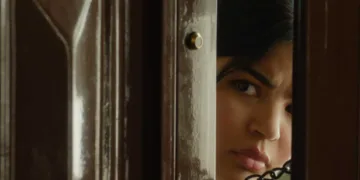
Our guide into this world is Nawal, a woman in Riyadh whose life has recently been dismantled by divorce and personal loss. Played with a captivating stillness by Mila Alzahrani, Nawal works a quiet administrative job at a police station. Her nights, however, are spent illuminated by her phone, absorbing the lessons of a true-crime influencer. When a young woman’s body is discovered in the desert, Nawal’s digital hobby is thrust into the analog world of actual consequence. She is pulled into the investigation, driven by a need to give a name to a ghost that society would rather forget.
An Investigation of Whispers
The film charts Nawal’s investigation not as a series of forensic discoveries, but as a slow, frustrating navigation of social codes. Her greatest breakthroughs come from listening. Where her male colleagues see a dead end, she detects the faint signal of a lie born from fear or shame.

She uses her perceived non-threatening status as a woman to enter domestic spaces and glean information through carefully guided conversations with school principals and grieving mothers who would never speak so freely to a man in uniform. The primary obstacle she faces is not a cunning adversary but a cultural insistence on silence. The concept of family honor becomes an active antagonist, a force that smothers truth to preserve appearances.
The film’s visual approach creates an interesting friction with this theme. The cinematography is often clean and composed, presenting a pristine, almost sterile version of Riyadh. The lighting feels deliberately artificial at times, like something from a high-end architectural magazine. This choice feels pointed, suggesting a disconnect between the polished, modern image the city projects and the messy, often painful realities hidden just beneath the surface. It’s a world where everything looks perfect, making the ugliness of the central crime all the more stark.
Portrait of a Modern Sleuth
Nawal is a wonderfully specific character, a woman whose quiet defiance feels both personal and deeply political. Her obsession with the case is clearly rooted in her own grief over a lost child, a detail that gives her mission a profound emotional anchor. In seeking justice for the anonymous victim, she is trying to reclaim a piece of what she herself has lost.
Mila Alzahrani’s performance is key; she projects a tough exterior that barely conceals a raw vulnerability. The film makes a fascinating choice in sourcing Nawal’s detective abilities from her online consumption of true-crime media. I’ve often wondered about the cumulative effect of the countless hours I’ve spent with podcasts dissecting cold cases. Does it make one smarter, or just more paranoid? The film argues for the former, presenting this digital education as a valid, if unconventional, form of expertise.
It’s a commentary on a generation that turns to the internet for skills the world has not taught them. This sharp character work is set against a backdrop of less developed supporting figures. The male police officers are often painted in broad, almost comical strokes, representing an inefficient and patriarchal old guard. They exist to underscore Nawal’s exceptionalism, a tonal choice that sometimes veers into caricature, but effectively highlights the institutional inertia she must fight against.
A Deliberately Fractured Mirror
The film saves its most audacious move for its final act, deploying a narrative twist that completely reframes the preceding story. It’s a shocking reveal that forces you to rewind the film in your mind, re-evaluating scenes and reassessing character motivations. This structural gambit turns the movie into something of a puzzle box, rewarding the attentive viewer with a second, darker layer of meaning.
The choice is deliberately provocative and is certain to be divisive. For some, it will feel like a clever, audacious conclusion that elevates the film beyond a simple procedural. For others, the sudden shift may feel jarring, a clumsy and sensationalist turn that risks cheapening the story’s thoughtful social critique. Yet, the ending feels thematically coherent.
It directly confronts the audience’s relationship with true crime as entertainment, questioning our appetite for neat narratives and shocking conclusions built from the suffering of others. The twist almost holds up a fractured mirror to the viewer. In her return to Saudi-set stories, Haifaa Al-Mansour has crafted a commercial thriller with an art-house soul, using the conventions of genre to smuggle in a complex and challenging look at the stories women tell, the secrets they keep, and the price of being seen.
The Saudi thriller film Unidentified is directed and co-written by the pioneering filmmaker Haifaa Al-Mansour. The story centers on Nawal Al Saffan (Mila Al Zahrani), a police department receptionist who is recruited to help an all-male team of detectives investigate a young woman’s abandoned, unidentified body found in the desert near Riyadh. The film, an Al Mansour Establishment production in association with Rotana Studios, had its world premiere in September 2025 at the Toronto International Film Festival (TIFF). Distribution rights for many territories, including North America, were acquired by Sony Pictures Classics.
Full Credits
Director: Haifaa Al-Mansour
Writers: Haifaa Al-Mansour, Brad Niemann
Producers and Executive Producers: Brad Niemann, Haifaa Al-Mansour
Cast: Mila Al Zahrani, Shafi Al Harthi, Aziz Gharbawi, Othoub Sharar, Adwa Al Asiri, Abdullah Al Qahtani
Director of Photography (Cinematographer): Monty Rowan
Editors: Rafael Nur, Steve Cohen
Composer: Sam Thompson, Amelia Warner
The Review
Unidentified
Unidentified is a sharp and intelligent thriller anchored by a fantastic lead performance from Mila Alzahrani. It successfully uses the crime genre to explore female agency in modern Saudi Arabia and offers a timely look at our digital obsession with tragedy. While its polished visuals can feel at odds with its subject, and a jarring final act twist will divide audiences, the film’s audacity is its greatest strength. It is a smart, tense, and distinctive piece of filmmaking that lingers long after its shocking final moments.
PROS
- A poised and magnetic central performance by Mila Alzahrani.
- An intelligent examination of contemporary Saudi society and women's roles within it.
- A clever premise that engages with modern true-crime culture.
- A bold and surprising narrative twist that challenges the audience.
CONS
- The visual style is occasionally too clean and polished for the gritty subject.
- Supporting characters often feel like one-dimensional stereotypes.
- The final reveal, while audacious, may feel jarring or clumsy to some.
- An uneven tone that shifts between serious drama and a lighter procedural feel.







