

























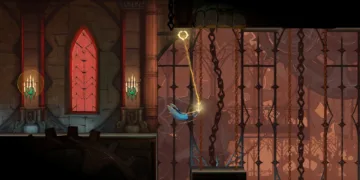


Hirogami presents a world that feels genuinely handcrafted, a rare quality in a digital medium. Following a lineage of arts-and-crafts inspired games like Tearaway and Paper Mario, it builds its entire existence from the principles of origami. Every surface, character, and swaying blade of grass appears meticulously folded from paper.
You play as Hiro, a practitioner of this ancient art in a land threatened by an opposing force. The Blight, a sterile infestation of digital “glitches,” seeks to overwrite this fragile papercraft reality. This invading force corrupts the land and its animal inhabitants.
The central conflict is immediately apparent. The stark visual contrast between the textured, imperfect paper world and the smooth, geometric shapes of the invading Blight establishes the game’s core theme without a single line of dialogue. It is a story about the preservation of tradition against an encroaching, impersonal future, and Hiro is the chosen guardian of his world’s delicate identity.
The Art of Folding
Hirogami operates as a 3D action platformer, but its identity is defined by a deep commitment to its central folding mechanic. Hiro’s basic abilities are serviceable, providing a standard jump and the invaluable technique of flattening himself into a single sheet of paper. This base paper form allows him to glide across chasms, catch updrafts, and slip through otherwise impassable cracks in the environment.
While useful, this is merely the gateway to the game’s more complex systems. The true mechanical heart of the experience is Hiro’s ability to transform into various animal forms, each unlocked by purifying a corrupted animal spirit encountered on his path. Each form is not just a key for a specific lock; it is a distinct toolset that redefines how the player interacts with the world.
The Armadillo form is the first to be unlocked and introduces a focus on momentum and speed. By curling into a ball, Hiro can race down slopes and across flat ground, breaking through wooden barricades that would stop him in his standard form.
This ability is used in both puzzle-solving and traversal, often requiring the player to build up speed on a specific path to launch from a ramp and cross a wide gap. The Frog form fundamentally changes vertical exploration. Its powerful leap allows Hiro to reach high ledges and platforms far outside the range of his normal jump. It also introduces a ground-stomp ability, useful for triggering switches or breaking specific objects from above.
The Gorilla form brings a sense of weight and power. It can push and pull heavy blocks to solve environmental puzzles, destroy large red-colored obstacles, and swing from conveniently placed vines to navigate complex vertical spaces. Finally, certain levels transition into guided flight sequences where Hiro folds into a Paper Airplane, turning the game into an on-rails shooter where he must dodge obstacles and fire paper projectiles at flying enemies.
The game’s design structure is one of its most intelligent features. Unlike many platformers that dole out new abilities at a slow pace, Hirogami provides the player with all of its core transformations within the first half of the adventure. This front-loading of mechanics shifts the challenge away from simply acquiring new skills and toward mastering their application.
Later levels are intricate sandboxes built around the assumption that the player has full access to their toolkit. A single puzzle might require using the Gorilla to move a block into position, climbing it to reach a ledge, switching to the Frog for a high jump onto another platform, and then transforming into the Armadillo to speed down a narrow path. This emphasis on combination and quick-switching in real-time creates a satisfying skill curve.
Progression through the game’s world is gated by the collection of Paper Cranes. These are awarded for completing specific objectives within each level, such as finishing within a time limit, finding all collectibles, or defeating a certain number of enemies. This system, reminiscent of the star-collecting in Super Mario 64, encourages a deep exploration of each stage.
A path that is inaccessible on a first playthrough may become reachable once the Gorilla’s vine-swinging ability is unlocked, prompting a return visit. This makes revisiting levels feel less like backtracking and more like a fresh discovery, as the player sees familiar spaces through the lens of new capabilities.
Creases in the Design
For all its cleverness in platforming and world design, Hirogami feels less refined when it comes to combat. The fighting system is built on a rigid dichotomy that often works against player freedom. Hiro’s primary weapon is a sacred fan, capable of dispatching the digital “glitch” enemies with a simple three-hit combo. These amorphous, orb-like creatures serve as the game’s basic fodder.

The problem arises with the world’s native fauna, animals that have been corrupted by the Blight. These creatures are completely immune to Hiro’s fan. To damage them, the player must switch to an appropriate animal form. For example, a corrupted gorilla can only be harmed by the powerful attacks of Hiro’s own Gorilla form.
This design choice constantly forces the player to stop, switch forms, and then engage. In mixed-enemy encounters, this leads to a tedious cycle of attacking glitches with the fan, dodging a corrupted animal, switching forms to deal with it, and then switching back to clean up the remaining glitches. This system prevents the emergence of a fluid combat rhythm and can make encounters feel stilted.
The general feel of combat suffers from this lack of fluidity. Controls can feel “sticky,” with character animations locking the player in place for just a moment too long, making it difficult to dodge incoming attacks. The enemy variety does little to alleviate this. Beyond the basic glitches and the handful of corrupted animal types, there are few unique threats to learn and counter. Boss battles are typically just larger, more powerful versions of the standard corrupted animals, with predictable patterns that test patience more than skill.
These control issues occasionally spill over into the platforming. While generally responsive, certain actions feel imprecise. The Frog form’s jump, a critical tool for vertical movement, has a heavy, somewhat unpredictable arc that can make precise landings a challenge. Hiro’s standard double jump offers such a minuscule height boost that its practical use is limited, removing a potential layer of player expression and skill in movement. Technical problems also appear from time to time.
Players may experience moments where Hiro clips through a piece of the environment, or where a jump from a swinging vine sends them in the opposite direction of their input. The camera can be another source of frustration, sometimes getting caught on geometry or choosing an angle that obscures an upcoming platform or enemy. The game’s generous checkpointing system is a welcome feature, as it ensures these moments of mechanical awkwardness or technical failure rarely result in significant lost progress.
A Tangible World
Where Hirogami excels without reservation is in its presentation. The art direction is a masterclass in commitment to a theme. Every single element in the game world is designed to look as if it were constructed from folded paper, creating an aesthetic that is both visually striking and cohesive. Characters move with a subtle stutter that effectively mimics stop-motion animation, giving them a physical, tangible presence.

This design choice makes the player feel like they are manipulating a real object on a set. The overworld map enhances this feeling, presenting the game’s levels as part of a sprawling pop-up diorama on a wooden table, complete with a stray teacup and books in the background. This framing device reinforces the miniature scale of the world and its handcrafted nature.
This powerful visual direction serves as the game’s most effective narrative tool. The story itself is simple, but the art constantly reinforces the central theme of tradition versus modernity. The rich textures, visible fold lines, and slight imperfections of the papercraft world stand in sharp contrast to the cold, perfect, geometric shapes of the invading Blight. The world feels warm and lived-in; the invaders feel sterile and alien. This conflict is communicated more effectively through the art than through any of the game’s sparse dialogue.
The audio design works in perfect harmony with the visuals to build this atmosphere. The soundtrack is a gentle, pensive score composed with traditional Japanese instruments. It rarely calls attention to itself, instead providing a quiet, melancholic backdrop that suits the serene beauty of the world and the threat it faces. In contrast, the sound effects are crisp, clear, and immensely satisfying.
The thud of the Gorilla’s ground pound has a palpable weight, and the digital hum of Blight enemies sounds appropriately out of place. The standout sound, however, is the sharp, rustling crumple of paper that accompanies every one of Hiro’s transformations. It is a perfect sonic reinforcement of the game’s core mechanic and visual identity, a constant reminder of the physical, paper-based nature of the hero and his world. The lack of voice acting further supports this approach, allowing the art and sound to tell the story on their own terms.
The Review
Hirogami
Hirogami is an artistic triumph, presenting a breathtaking origami world that is an absolute joy to explore. Its transformation-based platforming is inventive and creates many clever environmental puzzles. This brilliant presentation is unfortunately let down by stiff, awkward combat and persistent control imprecisions that keep the gameplay from matching the highs of its visual design. It is a beautiful experience recommended for its world-class artistry, so long as one has the patience for its mechanical shortcomings.
PROS
- Stunning and cohesive papercraft art direction.
- Clever transformation mechanics that encourage creative play.
- Rewarding level design that promotes exploration.
- Exceptional sound design that enhances the world's tangible feel.
CONS
- Combat is stiff, restrictive, and unsatisfying.
- Some platforming controls lack precision.
- Low enemy variety leads to repetitive encounters.
- Minor technical bugs and camera issues.