
















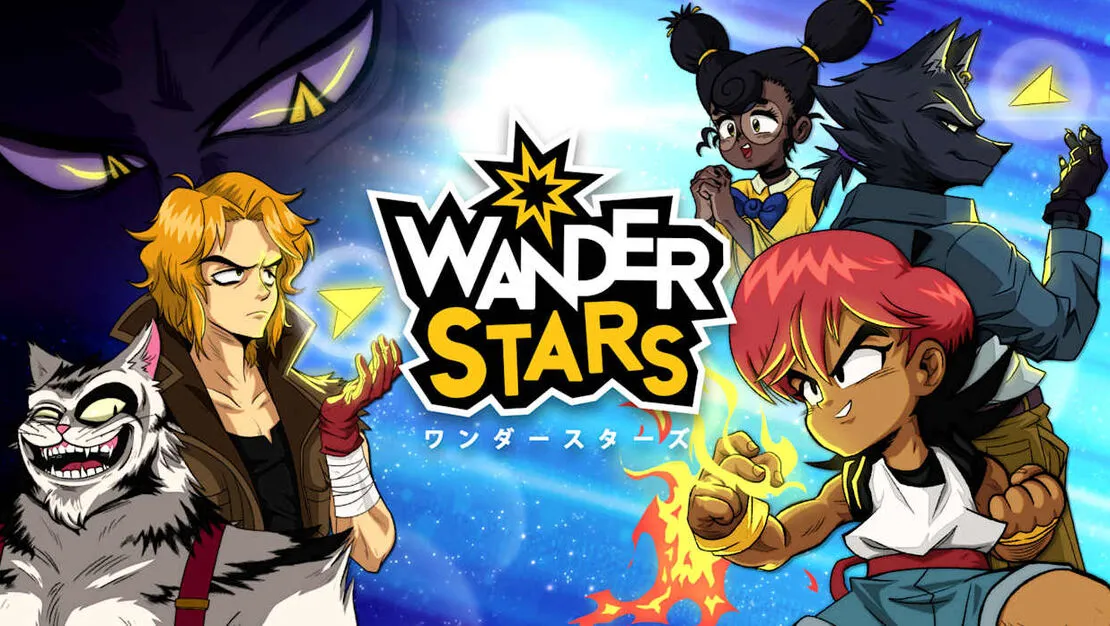

Few games attempt to bridge the gap between linguistic creativity and tactical combat, and fewer still succeed in making that bridge feel natural. Wander Stars, developed by Paper Castle Games and published by Fellow Traveller, takes the bold step of transforming words into weapons through its fictional martial art called “Kiai.” This turn-based RPG channels the spirit of 1990s anime series like Dragon Ball, Sailor Moon, and Cowboy Bebop, presenting its adventure across ten episodic chapters that mirror the serialized storytelling of classic animated shows.
The premise centers on Ringo, a young martial artist searching for her missing brother, who forms an unlikely partnership with Wolfe, a mysterious wolf with secrets of his own. Their quest for the Wanderstar Map becomes the driving force behind an adventure that feels authentically rooted in anime traditions while exploring fresh mechanical territory.
The game’s vocabulary-based combat system transforms every battle into an act of linguistic construction, where players build attacks by combining action words, elemental modifiers, and descriptive terms. This approach to RPG mechanics creates a distinctive identity that sets Wander Stars apart in the crowded indie RPG landscape.
A Galaxy of Familiar Faces and Timeless Tropes
Wander Stars commits fully to its anime inspiration, structuring its narrative around the episodic format that defined the medium’s golden age. Each of the ten episodes opens with title cards and follows pacing rhythms that immediately evoke Saturday morning cartoon memories. Ringo embodies the classic hungry, determined fighter archetype, while Wolfe fills the role of the brooding companion with a shadowy past. Their partnership begins as necessity but evolves into genuine friendship through dialogue that captures the earnest melodrama anime fans will recognize.
The supporting cast expands this familiar territory with space pirates, witches, and anthropomorphic characters that populate a vibrant galaxy. What elevates these archetypal characters is the game’s commitment to diverse representation and the genuine warmth in their interactions. The episodic structure allows each character relationship to develop naturally, giving story beats room to breathe while maintaining forward momentum.
Visually, Paper Castle Games has crafted a presentation that feels authentically pulled from 1990s animation studios. Bright colors and sharp character designs dominate the screen, with expressive portraits that convey personality even in the visual novel-style dialogue sequences. The limited animation works within these constraints effectively, though occasional fully animated cutscenes provide glimpses of what the game might have achieved with a larger budget. These moments feel special precisely because of their rarity.
The audio design deserves particular recognition for how it enhances the anime atmosphere. Battle themes pulse with brass-heavy arrangements that make routine encounters feel cinematic, while post-battle transitions echo the stylish flair of series like Persona. Sound effects lean into cartoon exaggeration, giving attacks a satisfying punch that reinforces the game’s playful tone. The commitment to anime conventions extends to characters shouting their attack names, a detail that transforms what could feel gimmicky into an authentic expression of the source material’s energy.
The Poetry and Pragmatism of Word-Based Combat
The heart of Wander Stars lies in its combat system, which transforms language into a tactical resource. Players construct attacks by combining three types of words: Action Words like “Kick” and “Punch” that form the foundation of moves, Elemental Words such as “Fire” and “Ice” that add damage types and status effects, and Modifiers like “Super,” “Wide,” and “Fast” that enhance or alter the attack’s properties. The first time you execute a “Super Fire Kick” feels like discovering a new form of creative expression, as the game translates your word choices into visual spectacle and mechanical effect.
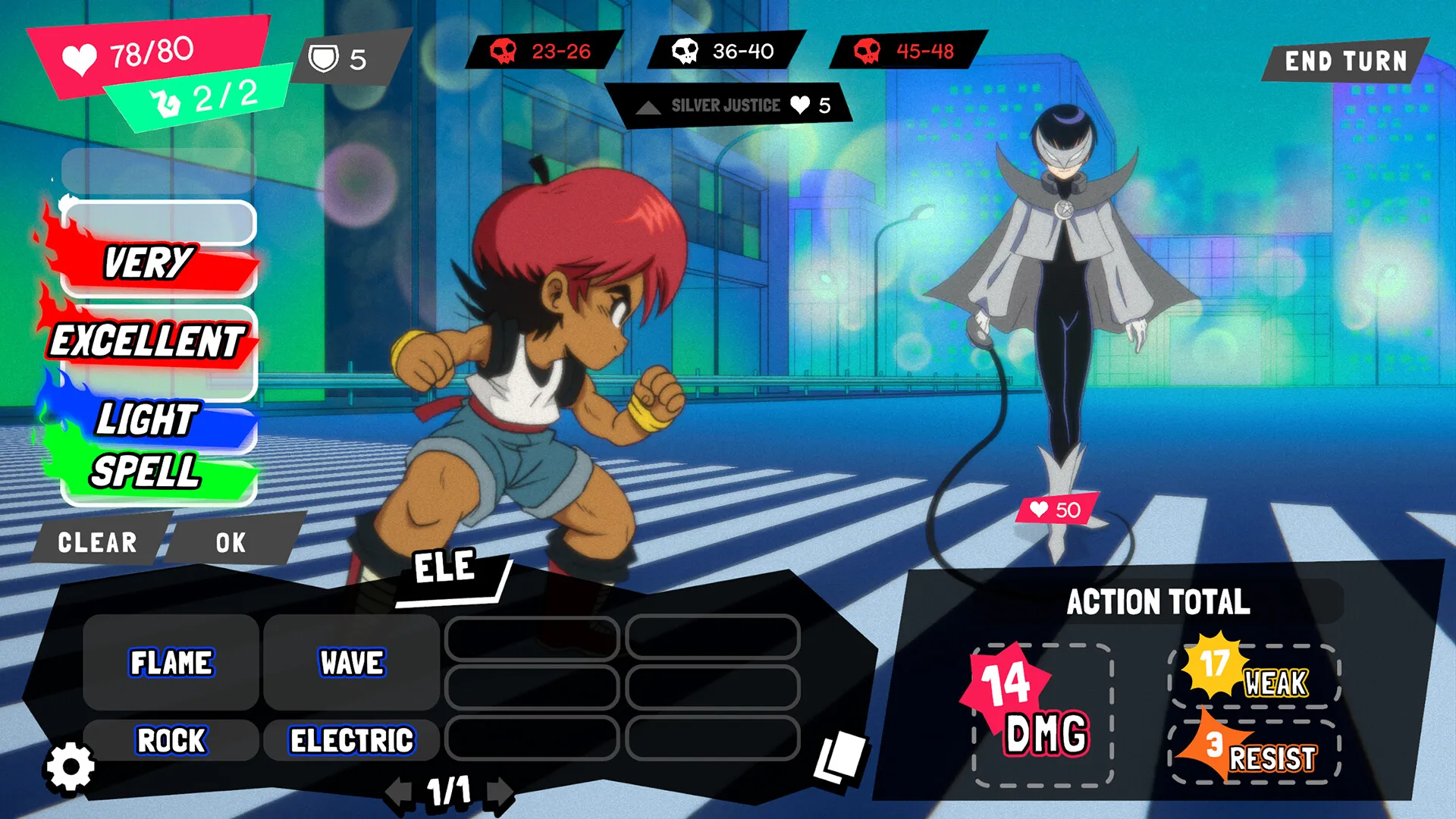
This system creates genuine moments of tactical creativity. Enemy weaknesses and resistances force players to adapt their vocabulary, while word slot limitations demand careful resource management. The cooldown system adds another layer of strategy, preventing players from repeatedly using the same powerful combinations while encouraging experimentation with different word pairings. When these elements work in harmony, combat feels like solving puzzles while writing poetry.
However, the system’s limitations become apparent over extended play. Episodes require players to select their vocabulary loadout at the beginning, locking them into choices that may prove problematic later. Discovering that most enemies resist ice attacks after committing to a frost-heavy build creates frustration that could have been avoided with mid-episode adjustment options. Early episodes particularly suffer from limited word pools that constrain the creative potential the system promises.
The “Peace Out” mercy mechanic introduces a compelling risk-reward dynamic that addresses both combat pacing and character progression. Players can spare enemies at low health to gain “Pep-Up” buffs that last for the remainder of the episode, ranging from stat boosts to additional word slots. This system encourages players to extend encounters strategically while reinforcing Ringo’s compassionate nature. The mechanic transforms what could be routine battles into meaningful choices about immediate safety versus long-term advantage.
Progression through Honor points provides permanent character improvements, creating a sense of growth that extends beyond individual episodes. Players can increase health, expand word slot capacity, or purchase new vocabulary entries, giving each playthrough a sense of meaningful advancement. This system works particularly well because it respects player investment while maintaining the episodic structure’s fresh-start feeling.
Structure, Systems, and the Sum of Their Parts
Wander Stars presents its adventure through board game-style maps that divide each episode into discrete encounters and events. Players navigate node by node, encountering battles, dialogue sequences, shops, and treasure locations. This structure provides clear progression paths while offering occasional route choices that can lead to different rewards or challenges. The system functions adequately, though the maps themselves lack the visual interest and strategic depth found in similar roguelite titles.
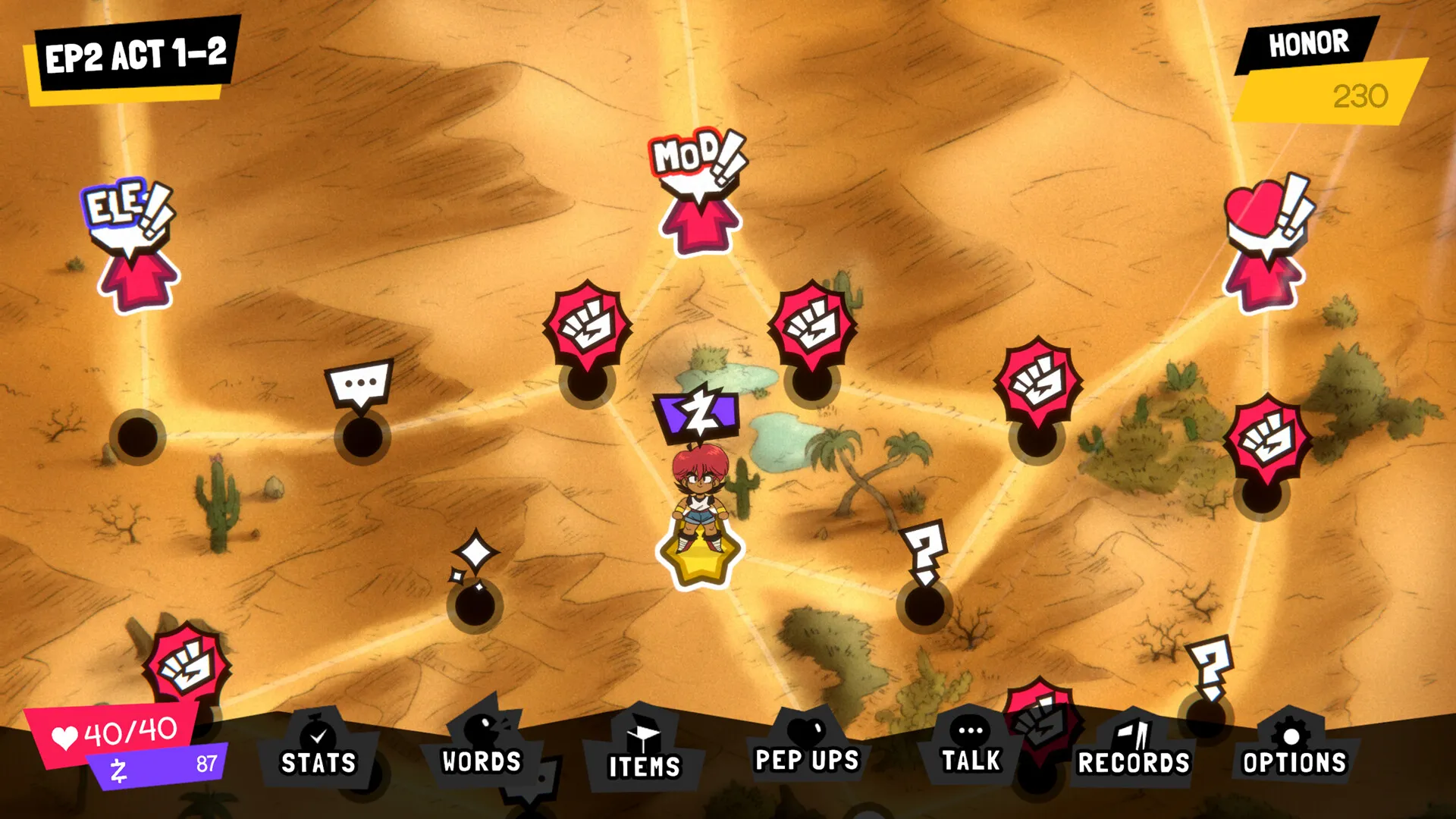
Episodes range from thirty minutes to two hours, creating a total experience of roughly 12-15 hours that feels appropriately scaled for its scope. The star rating system encourages replay, though the limited variation in episode content makes repeat visits less compelling than they could be. Random events attempt to add unpredictability, but too often these feel like arbitrary setbacks rather than meaningful choices with clear consequences.
Technical issues occasionally interrupt the experience, with stuttering animations and rare softlock situations that remind players of the game’s indie development constraints. These problems never completely derail the experience, but they do create moments of frustration that break the otherwise smooth progression.
The game’s appeal lies in its willingness to commit completely to its vision. Players seeking traditional RPG mechanics may find the word-based combat initially confusing, while those drawn to linguistic puzzles might struggle with the turn-based tactical elements. However, players who embrace both aspects will discover a game that offers something genuinely different in the RPG landscape.
At $24.99, Wander Stars provides solid value for its target audience. The game succeeds most when players approach it as an interactive anime experience rather than a traditional RPG optimization challenge. Its charm lies in the moments when all systems align: when the perfect word combination defeats a tough enemy, when character relationships develop through episodic storytelling, and when the visual and audio presentation creates authentic anime atmosphere.
Wander Stars represents ambitious indie development at its most creative, taking risks that larger studios might avoid. While the execution doesn’t always match the vision’s scope, the game creates memorable moments that linger after the credits roll. For players seeking something different in their RPG experiences, particularly those with fondness for 1990s anime, Wander Stars offers a journey worth taking despite its rough edges.
The Review
Wander Stars
Wander Stars succeeds through sheer creative ambition, delivering a genuinely original RPG experience that transforms words into tactical weapons. The anime-inspired presentation is authentic and charming, while the episodic structure provides satisfying narrative pacing. Combat mechanics offer genuine innovation, though system limitations occasionally frustrate. Technical issues and pacing problems prevent greatness, but the game's heart and creativity shine through its rough edges.
PROS
- Innovative word-based combat system
- Authentic 1990s anime presentation
- Strong episodic storytelling structure
- Excellent audio design and visual style
- Meaningful character progression
- Creative "Peace Out" mercy mechanics
CONS
- Limited word pools in early episodes
- Locked episode loadouts restrict flexibility
- Technical issues and occasional stuttering
- Repetitive board layouts
- Some pacing problems in longer episodes