














Some films feel like stepping into a dream, and others feel like walking into a memory. At The Place Of Ghosts is both. The film begins with a simple, unsettling premise: two estranged brothers, drawn together by a spectral visitation, must journey into the Canadian woodland of their youth to confront a secret they left buried there. What starts as an atmospheric horror story quickly reveals itself as a deeply poignant family drama.
Indigenous filmmaker Bretten Hannam has created a work rooted in Mi’kmaw culture, giving the story a specific and powerful voice. This is a film that moves at its own unhurried pace, building a mood of quiet dread and profound emotional weight. Its visuals are striking and its psychological landscape is dense. The film doesn’t just ask you to watch a story; it invites you to stand at the edge of a dark forest and prepare for a journey that is both spiritual and deeply unsettling.
A Brotherhood Fractured by the Past
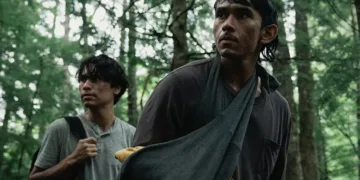
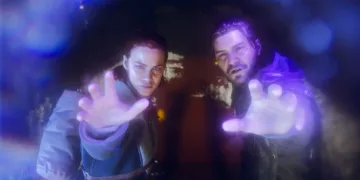
At the story’s center are Mise’l (Blake Alec Miranda) and Antle (Forrest Goodluck). Years of silence have built a wall between them. Mise’l, who is two-spirited, lives in the city, having fled his past, while Antle remains near their childhood home, raising a daughter.

Their reunion is forced and heavy with unspoken history. The performances from Miranda and Goodluck are the film’s anchor. Their chemistry is subtle and authentic, conveying years of shared pain and affection through quiet gestures and loaded glances instead of dramatic outbursts. The catalyst for their journey is a shadowy spirit that appears to Mise’l.
This apparition isn’t a typical movie monster; it acts as a physical manifestation of their buried trauma, an old anxiety that has finally returned to be faced. They don’t venture into the woods out of sheer terror. Instead, they proceed with a solemn, matter-of-fact acceptance that this is a responsibility they must shoulder together.
A Forest Unstuck in Time
The film’s most inventive element is the forest itself, Sk+te’kmujue’katik. It’s more than a location; it’s a living character with its own rules. Guy Godfrey’s cinematography captures a world that is hypnotically beautiful one moment and deeply ominous the next, a primal landscape pulsating with history.
It reminds me of hikes I’ve taken where, deep among ancient trees, you get the feeling that the place remembers things. Hannam takes that feeling and makes it literal. In this forest, time is not a straight line. The past, present, and even the future coexist and bleed into one another.
As the brothers walk, they see apparitions of their Mi’kmaw ancestors, the shadows of colonial soldiers, and most unnervingly, the specters of their own younger selves. The experience is dreamlike and disorienting, heightened by Jeremy Dutcher’s discordant, melancholy score. This is where the film departs from convention, using its supernatural framework to explore memory in a truly special way.
Reclaiming a Painful Inheritance
The brothers’ meandering path through the woods is a direct journey into their own psyches. This time-bending forest forces them to confront the traumatic memories of an event involving their abusive father.
The encounters with their childhood selves are especially powerful, allowing them to witness their own history and directly face the source of their pain. The film presents a sophisticated idea of what it means to heal. It suggests that healing isn’t about finding a single, cathartic release or erasing the past.
True healing comes from understanding, accepting, and finally taking ownership of one’s story, however painful it may be. The film avoids a traditional horror climax, choosing instead an ending that is introspective and emotionally honest. The final, stirring shot is one of quiet self-reflection, leaving us with a profound statement on family trauma, cultural memory, and the unbreakable bond between a people and their land.
At The Place Of Ghosts (Sk+te’kmujue’katik) is a Canadian thriller, fantasy, and horror film directed by L’nu filmmaker Bretten Hannam. The story follows two estranged Mi’kmaw brothers, Mise’l and Antle, who are forced to reunite after a malevolent spirit begins to torment them, prompting them to journey into a primordial forest known as Skite’kmujuekati’k (the Place of Ghosts) to confront their shared, traumatic past. The film premiered at the Toronto International Film Festival (TIFF) on September 6, 2025. It is distributed in Canada by VVS Films, and its genre-bending, otherworldly drama combines elements of Indigenous culture and colonial history. Information on where to stream or widely watch the film is dependent on its full theatrical release schedule following its festival run.
Full Credits
Director: Bretten Hannam
Writers: Bretten Hannam
Producers and Executive Producers: Diana Elbaum, Mitchel Fleming, Martin Katz, Jason Levangie, Marc Tetrault
Cast: Blake Alec Miranda, Forrest Goodluck, Brandon Oakes, Glen Gould, Cherish Violet-Blood, Pamela Matthews
Director of Photography (Cinematographer): Guy Godfree
Editors: Shaun Rykiss, Anne-Laure Guégan
Composer: Jeremy Dutcher, Devon Bate
The Review
At The Place Of Ghosts
At The Place Of Ghosts is a beautifully ambitious and emotionally resonant film that trades conventional horror scares for something far more haunting. While its unhurried pace and abstract narrative may challenge some viewers, its powerful performances, striking cinematography, and profound exploration of trauma, memory, and Indigenous identity make for a deeply rewarding experience. It’s a quiet, complex, and unforgettable journey into the heart of the past.
PROS
- Ambitious and original narrative structure that challenges storytelling conventions.
- Subtle and powerful lead performances with authentic chemistry.
- Stunning cinematography that beautifully captures the forest as a central character.
- A rich and specific exploration of Mi’kmaw culture and identity.
- A profound and unique take on the complex nature of healing and trauma.
CONS
- The unhurried, deliberate pacing may feel slow for some viewers.
- Its abstract, non-linear story can occasionally feel confusing or muddled.
- The introspective ending may not satisfy those seeking a traditional horror climax.