

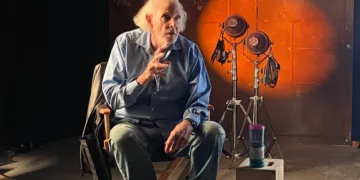









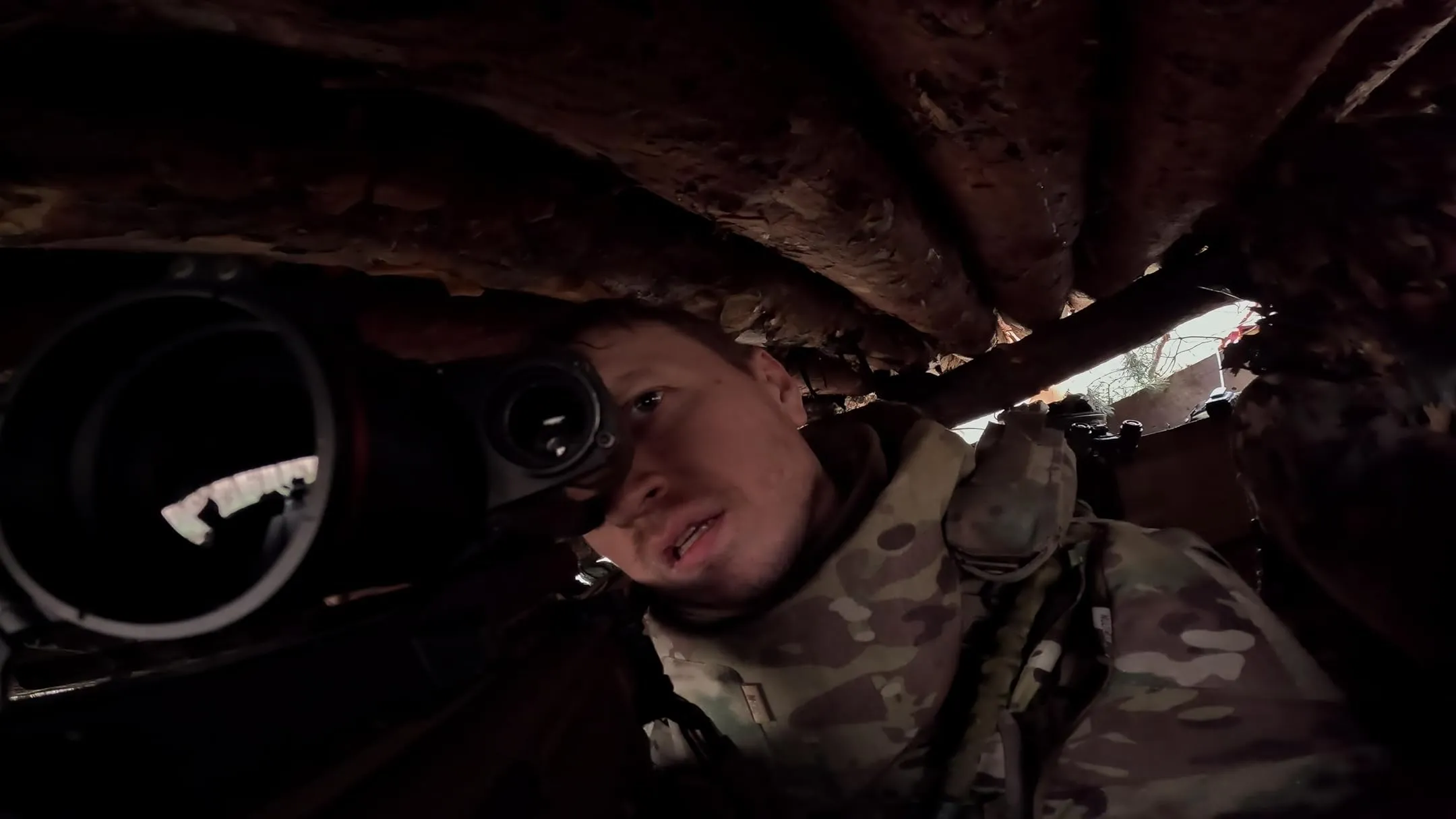

A camera lens is supposed to create distance, a circle of glass that separates the observer from the observed. For Artem Ryzhykov, a Ukrainian cinematographer, that distance collapses with the force of an artillery shell. A Simple Soldier is not a film so much as a raw data stream from a nervous system under siege. It begins where control ends.
Ryzhykov’s identity, forged in the precise arts of framing and lighting, is systematically dismantled by the anarchic reality of the 2022 Russian invasion. His chronicle is one of radical, terrifying subjectivity. The shuddering handheld footage, the frantic hunts for focus as dust fills the air, the sound design dominated by ragged breathing; all these elements submerge the viewer in his immediate, chaotic present.
The film rejects the composed, contemplative posture of traditional war documentaries. Instead, it poses a visceral, existential question: what becomes of the storyteller when the story is trying to kill him? He is caught between the impulse to record the event and the primal need to survive it, turning his camera into an extension of his own panicked eye. This is the film’s unrelenting premise, a portrait of an artist whose medium has become his battlefield.
The Geometry of Loss
War’s grand narrative is built from countless small, unendurable subtractions. A Simple Soldier masterfully illustrates this principle by anchoring its sprawling subject in the quiet erosion of Ryzhykov’s personal life. A drive with his wife, Ira, before the invasion becomes a moment of dark poetry.

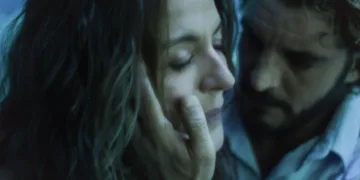
As they pass a series of blinking roadside lights, she observes the scene is “on the verge of both horror and romance,” a chillingly prescient line that captures the liminal state between a fragile peace and the coming abyss. After the invasion forces Ira to Poland, their connection is relegated to the cold glow of a screen. Their video calls are masterpieces of mundane tragedy.
The glitching pixels and audio lag are not mere technical flaws; they are the visual grammar of separation, rendering their attempts at intimacy as a series of disconnected, buffered moments. Each frame boxes them into their isolated realities. The film delivers its sharpest blow with a quiet, devastating report. Ryzhykov’s father dies not from a soldier’s bullet but from a lack of medical care after a nearby hospital is bombed.
There is no dramatic scene, no cinematic last breath. His death is an off-screen event, a consequence of systemic collapse. The film denies us catharsis, presenting loss as a logistical problem, a brutal fact that underscores how war’s true devastation lies in its power to make the sacred profane and turn a human life into a footnote.
A Reframing of Purpose
Every artist believes in the power of their instrument. Ryzhykov begins with the conviction that his camera can be a weapon, a tool for carving truth from the chaos. This romantic ideal is swiftly ground down by the hard pragmatism of the front line. To his comrades, his lens is not a conduit for witness but a liability. “Do you really have to film everything?”
a soldier snaps, his voice a mixture of anger and exhaustion. The question hangs in the air, a direct challenge to the film’s own existence. The act of observation is seen as a dereliction of duty, even a form of voyeurism in the face of acute suffering. Under the relentless pressure of his commanding officer and the sheer necessity of the situation, Ryzhykov is remade.
We watch him awkwardly learn the cold mechanics of a Kalashnikov, his hands, accustomed to the delicate operations of a camera, now fumbling with magazines and safeties. His eventual role as a drone pilot represents a strange and terrible apotheosis. It is a position that perfectly merges his past and present selves.
The skill set is that of a cinematographer: understanding movement, composition, and the power of a high-angle shot. The purpose, however, is purely military. The drone’s remote gaze is the ultimate expression of detached observation, a god’s-eye view that has been weaponized for reconnaissance and targeting. He has found a way to look through a lens again, but the act of seeing has been transformed into a potential act of killing.
Portrait in Negative
The film works as a methodical disassembly of war’s cinematic mythology. Ryzhykov’s narration provides a wry, grim counterpoint to the images, noting how movies fail to capture the banal terror of an “invisible enemy” or the sheer, stupid randomness of death. There are no soaring scores or heroic arcs, only the attritional grind of survival.
The most profound transformation the film documents is internal. We witness the steady calcification of Ryzhykov’s soul. He confesses with a chilling flatness that he feels nothing when a fellow soldier dies. The constant proximity to death has exhausted his capacity for grief, a psychological self-preservation that is its own form of annihilation. The camerawork subtly reflects this, at times becoming less frantic and more coldly observational, mirroring his own desensitization.
The film’s final statement is not an image but a sound. Alone in his car, away from the eyes of his comrades and his own lens, Ryzhykov screams. It is a ragged, pre-lingual howl of pure anguish, a sound that contains all the trauma the camera could not capture. This is the ultimate failure of the visual medium to convey the experience, a sound that pierces the frame and attacks the senses directly. It is the noise of a man completely unmade, an acoustic record of a soul’s erasure.
A Simple Soldier is a documentary film that chronicles the experiences of Ukrainian filmmaker and cinematographer Artem Ryzhykov, who joined the Territorial Defence Forces after Russia’s 2022 invasion. Co-directed by Ryzhykov and Juan Camilo Cruz, the film captures Ryzhykov’s personal perspective as he balances his duties as a soldier—nicknamed “Canon”—with documenting the chaos, loss, and moral complexities of modern warfare. The film had its world premiere at Sheffield Doc/Fest in June 2025 and was also an official selection for the Toronto International Film Festival (TIFF) 2025. While it has premiered at major film festivals, a specific public release date or streaming platform where it can be watched is not yet confirmed, but the genre and festival history suggest it may become available on a documentary channel or streaming service.
Full Credits
Director: Artem Ryzhykov, Juan Camilo Cruz
Writers: Juan Camilo Cruz, Jesper Osmund
Producers and Executive Producers: Juan Camilo Cruz, Artem Ryzhykov, Howard T. Owens, Ben Silverman, James Packer, John Battsek, Marcel Mettelsiefen, Isabel San Vargas, Drew Buckley, Catalina Ramirez
Cast: Artem Ryzhykov, Irina, Marta, Serhiy, Medich
Director of Photography (Cinematographer): Artem Ryzhykov, Ruslan Girin
Editors: Jesper Osmund, Inés Boffi Sae-Ammac
Composer: Andrés Velásquez, Úlfur Hansson
The Review
A Simple Soldier
A Simple Soldier is less a documentary than a raw nerve exposed. It is a devastating, first-person transmission from the center of a vortex, charting not the course of a war, but the systematic dismantling of a man's soul. By turning the camera inward, Artem Ryzhykov creates a harrowing and essential document that forces the viewer to confront the psychological devastation that lingers long after the smoke has cleared. It is a brutal, unforgettable piece of filmmaking that rejects narrative comfort in favor of a terrifying, subjective truth.
PROS
- An intensely immersive and unflinchingly raw first-person perspective.
- A powerful and profound examination of the psychological erosion caused by combat.
- Effectively grounds the abstract scale of war in specific, intimate human loss.
- Its chaotic, subjective visual style serves as a powerful thematic tool.
CONS
- The relentlessly grim tone and visceral content can be emotionally punishing for the viewer.
- Offers little broader geopolitical or military context, focusing almost exclusively on personal experience.
- The raw, handheld camerawork may be disorienting for some viewers.