



















![Kingdom Hearts Collection [I-III] Review](https://gazettely.com/wp-content/uploads/2026/10/Kingdom-Hearts-Collection-I-III-1-360x180.webp "Kingdom Hearts Collection [I-III] Review: KHII Holds Steady as Newer Entries Fluctuate 40")


The film frames Haggard’s life as a study in moral ambiguity and the pressure of personal history. His father’s death at age nine sets a long slide into truancy and crime. The documentary tracks his years as a juvenile delinquent and his incarceration at San Quentin prison, where he turns 21. That beginning fuels the authentic fatalism that colors his later work.
Fame arrives quickly and thickens the ethical gray zones that shape his public image. The same artist who wrote the often-labeled conservative anthem “Okie From Muskogee” later endorses Hillary Clinton. The portrait stays with a man shadowed by his past, uneasy with wealth, and marked by the fallout from five marriages.
Hawke builds the biography from rich archival material, including Haggard’s eloquent prose from his autobiographies. The gravitational center is the extensive 2014 interview from the Ken Burns series, where Haggard’s weathered face carries the story.
Commentary from peers like Dolly Parton and Willie Nelson provides a human scale, while Taj Mahal offers pointed assessments of his artistry. The film states its case with clarity: a life shaped by foundational trauma and a search for identity, staged as a neo-noir character study in the blazing light of the American Dream. Identity rubs against fate. Choice strains under guilt. The camera watches that tension gather.
The Structure of Repetition and Catharsis
The “double album” conceit works as a narrative exoskeleton, dividing story and music into two distinct sides. The generous length feels earned, giving biography and performance room to breathe without hurrying tragedy or triumph.
Performance becomes the film’s structural anchor. In the recording studio, a deliberate chiaroscuro sensibility, a classic noir technique, turns the intimate acoustic renditions into chambers of shadow and song. Chiaroscuro does heavy lifting. It usually does.
The interpreters form a striking roster: Lucinda Williams, Dwight Yoakam, Gillian Welch, and Los Lobos. Their range shows how Haggard’s themes of loss and pride travel across styles, heard clearly in “Mama’s Hungry Eyes” and “Going Where The Lonely Go.”
Performances often end on a lingering shot that holds a quiet, almost devotional exchange between the covering artist and Haggard’s lyric line. The pacing fixes the songs as indelible artifacts, far from karaoke. Sound design calibrates the room, guides attention, and nudges the audience toward a shared pulse of release. Tension, then breath. The ear leads the eye.
The Director’s Gaze: A Foundational Metaphor
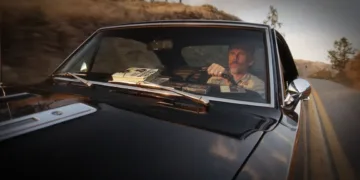
Hawke shapes his vision around California’s State Route 99 as a guiding metaphor. The highway connects the Dust Bowl migration and Haggard’s Bakersfield roots and functions as a thematic artery. He drives his father’s vintage car along that road and turns the trip into a personal pilgrimage, a search for a generational and emotional root. Shots of the open landscape lean toward expressionism and register emptiness or searching, depending on the mood. The horizon keeps its secrets. The frame waits.
Hawke’s on-screen presence invites risk. He serves as director, narrator, and reader of Haggard’s memoir, and his palpable passion at times edges into the theatrical, interrupting Haggard’s plainspoken poetry. The filmmaking stages a productive contradiction: the director’s earnest, almost verbose love set against the subject’s laconic understatement. The editorial craft is sharp. Barry Poltermann weaves decades of archival audio, new interviews, and rhythmic driving footage into a steady current. The film carries Hawke’s personal connection with clear momentum and fixes a kinetic cinematic monument to the legend.
Highway 99: A Double Album is a 2025 American documentary film directed by Ethan Hawke that pays tribute to the life and musical legacy of country singer-songwriter Merle Haggard. Structured like a “double album” with a generous runtime of 174 minutes, the film premiered at the Telluride Film Festival on August 29, 2025. The documentary blends biographical details, archival footage, and over two dozen intimate cover performances of Haggard’s songs by artists from various genres. The film was produced by companies including Mercury Studios, Sony Music Publishing, and Rolling Stone Films. Information regarding its wide distribution platform or content rating is not specified in the initial festival reports.
Credits
Title: Highway 99: A Double Album
Distributor: Mercury Studios, Sony Music Publishing, Rolling Stone Films, Under the Influence, September Club
Release date: August 29, 2025 (Telluride Film Festival)
Running time: 174 minutes
Director: Ethan Hawke
Producers and Executive Producers: Barak Moffitt, Daniel Seliger, Jeremy Coon, Jason Fine, Gus Wenner, Ethan Hawke, Ryan Hawke
Cast: Merle Haggard, Ethan Hawke, Dolly Parton, Willie Nelson, Rosanne Cash, Lucinda Williams, Dwight Yoakam, Gillian Welch, Steve Earle, Norah Jones, Sturgill Simpson, John Doe, Los Lobos, Valerie June, Taj Mahal, Bob Weir
Director of Photography (Cinematographer): Buddy Squires
Editors: Barry Poltermann
The Review
Highway 99: A Double Album
Ethan Hawke's tribute operates as a profound existential inquiry, framing Merle Haggard's life as a classic American struggle with guilt and contradiction. The "double album" structure allows for a richly textured, if lengthy, exploration of biographical trauma and lyrical genius. While Hawke's passionate presence occasionally threatens to draw focus, the film's skillful chiaroscuro cinematography and the sheer quality of the acoustic performances solidify its status. It is an essential, sprawling piece of musical history and psychological portraiture, successfully translating the emotional complexity of Haggard’s catalog onto the screen.
PROS
- Functions as an existential inquiry into moral ambiguity and identity.
- Uses chiaroscuro lighting and expressionistic framing, aligning the documentary with noir aesthetics.
- Features exceptional, intimate acoustic performances from a diverse, talented roster of artists.
- Expertly utilizes rich archival footage, especially the late-life interviews, to convey gravitas.
CONS
- Hawke's active, theatrical on-screen role occasionally threatens to overshadow the subject's plainspoken poetry.
- The film is sprawling, and the duration may present a challenge for audiences expecting a more conventional biography.
- The generous structure, while often effective, occasionally feels less taut than a more tightly edited psychological thriller.