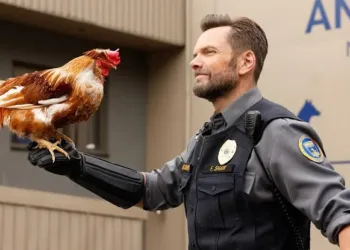































Merry Christmas, Ted Cooper! lands as a confident entry in the annual holiday cycle. The film stars Robert Buckley as Ted Cooper and Kimberley Sustad as Dr. Hope Newberry. The story fixes on an existential knot: the strain of being New York’s most likeable man who attracts seasonal calamity with clockwork regularity. Cooper works as a perpetually upbeat weatherman, famous at the office for his Christmas misfortune and the betting pool that follows it.
His trip home faces early interference from mishaps that include lost luggage and a minor injury. These fumbles open the path to a reunion with Hope, the high school crush who now treats his newest ailment. The tone mixes charm with comfort. Warmth and humor sit under the expected holiday gloss. The film treats free will and chaos like rival theories dressed in tinsel, which feels both playful and pointed.
The Magnetic Field of Affective Labor
The drama runs on a two-engine system built by its leads. Buckley’s Ted offers a portrait of easy magnetism. He fits the template of American affective labor, the civic optimist whose cheer becomes a kind of public utility. He steadies a fictional community and keeps the emotional weather clear. Sustad supplies a counterforce that matters.
Hope plays as a realist with dry wit and crisp timing, the comic ballast that reins in the story’s stranger ornamentation. The performance avoids the default “straight woman” lane and shows range that sharpens each scene. Ted’s brightness stays sweet without turning sticky because her humor trims the excess. Their rapport works on both romantic and comic frequencies.
Call it the Buckley–Sustad Axiom: chemistry rises from complementary friction, a controlled collision between chaos and order. The film keeps returning to that mix and finds spark there. Brendan Penny, as rival anchorman Ken, adds short, needling bursts of antagonism that hit like well-placed jabs. The appearances are brief, the smirk is studied, the laughs arrive on schedule.
Chaos Theory and the Comedy of Acquiescence
Russell Hainline’s script steers clear of greeting-card mush and delivers jokes that land. The recurring thread of Ted’s “Christmas bad luck” supplies the structure. An office pool tracks his possible doom, a box of lights clocks him, and the pattern repeats with ritual precision. The gag reads like a folk version of determinism. People expect failure and still reach for redemption. The movie treats fate as a workplace meme and a metaphysical itch. Comedy covers the frame, but a philosophical sketch sits underneath.

An escape room date becomes the emotional fulcrum. The confined space acts like a confessional booth and asks for truth without props. Hope presses on Ted’s central flaw. He avoids asking for the life he wants, at work and in love. The string of accidents mirrors that habit. Events happen to him. He accepts the narrative as written by chance and by other people. The film argues for a different posture. Agency offers its own holiday miracle, small-scale and human. Speak, then step. That is the ethic.
There is a social echo here. The likable public servant who keeps the mood bright resembles a civic role built by modern media. The office wager on catastrophe feels like a miniature market, a cozy futures exchange that prices fate with candy-cane odds. The story winks at that arrangement. It also suggests a gentler model of communal care, where optimism has value but requires a partner who can say no with style. Hope supplies that check. Ted learns to match it.
The ending turns on a simple move. He states what he wants. The philosophy stays modest and clear. Fortune remains mischievous. Choice still matters. Holiday cinema has used this formula since radio-era melodrama, and the film knows the lineage. The difference comes from calibration. Cheer meets critique. Agency answers accident. The joke keeps ringing, and so does the bell behind it.
Merry Christmas, Ted Cooper!, a holiday romantic comedy film. It premiered on the Hallmark Channel on Saturday, October 25, 2025, as part of the network’s “Countdown to Christmas” programming. The movie tells the story of Ted Cooper, a perpetually optimistic weatherman notorious for his annual Christmas bad luck, who returns to his hometown and reconnects with his high school crush, a doctor named Hope Miller. The film is typically available for streaming the next day on Hallmark+. The running time is approximately 1 hour and 30 minutes (90 minutes). As a Hallmark Channel movie, it is generally considered to be rated TV-G or TV-PG.
Credits
Title: Merry Christmas, Ted Cooper!
Distributor: Hallmark Channel
Release date: October 25, 2025
Rating: TV-G, TV-PG
Running time: 1 hour 30 minutes (90 minutes)
Director: Jason Bourque
Writers: Russell Hainline, Robert Buckley (Story and concept), Russell Hainline (Teleplay)
Producers and Executive Producers: Marc Petey, Jenni Baynham, Kristofer McNeeley, Robert Buckley, Fernando Szew, Chaya Ransen
Cast: Robert Buckley, Kimberley Sustad, Meghan Heffern, Toby Hargrave, Katie Stone, Daniel Bacon, Barbara Pollard, Reedan Elizabeth
Director of Photography (Cinematographer): Nelson Grande, Graham Talbot (Directors of Photography)
The Review
Merry Christmas, Ted Cooper!
Merry Christmas, Ted Cooper! transcends its genre limitations primarily due to the potent, delightful chemistry between Robert Buckley and Kimberley Sustad. The script transforms a standard "bad luck" premise into a thoughtful comedy about personal agency and optimism in the face of chaos. The film’s blend of sharp humor and genuine warmth makes it a highly effective seasonal viewing choice. It is a welcome, sophisticated addition to the holiday cinematic landscape.
PROS
- Effortless Lead Chemistry The delightful and effective rapport between Robert Buckley and Kimberley Sustad elevates the entire film.
- Sharp Humor The script incorporates genuinely funny, effective jokes and running gags that differentiate it from its peers.
- Thematic Layer The film explores the interesting theme of Ted finding agency and asking for what he truly wants in life.
- Strong Supporting Roles Scene-stealers like Brendan Penny as the rival anchorman add excellent comic relief.
CONS
- Familiar Framework The core romantic comedy structure and eventual happy ending are predictable.
- Relies on Charm The movie depends heavily on the magnetism of its lead actor to sustain the central premise.
- Gimmick Overuse Some viewers might find the continuous stream of "bad luck" incidents slightly repetitive or excessive.