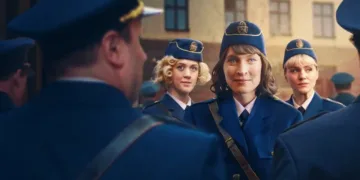






























A story about a historical first arrives with a built in narrative challenge: how to make the past feel alive without treating its subjects like museum exhibits. The New Force attempts to solve this problem by anchoring its 1958 setting in the familiar structure of a police procedural. The premise involves a social experiment born of convenience: with a shortage of men willing to take low paying police work, the Stockholm department opens its doors to women for the first time.
This decision populates the city’s most dangerous precinct, Klara, with a trio of female pioneers: Carin, Siv, and Ingrid. The show immediately establishes its dual focus. One track follows a grim murder investigation that the male officers would happily file away. The other, more compelling track, is a sustained study of the institutional hostility and quiet indignities the women face. The series sets out to be an exploration of the cost of breaking ground, proposing that the most dangerous territory is not the city streets, but the precinct house itself.
The Trailblazing Trio: Character and Performance
The show’s narrative strength rests on the shoulders of its three lead characters, each embodying a different strategy for surviving in a hostile professional world. The story’s main driver is Carin Eriksson, a woman whose idealism is matched only by her impulsiveness. Her character is defined by a fierce sense of justice that constantly puts her at odds with protocol and common sense.
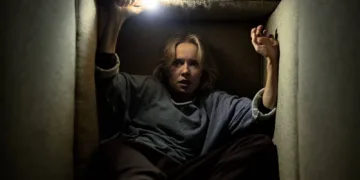
This is established immediately when a lost badge, a significant professional failure, sends her on a reckless, unauthorized undercover mission into a brothel. This single-mindedness soon fixates on the murder of a sex worker, a case the male establishment views as collateral damage.
For Carin, the case becomes a crusade, an act of defiance against a system that grades the value of its victims. Josefin Asplund’s performance captures this blend of passion and recklessness well; she projects a vulnerability that makes Carin’s dangerous choices feel less like heroic posturing and more like the desperate actions of someone who simply cannot let an injustice stand.
If Carin is the story’s conscience, Siv Morell is its political operator. Her ambition is her armor. She explicitly states her goal of becoming a detective and recognizes that navigating the precinct’s male hierarchy is the only way to get there. Siv is acutely aware of how she is perceived, bristling at the demeaning nickname ‘Miss Sweden’ and the assumption that her appearance negates her professional capability. Her response is strategic; she cultivates a relationship with Detective Oscar Thornberg, a man with the influence to advance her career.
Also Read




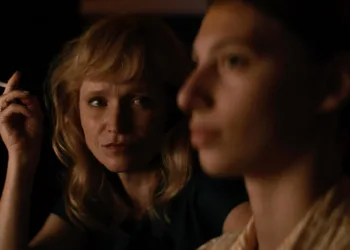

Agnes Rase portrays Siv with a compelling ambiguity. Her ambition is not simple; it is a complex mix of genuine drive, a need to prove her worth to her family, and a sharp-edged jealousy that occasionally surfaces in her interactions with the other women. Rase ensures that Siv never feels like a mere archetype, but rather a complicated individual whose methods are a direct product of the obstacles placed before her.
Rounding out the trio is Ingrid Gustafsson, who initially appears to be the most reserved and uncertain. She begins her journey as an observer, absorbing the quiet hostility of her environment. Her relationship with her patrol partner, the deeply misogynistic Wallin, is a masterclass in workplace tension. His initial refusal to even speak to her evolves into a form of mentorship that is itself another kind of control. Ingrid’s character arc is the most internal of the three.
Her journey from quiet apprehension to a calculated form of courage is gradual and believable. She learns that in this environment, direct confrontation is not always the answer. Malin Persson’s performance is wonderfully subtle and grounded. She conveys Ingrid’s transformation through watchful eyes and a carefully maintained composure, showing a character who learns to wield tact and observation as weapons in a silent war of attrition.
A Tale of Two Shows: The Uneven Narrative
At its core, The New Force is a series engaged in a constant tug of war with itself. It is structured as two different shows running in parallel, and one is significantly more successful than the other. The first is a season-long police procedural centered on the murder of a sex worker. This plotline serves as the narrative’s skeleton, providing a reason for the characters to act and a timeline for the season to follow. As a mystery, however, it is the show’s least effective element.

The investigation lumbers forward, often propelled by convenient coincidences and clues that fall into Carin’s lap with a surprising lack of effort. The pacing of the reveals is unsteady, and the eventual unmasking of the perpetrator lacks the dramatic weight needed to make the journey feel worthwhile. The case ultimately functions as a vehicle for character development, a mechanism to showcase Carin’s tenacity and the department’s indifference. It is a necessary part of the show’s architecture, but it is not the reason to watch.
The series finds its voice and its purpose in its second identity as a social drama. The storytelling is at its most powerful when it shifts focus from the central crime to the daily, systemic struggles of its female protagonists. The show’s most memorable scenes are built from small, sharp observations of the misogyny they endure. We see their discomfort as they patrol in impractical skirts and heels, a uniform designed for appearance rather than function.
We feel their frustration as they are dismissed by the public, ignored by their partners, and treated as a public relations stunt by their superiors. The narrative effectively uses these details to build a comprehensive picture of a hostile environment.
It also thoughtfully expands its scope to touch upon larger social issues of the period, like the quiet desperation surrounding illegal abortions and the societal expectation that women must choose between a career and a family. These moments of lived reality are what give the series its texture and relevance, offering a more compelling investigation into the past than the murder mystery ever could.
Recreating 1958 Stockholm: Aesthetics and Style
The show’s production is a notable success, meticulously recreating its 1958 Stockholm setting. The design team has a sharp eye for period detail, from the heavy, rolling automobiles to the grimy, lived-in feel of the Klara district’s streets. The cinematography captures the era with a muted color palette that emphasizes the bleakness of the city’s underbelly and the oppressive, claustrophobic atmosphere of the police station.

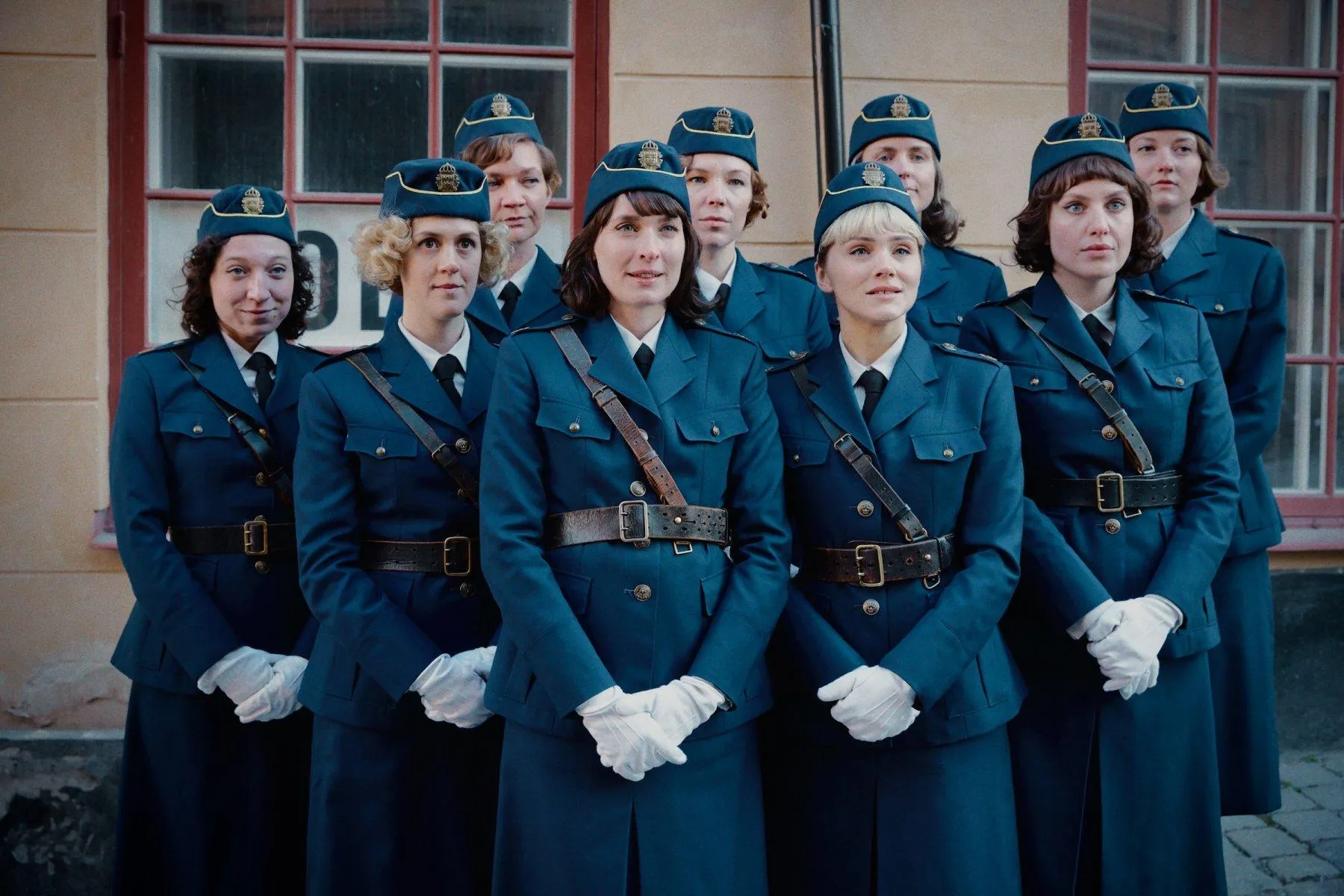
The costume design is particularly effective as a storytelling tool. The women’s uniforms, with their ill-fitting jackets and impractical footwear, serve as a constant visual metaphor for their status as outsiders. They are women forced into an institution, and a wardrobe, that was not made for them.
While grounded in historical authenticity, the series also takes some experimental stylistic swings. The editing occasionally deploys split-screens to show simultaneous events, and archival footage is sometimes used to lend a documentary feel to the proceedings. The most audacious choice is the anachronistic use of a modern hip-hop soundtrack.
This technique seems intended to draw a direct line between the struggles of the past and the present, framing the women’s fight for equality in a contemporary context. The effectiveness of this choice is inconsistent. At its best, it adds a surprising energy to a scene. At its worst, it creates a tonal clash, pulling the audience out of the carefully crafted period setting and breaking the dramatic tension.
Systemic Foes: Depicting Antagonism and The Patriarchy
The opposition in The New Force is portrayed as a force that is both individual and institutional. The male officers represent a spectrum of prejudice, from the undisguised contempt of characters like Wallin to the more subtly paternalistic support of Detective Thornberg.
Even Carin’s relatively accommodating partner, Johan, displays a cautiousness that reveals the cultural pressure to conform. While some of these antagonists could be criticized as one-dimensional, their collective lack of complexity serves a clear thematic purpose. They are not meant to be deep character studies; they are pillars of a monolithic and unwelcoming institution.
Ultimately, the series argues that its true antagonist is not any single person, but the patriarchal system itself. The problem is woven into the very fabric of the police department. It is visible in the rules, the culture, and the unspoken priorities that govern daily life. The official indifference to the murder of a sex worker is the most potent example of this systemic bias.
It is a narrative choice that makes the show’s central argument clear: a system built by and for men will always devalue crimes against women. The conflict at the heart of the series is therefore not just about a few women trying to do a job. It is about their attempt to seek justice within a structure that was fundamentally designed to deny it to people like them.
The Swedish drama series The New Force (Skiftet) premiered globally on Netflix on October 3, 2025. Set in 1958, the series is inspired by the true events surrounding Sweden’s introduction of its first female police officers. It follows a small group of women—pioneers for gender equality—as they graduate and are assigned to patrol Stockholm’s most crime-ridden district, the Klara police district, facing immediate tension and prejudice from their male colleagues and the public. The series is currently available to watch exclusively on Netflix.
Full Credits
The Review
The New Force
While its central mystery feels like a narrative afterthought, The New Force succeeds as a sharp and compelling social drama. Anchored by three excellent lead performances, the series is at its best when exploring the small, daily battles against a deeply ingrained patriarchal system. The show’s meticulous period detail and nuanced character work make it a powerful examination of the cost of being first, even if its procedural elements fail to keep pace with its thematic ambitions.
PROS
- Strong, nuanced performances from the three lead actresses.
- Meticulous production design that effectively recreates 1950s Stockholm.
- A powerful and detailed exploration of systemic misogyny.
- Compelling and distinct character arcs for the central trio.
CONS
- The season-long murder mystery is underdeveloped and predictable.
- An uneven narrative balance between the police procedural and social drama elements.
- The modern soundtrack can be tonally jarring and distracting.
- Some of the male antagonists are written as one-dimensional foils.